What Happened
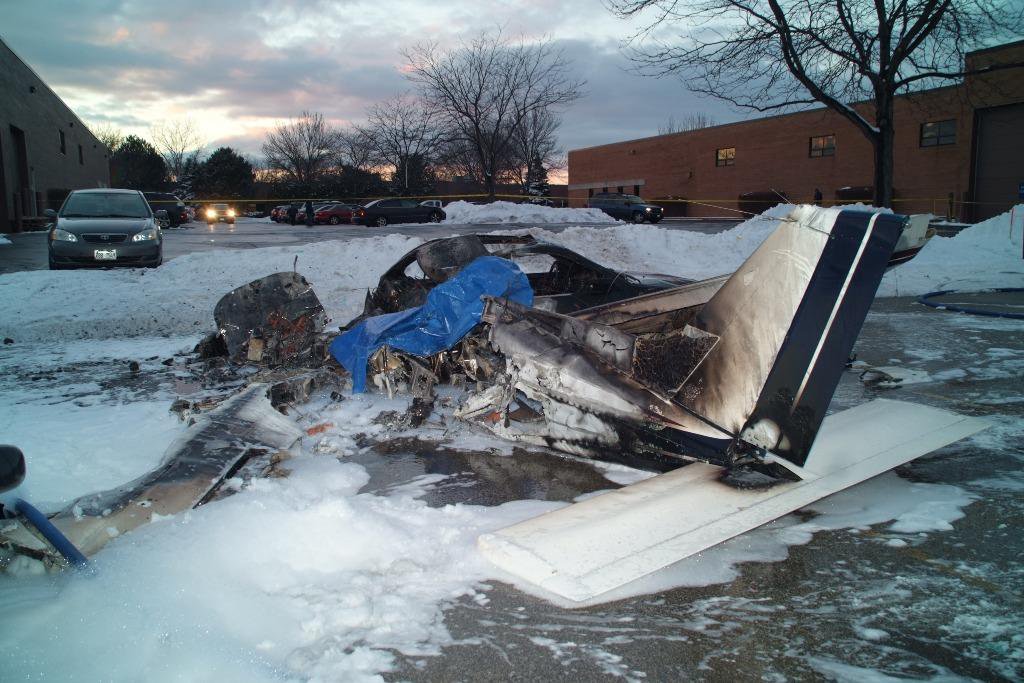
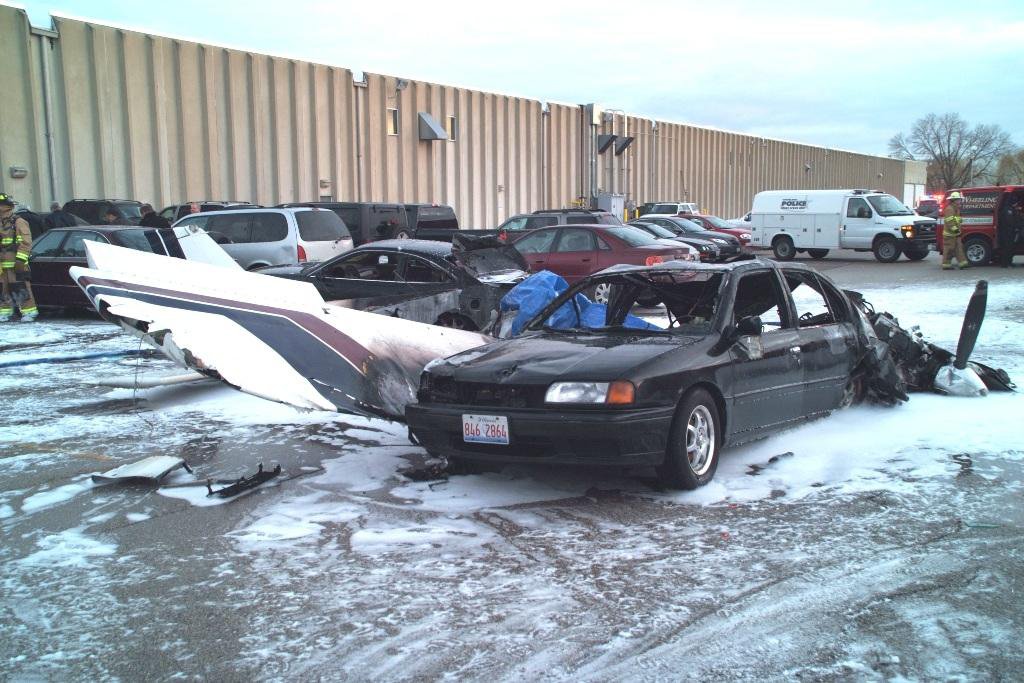
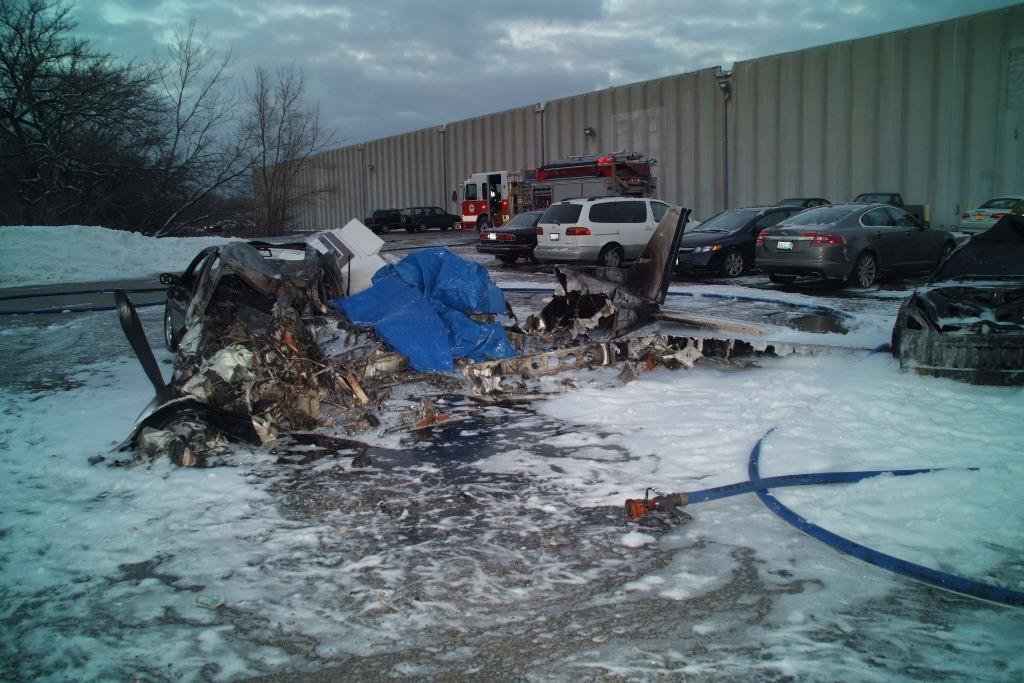
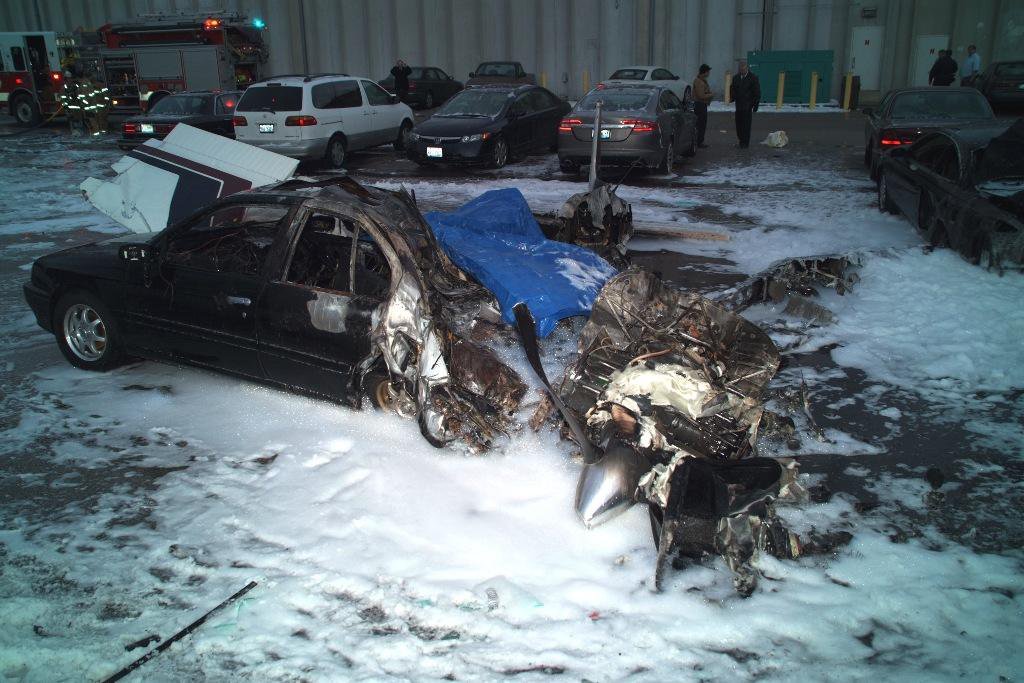
On December 22, 2010, at 1446 central standard time, a 1978 Beech C24R, N5293M, lifted off runway 34 at Chicago Executive Airport (PWK) in Wheeling, Illinois, climbed to somewhere between 50 and 200 feet above the ground, and never came back down the way anyone intended. The private pilot sustained serious injuries. His passenger did not survive. The airplane came to rest in a parking lot half a mile northwest of the field after clipping the roof of a two-story office building, and a post-impact fire consumed most of the engine compartment.
The pilot, 36 years old, held a private certificate for single-engine land with approximately 1,170 total hours logged as of his last logbook entry in July 2010. He also held an airframe and powerplant mechanic certificate, which matters here. He had roughly 3.5 hours in the Beech C24R specifically. He had flown into PWK that morning with three other people specifically to pick up N5293M for a new owner and ferry it back to Jacksonville, Illinois, with an en route stop at Schaumburg Regional. The plan was a two-airplane flight, the accident airplane and the one they’d arrived in.
The airplane had been sitting outside on the ramp. The pilot cleared snow off it himself while a flight school mechanic installed the battery. He started the engine, let it run for five to ten minutes, then taxied to the FBO to get the airplane fueled and de-iced. He sumped the fuel tanks, found no water contamination, and put the fuel sample back in the tank as the line crew suggested rather than dumping it on the cold ramp. He reported three separate engine run-ups before takeoff, all of them normal. At 1436, he requested taxi clearance for both airplanes and was cleared to runway 34. At 1444, the accident airplane was cleared for takeoff from the runway 06 intersection, leaving 4,200 feet of usable pavement ahead.
The takeoff roll appeared normal to witnesses watching from the ramp. The airplane lifted off and the pilot retracted the landing gear somewhere between 50 and 75 feet AGL. At around 200 feet AGL, he retracted the flaps. That’s when things changed. The airplane began to sink. The pilot recalled it later as the airplane not climbing the way it should have after the flap retraction, so he decided to turn back toward the airport. Then, during that turn, the engine began to vibrate and lose power. He could feel it through the control yoke. He radioed the tower at 1446 and declared an emergency, telling them he was turning around because there were “all kinds” of vibrations and the airplane was “losing power quick.” That was his last radio transmission. ATC cleared him to land on any surface. He began a left turn, couldn’t hold altitude, and the airplane descended into the parking lot. The nose gear struck a raised section of the building’s facade on the way down, the left wingtip came to rest on the roof, and the airplane then dropped into the adjacent lot where it struck five parked cars before the fire started.
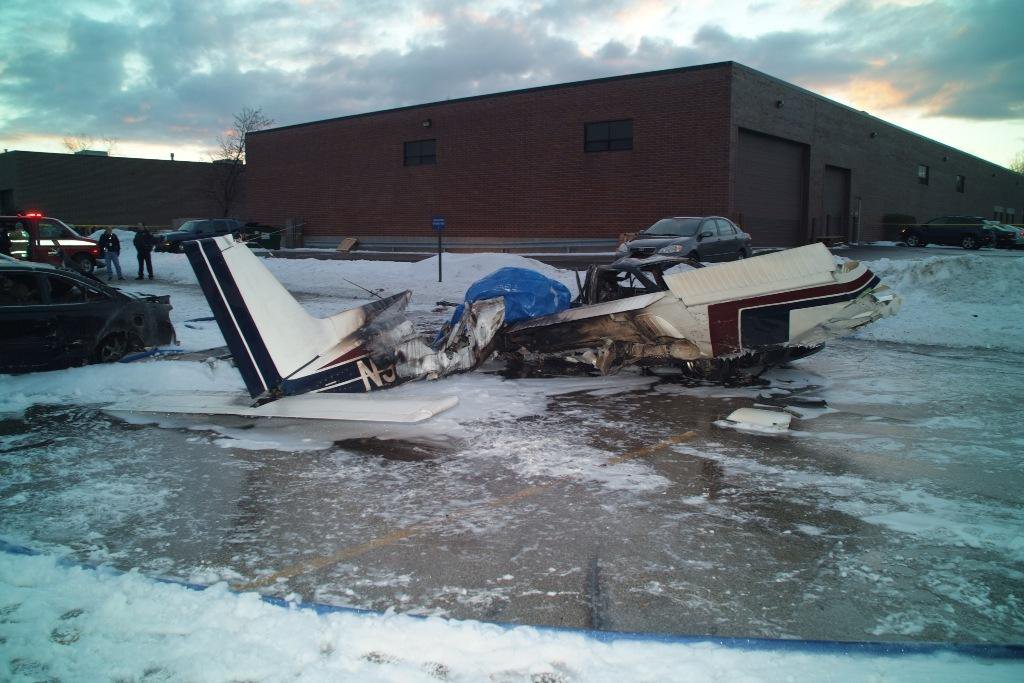
Witnesses on the ground described the airplane in a nose-high attitude with the wings rocking after liftoff. They watched the left wing drop abruptly, saw the descent begin, and lost sight of the airplane behind the building. One witness noted the pitch and bank leveled just before impact. The landing gear was extended. The flaps were retracted. The witnesses who could hear the engine said it sounded normal on the takeoff roll. A line person who had watched an earlier engine start, however, reported that the engine hadn’t sounded right from the beginning. He said he heard what sounded like “burbles.”
Investigation Findings
NTSB investigators examined the wreckage thoroughly. The airframe and flight control systems showed no evidence of pre-impact mechanical failure. Engine continuity was established. Cylinder compression checked out. All three propeller blades showed rotational signatures, meaning the engine was producing power at impact, though all three blades also showed gouging, scraping, and slight twisting consistent with impact damage. Internal marks suggested the propeller was on the low pitch stop at the moment of contact with the building.
Inside the fuel servo inlet strainer, investigators found a foreign piece of material. It was opaque, cylindrical, and matched the inside diameter of the metal fitting at the end of the screen. The NTSB Materials Laboratory identified it as polyacetal, also known as polyoxymethylene, a thermoplastic used in some fuel system components. But investigators concluded that this debris was most likely a product of the post-impact fire rather than a pre-existing contaminant. The fuel servo had been exposed to intense heat, and the melted plastic spacer from the mixture control valve was the probable source.
What investigators found in the engine accessory section told a different story. The engine-driven fuel pump had survived the fire well enough to read the number stamped into its base: 15472. Part number 15472 is a low-pressure fuel pump. It delivers fuel pressure between 4 and 6 psi. The engine installed on N5293M, a Lycoming IO-360-A1B6, requires a high-pressure pump, part number 15473, which delivers approximately 14 psi. The Beechcraft Sierra C24R POH lists a maximum fuel pressure of 12 psi. The overhaul shop had installed the wrong pump. The engine logbook recorded the installation of “overhauled LW15472 fuel pump” during the September 2010 overhaul work, but nobody caught the discrepancy between 15472 and the 15473 the engine actually needed. At low demand, during ground runs and taxi, a low-pressure pump can keep an engine fed. But under the load of a full-power climb with landing gear cycling and flaps retracting, the fuel pressure dropped below what the engine needed to keep running cleanly. The pump simply couldn’t keep up.
The airplane had been flown for approximately one hour after the overhauled engine was installed. That flight was reported as normal. The airplane then sat on the ramp for at least a month before the accident flight. Multiple engine runs were performed during that period, all reportedly without incident. The conditions that revealed the pump’s inadequacy appear to have been the full-power sustained climb demand of an actual departure, loaded, in cold December air.
NTSB Probable Cause
The installation of the wrong engine-driven fuel pump, which resulted in a loss of engine power during takeoff, and the pilot’s subsequent decision to turn back toward the airport at an insufficient altitude to complete the maneuver. Contributing to the accident was the pilot’s failure to maintain airspeed, which resulted in a loss of aircraft control.
Safety Lessons
Three things converged here, each one survivable on its own. Together they left no margin. The wrong fuel pump had been in place for months. The turnback decision happened below 200 feet. And airspeed got away from the pilot during the turn. Any one of those factors being different changes the outcome. All three going wrong at the same time is how accidents like this happen.
- Part numbers are not interchangeable without verification. The difference between LW-15472 and LW-15473 is one digit. The difference in function is a pump that delivers 4-6 psi versus one that delivers 14 psi. An IO-360 running on a low-pressure pump may idle fine, taxi fine, and pass three run-up checks without complaint. It can even fly for an hour under the right conditions. But ask it to climb at full power on a cold day with gear cycling and flaps retracting and the fuel demand spikes exactly when the pump can’t meet it. Anyone signing off an overhaul installation needs to verify the part number against the engine’s type certificate data sheet, not just against the paperwork that came back from the shop.
- The turnback maneuver requires altitude you almost certainly don’t have after liftoff. At 200 feet AGL on departure, a 180-degree turn back to the runway requires a precise airspeed, a coordinated bank, and enough altitude to complete the arc and roll out aligned with the runway. Most training programs that have actually measured the altitude required for a successful turnback find the number is closer to 500-1,000 feet, depending on aircraft performance and pilot execution. Below that, a straight-ahead or shallow-angle forced landing into whatever is ahead almost always produces a better outcome than the attempt to return. N5293M was somewhere between 50 and 200 feet when the decision was made to turn back. That margin didn’t exist.
- A nose-high attitude at low altitude with a sick engine is a stall setup, not a climb. Witnesses described N5293M in a nose-high attitude with wings rocking before the left wing dropped. The probable cause cites failure to maintain airspeed leading to loss of control. When an engine loses power during a turn at low altitude, the instinct to pitch up and hold altitude is exactly backwards. Airspeed is the only thing keeping the wings flying. Letting it bleed away in a turn, with the left bank already in, puts the airplane right at the bottom of the envelope where a spin entry requires almost no additional provocation. This is the part of the emergency that training has to build into muscle memory before it’s ever needed.
Frequently Asked Questions
Q: How did the wrong fuel pump pass multiple engine run-ups without being caught?
A: A low-pressure pump delivering 4-6 psi can sustain engine operation at idle and moderate power settings, especially on the ground where fuel demand is lower. During taxi and run-up checks, the engine receives enough fuel to run smoothly. The deficiency only became critical under sustained full-power climb conditions with simultaneous gear retraction and flap cycling, which dramatically increases fuel demand. Three run-up checks at PWK and even a prior one-hour flight didn’t expose the pump’s inability to keep up under those combined loads.
Q: What altitude is generally considered the minimum for a safe turnback after engine failure on departure?
A: There is no single universal number, but most aviation safety research and instructional programs put the practical minimum at roughly 500 to 1,000 feet AGL, depending on the aircraft’s best glide and maneuvering speeds, bank angle used in the turn, and the pilot’s proficiency with the maneuver. Some aircraft require even more. N5293M was between 50 and 200 feet AGL when the decision to turn back was made. At that altitude, a straight-ahead landing into available terrain or a shallow-angle diversion almost always offers a better survival probability than attempting the 180-degree arc back to the departure runway.
Q: What is polyacetal and why was it found inside the fuel servo?
A: Polyacetal (polyoxymethylene) is a thermoplastic used in some fuel system components, including spacers and valve aligners. Investigators found what appeared to be polyacetal inside the fuel servo inlet strainer. However, the NTSB concluded this material was most likely produced by the intense post-impact fire melting the plastic spacer and mixture control valve aligner inside the servo, not a pre-existing contamination. The material’s appearance, with trapped bubbles and heat-browned areas, was consistent with high-temperature exposure rather than in-flight fuel contamination.
Q: Why did the passenger die while the pilot survived with serious injuries?
A: The Cook County Medical Examiner listed the passenger’s cause of death as smoke inhalation and thermal injuries, meaning the post-impact fire was the fatal mechanism rather than the impact itself. Toxicology found 16 percent carbon monoxide in the passenger’s blood and 0.46 micrograms per milliliter of cyanide, both consistent with fire exposure. The passenger likely survived the initial impact but was unable to escape before the fire became fatal. The pilot, despite serious injuries, was able to exit the wreckage.
Q: How should pilots receiving a freshly overhauled engine verify that correct parts were installed?
A: At minimum, the accepting mechanic should compare every part number on the returned engine against the type certificate data sheet and the overhaul shop’s parts list before the engine is signed off and installed. For fuel system components specifically, the pump part number should be cross-referenced against the engine model’s Lycoming (or Continental) service documentation, not just accepted based on what the shop’s paperwork says. An A&P who is also the pilot accepting the airplane has both the authority and the responsibility to verify this before the first flight. A pre-buy inspection by an independent mechanic, which reportedly did not occur here, provides an additional layer of verification.