Decision Support for Your Next Flight

Mission Ready

A pilot decision-support system for assessing risk before flight, debriefing decisions after landing, and recognizing patterns over time.

Why Pilots Trust Mission Ready

Grounded in documented mishaps and real-world safety analysis.

Fighter Pilot Methodology

Uses the same decision-making frameworks fighter pilots rely on in high-risk environments

Backed by Real Mishap Data

Every lesson comes from real mishaps — not opinions or generic checklists

Built for Real-World Flying

Simple, fast, and practical. Built for the real world where risk changes with every flight

Who Mission Ready Supports

General Aviation Pilots

Make risk visible and deliberate before flight using structured decision inputs

Flight Instructors

Provide students with a structured way to reflect on risk and decision-making

Flight Schools & Clubs

Support student pilots through the use of a structured, non-punitive approach to preflight risk discussion and post-flight debriefing

Mission Ready helps make risk visible so pilots can involve others in thoughtful preflight conversations.
It does not approve or prevent flights.

How Pilots Use Mission Ready

1

Assess Risk Before You Fly

Evaluate personal, aircraft, environmental, and mission factors using a structured preflight risk assessment.

Make risk visible and deliberate before committing to the flight.

2

Debrief After Landing

Capture how the flight actually went while details are still fresh.

Record surprises, workload, decision points, and lessons learned.

3

Build Awareness Over Time

Track trends in risk, proficiency, and exposure across flights.

Use Mission Ready as a personal learning record—not a one-time checklist.

Reduce uncertainty by making risk factors explicit before each flight

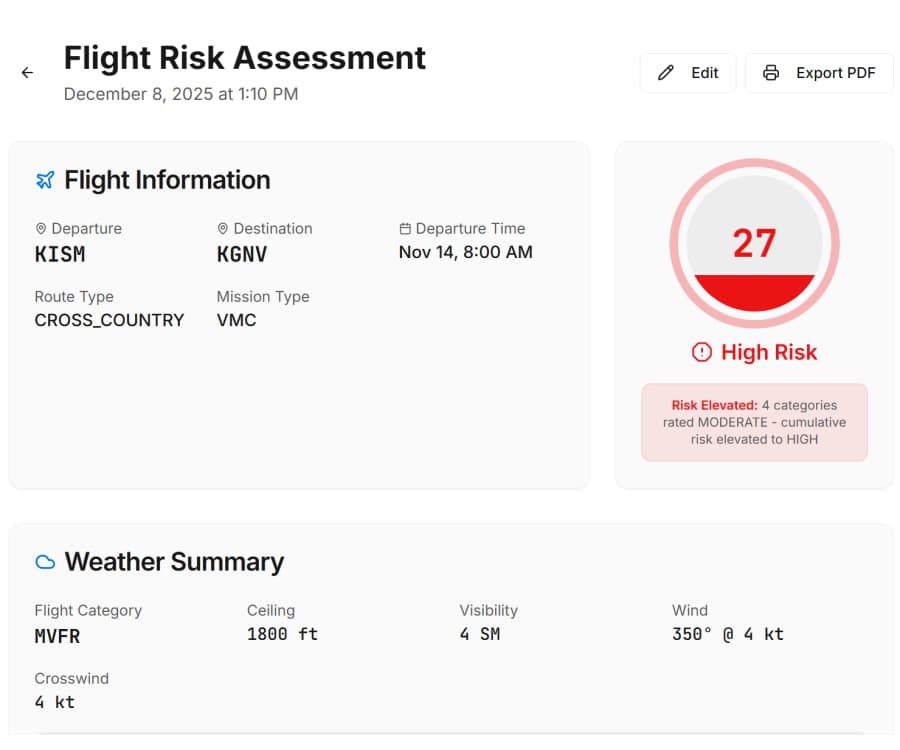
Flight Risk Assessment details page showing flight information for a cross-country VMC flight from KISM to KGNV with departure time Nov 14 at 8:00 AM, a circular gauge displaying a high-risk score of 27 due to four moderate categories, and a weather summary indicating MVFR conditions with 1,800-foot ceiling, 4 statute miles visibility, and winds 350° at 4 knots.

Key flight risk factors organized into a structured preflight assessment

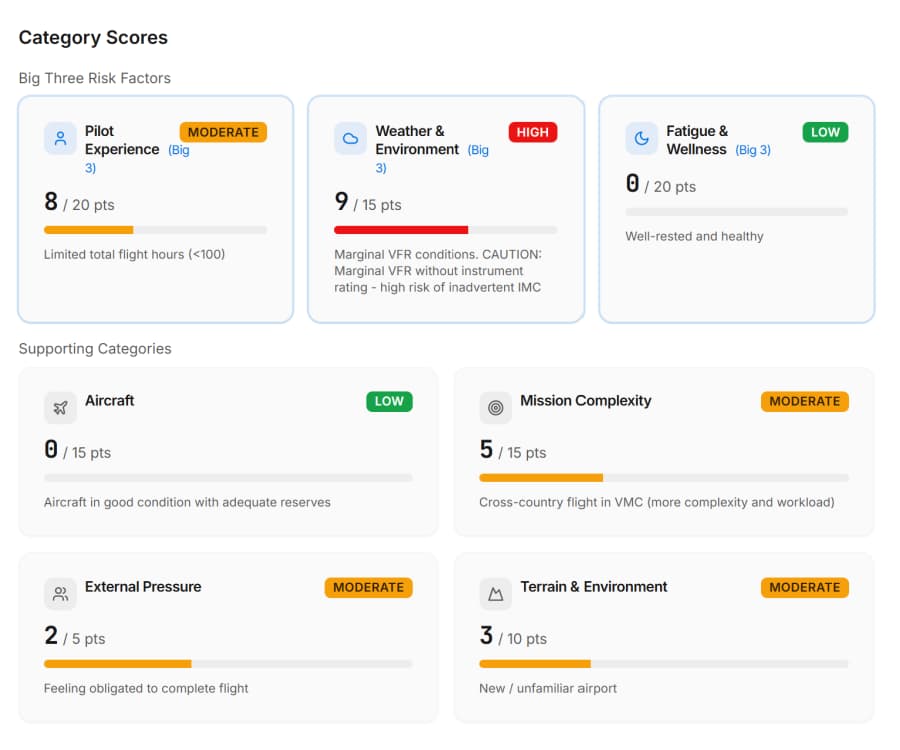
See which factors are contributing most to overall risk

Category scores panel for a flight risk assessment showing Big Three Risk Factors and supporting categories: Pilot Experience rated MODERATE with 8 of 20 points due to limited total flight hours under 100; Weather and Environment rated HIGH with 9 of 15 points citing marginal VFR and risk of inadvertent IMC; Fatigue and Wellness rated LOW with 0 of 20 points; Aircraft rated LOW with 0 of 15 points; Mission Complexity rated MODERATE with 5 of 15 points for a cross-country VMC flight; External Pressure rated MODERATE with 2 of 5 points for feeling obligated to complete the flight; and Terrain and Environment rated MODERATE with 3 of 10 points for a new or unfamiliar airport.

Contributing factors are scored to highlight areas that may warrant additional attention

Used by pilots who want structured support alongside experience and judgment

Free 14-Day Trial. No Credit Card Required.

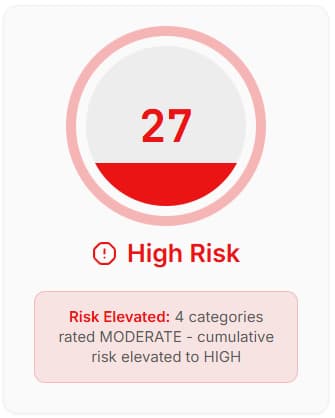
High Risk indicator card showing a circular gauge with a score of 27 in red, a warning label reading “High Risk,” and a note explaining that four categories rated moderate have cumulatively elevated the overall risk to high.

Example output generated from pilot inputs, aircraft, conditions, and experience