What Happened
On the morning of July 29, 2023, both pilots walked into the same briefing room at EAA AirVenture Oshkosh. They sat through the daily rotorcraft briefing for the Fun Fly Zone, the same briefing that had been running every morning of the event. And at that briefing, event coordinators said it again, the same thing they had been saying every day that week: do not perform 360° turns in the traffic pattern. If you need spacing, side-step and fly another circuit. The message was not subtle. It was, by multiple witness accounts, a direct response to gyroplane pilots who had already been doing it.
About 1227 central daylight time, a Rotorway 162F helicopter, N193AZ, was working the left-hand rotorcraft short traffic pattern near Wittman Regional Airport (OSH) in Oshkosh, Wisconsin. The helicopter had two people aboard, a pilot who was well known in the Fun Fly Zone community and was considered an air safety advisor to the flight operations, and a passenger. The helicopter had departed the designated rotorcraft takeoff and landing zone to the west of the ultralight/homebuilt runway and was established on the base leg from the south, following the north/south paved road inbound. Onboard GoPro video confirmed the helicopter was at roughly 225 feet above ground level, descending at 200 feet per minute, indicating 77 mph, engine instruments solidly in the green. Everything about that aircraft was normal.
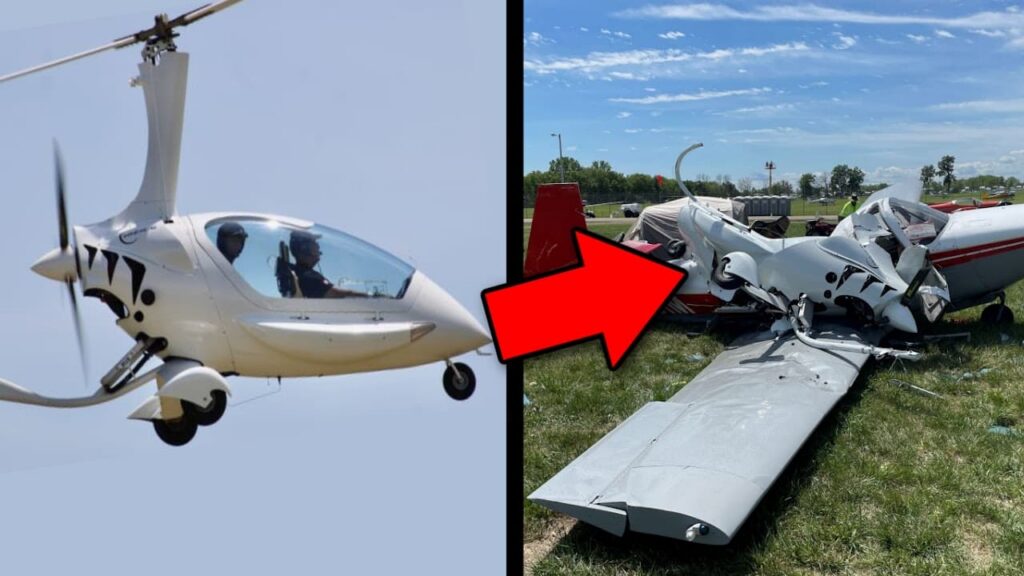
An ELA Eclipse 10 gyroplane, N221EL, was also in the pattern. It carried a pilot and a rear-seat passenger who had not previously met the pilot before the flight and was aboard for a demonstration ride. The gyroplane had departed runway 36, traveled south, then west, then back north to enter the rotorcraft traffic pattern near the intersection of Highway 26 and County Road N. GPS data showed the gyroplane was on the base leg from the south. About 35 seconds before impact, the rear-seat passenger picked up his phone and started recording video. At that moment, the gyroplane was on base leg and began a 360° left turn. The same maneuver that had been specifically prohibited at that morning’s briefing. The same maneuver the pilot had performed the day before in roughly the same area, as GPS data from the previous day confirmed.
The helicopter was directly behind the gyroplane in the pattern, also inbound on the base leg, also from the south. The GoPro in the helicopter captured what happened next. The right-seat occupant flinched. Then the undercarriage and right side of the gyroplane appeared through the helicopter’s windscreen, crossing left to right in a left bank. Three tenths of a second after it became visible, there was impact. The gyroplane’s rotor system struck the helicopter’s main rotor blades. Both aircraft immediately lost structural integrity. A witness on the ground saw the gyroplane make what he described as a hard 180° turn on the base leg over the trees and thought it was a go-around for spacing. He did not see the collision. He heard a loud bang, then watched debris falling. Both aircraft descended in near-vertical attitudes with pieces separating the entire way down. The helicopter hit terrain, came to rest inverted, and caught fire. The helicopter pilot and passenger were fatally injured. The gyroplane struck an unoccupied parked airplane between the paved road and runway 36L. The gyroplane pilot and passenger received serious injuries. The gyroplane pilot later reported no recollection of the flight at all.
Investigation Findings
Postaccident examination of both aircraft told the physical story of the collision clearly. The outboard sections of the helicopter’s main rotor blades had separated and come to rest in the debris field. Those blade sections showed impact marks and white paint transfers consistent with the gyroplane’s structure and paint color. On the gyroplane side, the right horizontal and vertical stabilizers showed shear cuts and separated structure consistent with helicopter main rotor blade contact. The gyroplane’s main rotor mast was severed about mid-length, with an impact signature also consistent with the helicopter’s main rotor blade. The geometry of the damage matched the flight track data: the gyroplane, in a left bank during its prohibited 360° turn, crossed directly into the helicopter’s rotor disc from the left side.
Investigators found no evidence of any preimpact mechanical malfunction or failure on either aircraft. Both were flying normally up until the moment of contact. Toxicology testing of the helicopter pilot found salicylic acid, metoprolol, rosuvastatin, and valsartan, medications consistent with treatment of high blood pressure, high cholesterol, and cardiovascular disease prevention. None of those substances are known to adversely affect pilot performance. The ADS-B and GPS data, the GoPro footage from the helicopter, and the cellular phone video from the gyroplane’s rear-seat passenger were all correlated and reviewed by the NTSB Vehicle Recorder Division. The data painted a consistent and unambiguous picture of the gyroplane’s flight path and the moment of impact.
The broader context mattered too. EAA AirVenture 2023 was the gyroplane pilot’s first year flying his gyroplane at the Fun Fly Zone. He had flown the aircraft there the day before the accident, and GPS data showed he had performed a 360° turn near the northwest end of the ultralight/homebuilt runway on that previous day. Multiple witnesses reported that concerns about gyroplane 360° turns had been raised during several of the daily briefings leading up to the accident. Event coordinators had specifically told gyroplane pilots to stop. The alternative they provided was clear: side-step and fly another circuit. That option was available. It was not used.
NTSB Probable Cause
The failure of the gyroplane pilot to see and avoid the helicopter while maneuvering in the traffic pattern. Contributing to the accident was the gyroplane pilot’s performance of a prohibited maneuver in the traffic pattern.
Safety Lessons
Two aircraft, two crews, one shared traffic pattern, and a maneuver that had been explicitly prohibited that same morning. There are a few things worth sitting with here.
- A briefing is not a suggestion. The Fun Fly Zone coordinators did not quietly include the 360° prohibition in a footnote. They said it out loud, repeatedly, over multiple days, directly in response to pilots already doing it. When an event briefing tells you a specific maneuver is prohibited, the reason is almost always traffic conflict. At OSH, with multiple rotorcraft sharing a small traffic pattern at low altitude, a 360° turn puts you back where you started in an airspace that has moved on without you. The aircraft that was behind you is now occupying the space your turn is about to place you in.
- See and avoid has a geometry problem in the pattern. The helicopter was directly behind the gyroplane on the base leg. The gyroplane began a left turn. In a left bank, the cockpit visibility toward the inside of the turn, toward where the helicopter was, is degraded. The helicopter’s crew had somewhere between three tenths of a second and zero warning before impact, depending on when the right-seat passenger actually registered what he was seeing through the windscreen. At 77 mph indicated airspeed in a tight traffic pattern with other aircraft in close proximity, see and avoid is not a reliable backstop. Procedural separation, staying in your lane and flying the briefed pattern, is what actually keeps aircraft apart.
- GPS data is a mirror. The investigation confirmed the gyroplane pilot had performed a 360° turn near the runway the day before the accident. That data point matters not because it assigns more blame, but because it shows the maneuver was habitual. When a behavior is comfortable and practiced, a briefing that prohibits it may not penetrate as deeply as it needs to. If you have a habit that you know is outside standard procedures, or outside the specific rules of the airspace you are flying in, it takes active, deliberate effort to break it. Passive awareness is not enough.
Frequently Asked Questions
Q: What caused the midair collision at EAA AirVenture Oshkosh in 2023?
A: A gyroplane performing a prohibited 360° left turn on the base leg of the traffic pattern crossed directly into the flight path of a Rotorway 162F helicopter that was following it in the pattern. The gyroplane’s rotor system struck the helicopter’s main rotor blades at approximately 225 feet above ground level. The gyroplane pilot had been briefed that same morning that 360° turns in the traffic pattern were prohibited.
Q: Why are 360° turns prohibited in the traffic pattern?
A: A 360° turn returns you to a position in the pattern where other aircraft have continued moving. The aircraft that was behind you when you started the turn may now be in the space your turn is about to bring you back through. In a busy, low-altitude pattern like the EAA Fun Fly Zone with multiple rotorcraft, this creates a collision geometry with almost no margin for error. Standard procedure for spacing is to side-step and fly an additional circuit, keeping all aircraft moving in the same direction through the pattern.
Q: Did either aircraft have a mechanical problem that contributed to the accident?
A: No. Postaccident examination of both the Rotorway 162F helicopter and the ELA Eclipse 10 gyroplane found no evidence of any preimpact mechanical malfunction or failure. The helicopter’s GoPro video confirmed all engine instruments were in the green range at the moment of impact. The collision was caused entirely by the gyroplane’s flight path intersecting the helicopter.
Q: What changes did the EAA make after the 2023 Oshkosh midair collision?
A: Following the accident, the EAA implemented standardized briefings for all Fun Fly Zone operations, a standardized traffic pattern for all FFZ aircraft types, standardized aircraft spotter locations, a designated sterile corridor for traffic on the base leg over the north/south paved road, and a one-strike rule for pilots who do not conform to FFZ procedures.
Q: How much warning did the helicopter crew have before impact?
A: Based on the GoPro video recovered from the helicopter, the gyroplane first became visible through the helicopter’s windscreen three tenths of a second before impact. The right-seat occupant was captured on video flinching at that moment. At an indicated airspeed of 77 mph and only 225 feet above the ground, there was no time for any evasive action.