What Happened
On September 28, 2022, around 1340 eastern daylight time, a Piper PA-28-140, registered N7329F, departed from Xl Aviation Airport (XLL) near Allentown, Pennsylvania on what was supposed to be a routine instructional flight to a nearby tower-controlled airport. The student pilot was fatally injured. The flight instructor, seated in the right seat, survived with serious injuries. The airplane was destroyed — first by the impact, then by the fire that followed.
The plan was straightforward. The instructor wanted the student to practice a soft-field takeoff. They completed the preflight inspection, ran through the engine run-up, and set up for departure. What happened next unfolded over the course of less than a minute, but the sequence of events that led to it may have started building before the wheels ever left the ground.
During the takeoff roll, the instructor noticed the airplane hadn’t become airborne when he expected it to. He prompted the student to increase pitch. The airplane lifted off, but the student then relaxed the pitch to stay in ground effect — and the airplane briefly settled back onto the runway before getting airborne again. The instructor attributed the sluggish acceleration to climb speed to that initial high pitch attitude, and when the airplane finally reached Vx — the best angle of climb speed — he took control. What he took control of was an airplane that was, in his words, “noticeably weak.”
The engine was running. There was no sudden stoppage, no alarming bang, no silence. But the power wasn’t there. The airplane labored through the climb, barely cleared the trees off the departure end of the runway, and then simply could not climb anymore. The instructor raised the flaps, held Vx, and watched the airplane continue to drift toward rising terrain with about 200 feet of altitude between him and the ground. He scanned for somewhere to put it down. There was nothing suitable. The airplane descended into trees approximately 0.8 miles from the runway, impacted the ground, and a fire started immediately. A witness at the residence where the airplane came down was able to pull one occupant from the wreckage. He could not reach the other before the fire consumed the cabin.
Investigation Findings
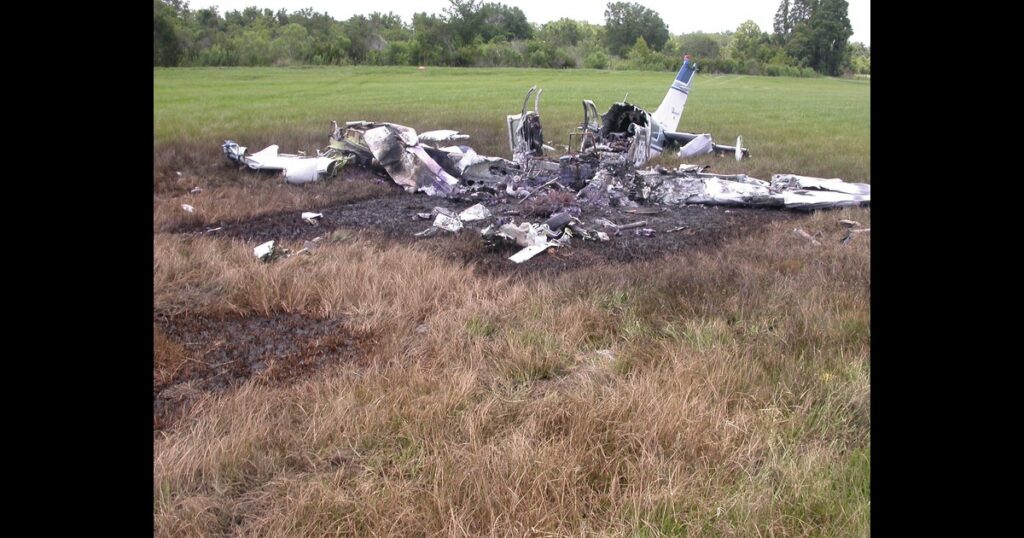
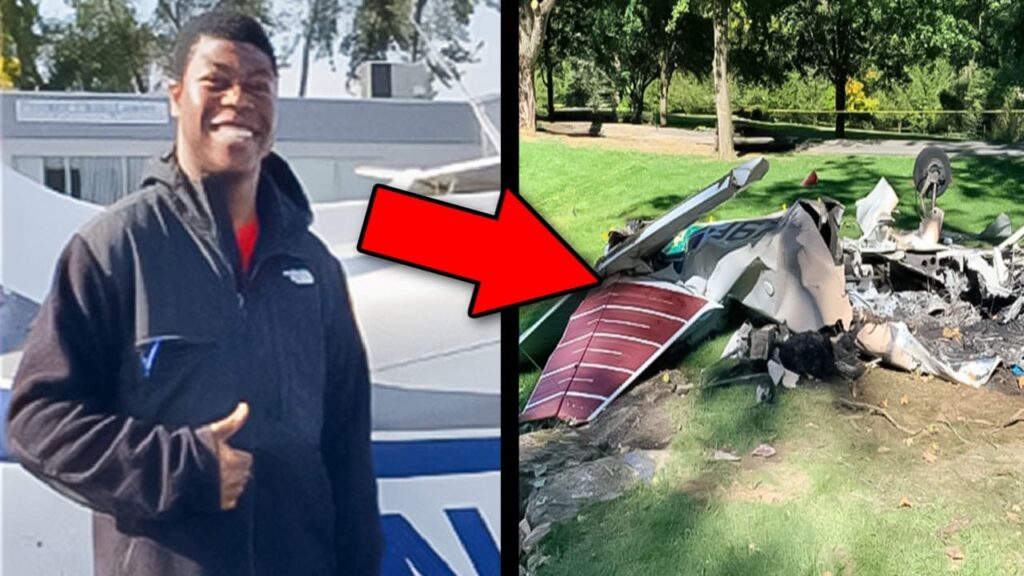
Investigators examined the airframe and engine at the accident scene. All major components were accounted for. The inboard section of the left wing had lodged in a tree about 15 feet above the ground; the rest of the wreckage was at the base of that tree. The right wing was adjacent to the fuselage remnants. The empennage was still attached to the aft fuselage. The engine, propeller still mounted, sat at the front of what remained of the burned cabin section. That fire was the central problem for the investigation: it prevented functional testing of several components, and investigators could not definitively identify a mechanical cause for the partial power loss the instructor described.
The recorded ADS-B data told part of the story. The airplane departed and flew roughly 0.8 miles on runway heading before making a slight left turn — the last recorded position was about 450 feet from the accident site. When investigators worked the math on the ADS-B groundspeed data against the reported surface winds — 310 degrees at 8 knots — the derived airspeed during the final portion of the flight came out below Vx but above the published stall speed. The PA-28-140 owner’s manual lists a stall speed with flaps up at maximum gross weight of 64 mph indicated. The airplane wasn’t stalled. But it was below its best-angle-of-climb speed, which would have cost it whatever marginal climb performance the weakened engine could still produce. Investigators noted that the actual wind the airplane encountered aloft could not be confirmed, and that discrepancy might account for some of the difference between the derived speed and what the instructor reported flying.
The weather data pointed to something else worth examining. At the time of the accident, the temperature at XLL was 18°C with a dewpoint of 10°C — a spread of 8 degrees. According to FAA Special Airworthiness Information Bulletin CE-09-35, those conditions placed the airplane squarely in the range of susceptibility for serious carburetor icing at glide power, and between the range for icing at glide and cruise power and serious icing at cruise power. The PA-28-140 is carburetor-equipped. Carburetor ice can rob an engine of a significant amount of power — sometimes gradually enough that a pilot doesn’t immediately recognize what’s happening, particularly during a takeoff sequence where attention is already divided. The NTSB could not confirm carburetor icing as the cause because the fire eliminated the physical evidence needed to make that determination. But the atmospheric conditions were consistent with it.
Toxicological testing of samples from the student pilot revealed the presence of potentially impairing substances. The NTSB noted this finding but also noted that the flight instructor had reported taking control of the airplane during the climb. The student was not flying the airplane when it hit the trees.
One additional detail from the personnel section of the report is worth understanding clearly. The flight instructor held an active first-class medical certificate issued in December 2017, which under 14 CFR Part 61.23(d) remained valid through December 31, 2022, for a pilot under 40 years old. However, his commercial pilot certificate — the certificate his flight instructor certificate was required to accompany in order to be valid — had been surrendered to the FAA on October 7, 2021, nearly a year before this flight. The implications of that finding were part of the original report; the report was subsequently modified on February 26, 2025, and the original can be viewed in the docket.
NTSB Probable Cause
A partial loss of engine power for undetermined reasons.
Safety Lessons
This accident compressed a lot of risk factors into a very short flight. The partial power loss was the triggering event, but the margins were thin from the start — thin runway performance, thin obstacle clearance, thin altitude over rising terrain. When the engine stopped producing full power, there was no margin left to absorb it.
- Carburetor heat is not just for cruise flight. Conditions on September 28, 2022 near Allentown were solidly in the carburetor icing susceptibility range — 18°C with a 10°C dewpoint. That kind of temperature-dewpoint combination can produce ice in a carburetor even at climb power settings, not just at idle or glide power. The PA-28-140 Pilot’s Operating Handbook calls for checking carb heat during the run-up, but carb ice can accumulate after the run-up is complete, during the takeoff sequence itself. If an engine is running “noticeably weak” on departure and the conditions are conducive to carb ice, applying carburetor heat should be among the first responses — not a last resort. A brief, full application during the run-up that shows an RPM drop followed by a recovery is confirmation the system is working. It is not confirmation that ice won’t form afterward.
- Below-Vx performance is not just an airspeed number — it is a terrain clearance problem. The ADS-B data indicated the airplane was flying below its published Vx of approximately 70 mph during the final portion of the flight. In a scenario where the engine is already underperforming and terrain is rising ahead, every knot below Vx is obstacle clearance that isn’t happening. The instructor’s decision to raise the flaps and maintain Vx was textbook — but the data suggests the airspeed had already decayed. In a partial-power emergency just after departure, establishing and holding the correct airspeed is the one variable entirely within the pilot’s control. When everything else is going wrong, that number has to be right.
- Soft-field technique and marginal performance conditions are a demanding combination. The soft-field takeoff sequence requires lifting off early, staying in ground effect, and accelerating before climbing. Done correctly, it works. Done with a student who pulls back too hard and then relaxes pitch and then touches down again, it consumes runway, costs energy, and puts the airplane at a lower airspeed when it finally reaches the trees at the end. If the engine was already developing reduced power at the start of the roll — and the conditions were consistent with that — the soft-field sequence may have hidden the problem until it was too late to abort. Instructors teaching soft-field technique at airports with short runways and rising terrain off the departure end should have a clear mental abort point, and they should be treating an engine that feels weak during the roll as a reason to stop, not a reason to encourage more pitch.
Frequently Asked Questions
Q: What causes carburetor icing on a PA-28-140?
A: The Piper PA-28-140 uses a carburetor rather than fuel injection. As air passes through the carburetor venturi, it expands and cools rapidly — sometimes by as much as 70°F. That cooling, combined with moisture in the air, can cause ice to form on the carburetor throat and throttle plate, restricting airflow and reducing engine power. The process can happen at ambient temperatures well above freezing, particularly when relative humidity is high. FAA SAIB CE-09-35 identifies the temperature and dewpoint combinations most likely to produce serious carburetor ice at various power settings. The conditions on September 28, 2022 near Allentown fell within the serious icing range at glide power.
Q: What is Vx and why does it matter so much in an obstacle environment?
A: Vx is the airspeed that produces the greatest amount of altitude gain for a given horizontal distance traveled. On the PA-28-140, Vx is approximately 70 mph indicated. It is the correct speed to use when there are obstacles — trees, terrain, buildings — immediately off the departure end of the runway. Flying slower than Vx reduces climb angle and reduces obstacle clearance. Flying faster than Vx increases climb rate in feet per minute but flattens the climb angle, also reducing how much altitude you gain before reaching the obstacle. In a partial-power situation, maintaining Vx exactly is critical because the airplane has less power available to work with and any deviation from the optimal speed compounds the performance deficit.
Q: What should a pilot do if the engine feels weak during takeoff?
A: If power feels reduced during the takeoff roll and there is runway remaining, the safest response is to abort the takeoff. Once airborne with insufficient altitude to return, options narrow quickly. If a partial power loss occurs just after liftoff in conditions conducive to carburetor icing, applying full carburetor heat is a reasonable immediate action — accepting the brief additional power reduction that sometimes accompanies carb heat application in exchange for clearing the ice. The pilot should also establish the best-glide or Vx airspeed as appropriate, avoid steep turns that increase load factor and stall speed, and prioritize landing straight ahead or with minimal heading change if altitude is critically low. An emergency landing in a field or on a road is survivable at low speed. A stall-spin from 200 feet is not.
Q: Can carburetor ice form during a climb at full power?
A: Yes. Carburetor ice is most commonly associated with low-power settings like glide or idle, where the venturi cooling effect is most pronounced. But in high-humidity conditions, ice can form even at climb power settings. FAA SAIB CE-09-35 specifically identifies temperature and dewpoint combinations that create susceptibility at cruise power and above. The icing risk during a climb is lower than at idle, but it is not zero — particularly when the temperature-dewpoint spread is small and ambient temperatures are in the 50°F to 70°F range.
Q: What is a soft-field takeoff and why is it used?
A: A soft-field takeoff technique is used on runways with soft, wet, or uneven surfaces — grass strips, dirt runways, or any surface where rolling resistance is high. The technique involves holding back pressure during the roll to transfer weight off the nosewheel early, then lifting off at a lower-than-normal airspeed and immediately transitioning into ground effect to accelerate before climbing. The goal is to minimize the time the airplane spends rolling on a surface that creates drag. The technique requires careful airspeed management: too much back pressure and the airplane climbs too steeply before it has enough airspeed; too little and it stays on the ground longer than necessary. When an engine is not developing full power, a soft-field takeoff can mask the problem in the early stages because the airplane gets airborne before the performance deficit becomes obvious.