What Happened
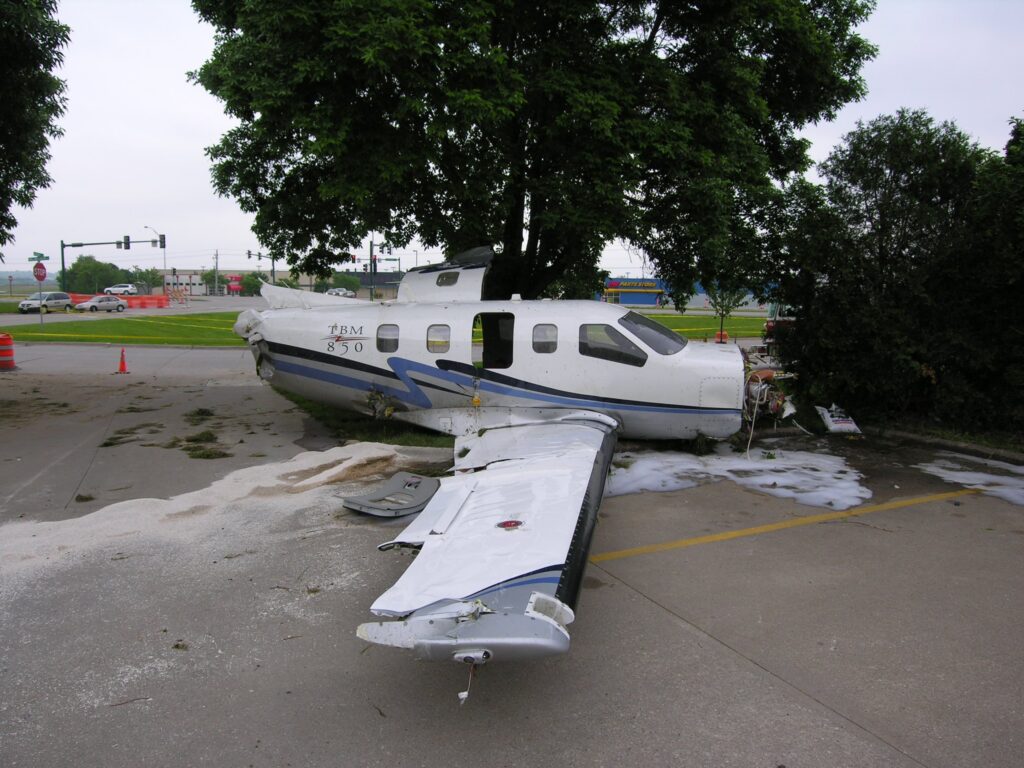
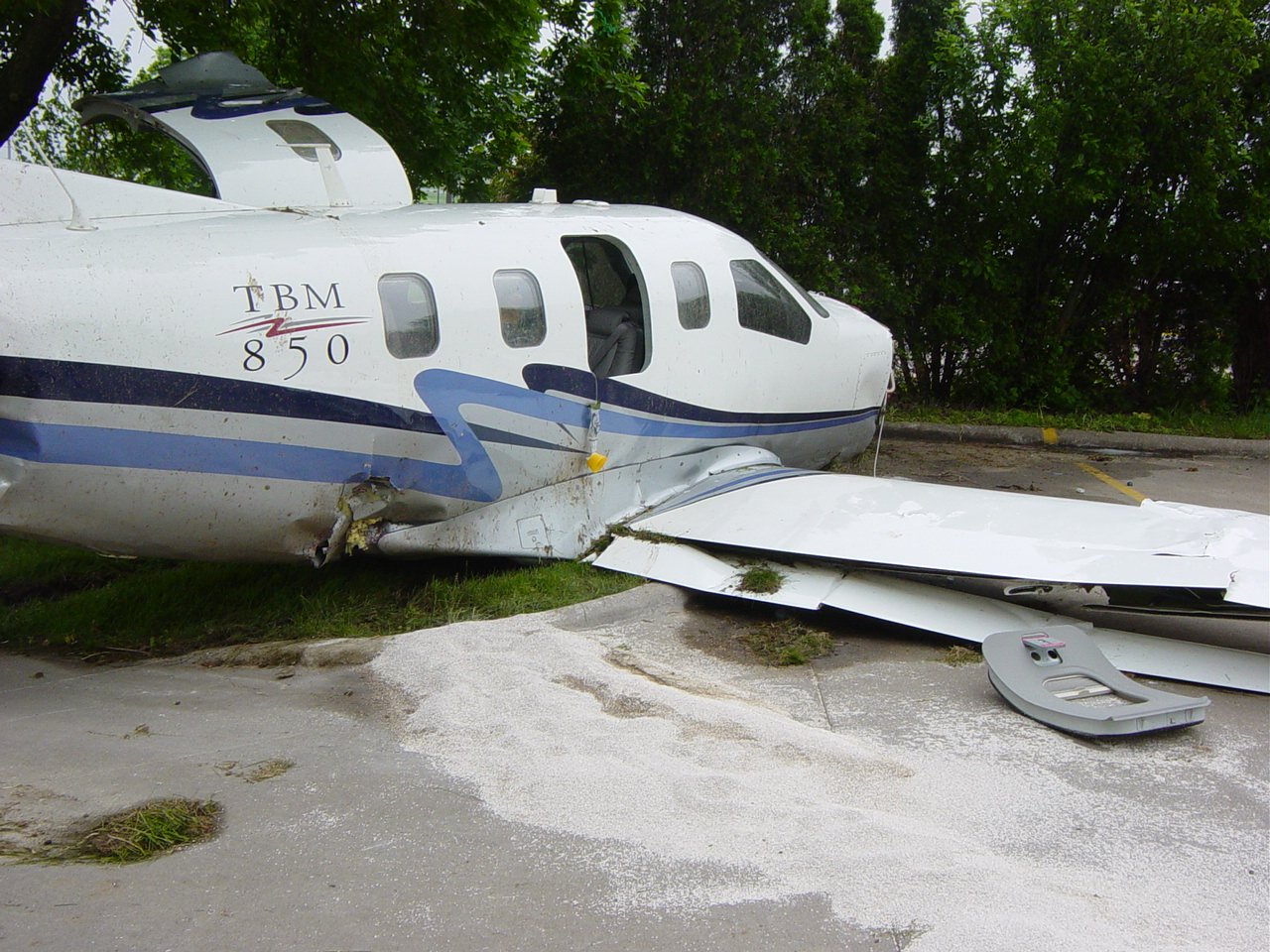
On the morning of June 3, 2008, a 2007 Socata TBM 700 (850), registered N849MA, rolled down runway 30 at Iowa City Municipal Airport (IOW) in Iowa City, Iowa, lifted off with a full tailwind, stalled at roughly 30 feet above the ground, and cartwheeled into a parking lot 0.28 miles from the departure end of the runway. The pilot and the adult passenger survived with minor injuries. The second passenger, a 2-year-old girl being transported home after a medical procedure, was killed. She had been held in her mother’s lap, unrestrained, as she had been on every previous Angel Flight the family had taken.
The flight was operating under 14 CFR Part 91 as an Angel Flight Central volunteer mercy mission. The pilot, a private pilot with 5,688 total hours and 4,388 hours in the TBM make and model, had flown into IOW that same morning to pick up the mother and daughter. The family was heading back to Pryor Field Regional Airport in Decatur, Alabama. They had flown up from Thomasville, Georgia, for the daughter’s scheduled medical treatment, and this was their return leg home.
When the pilot arrived at IOW around 0937, he touched down on runway 30 with winds from about 073 to 080 degrees at 5 to 6 knots. Runway 30 has a magnetic heading of 300 degrees. A wind from 080 degrees on a runway aligned at 300 degrees is almost exactly a direct crosswind tending toward a tailwind, but at 5 to 6 knots it was manageable. He parked at the terminal, met the passengers, and completed the Angel Flight paperwork. The mother later recalled it was drizzling when she arrived at 0845, and that when the airplane touched down she could see water splashing off the runway. She thought the worst of the weather had passed.
What the ASOS was recording during those minutes told a different story. Between 0931 and 0941, while the pilot was on the ground meeting his passengers, the wind direction was rotating steadily from 326 degrees clockwise through north, through east, and past due east. By 0941 the ASOS showed winds from 103 degrees at 9 knots with gusts to 11. The pressure gradient behind a stationary front south of Iowa was tightening, and convective activity was building. By 0958, ten minutes before the accident, the ASOS recorded winds from 100 degrees at 21 knots with gusts to 28. By 1003, the gusts were reaching 36 knots from 101 degrees. The airport manager recalled looking at the ASOS screen shortly before the takeoff and seeing steady winds of 25 knots gusting to 33. He noted that the visual wind tee was favoring runway 12, the reciprocal direction. Runway 12 would have given the crew a headwind. Runway 30 gave them a direct tailwind.
Iowa City Municipal is a non-towered airport. Runway 07-25, the longer runway at 4,335 feet, was closed to VFR operations Monday through Friday from 0700 to 1900, per an active NOTAM. The pilot had even annotated his Jeppesen approach chart with a handwritten note: “Clsd 7 AM – 7 PM IF VFR.” The flight was operating IFR. Runway 07-25 was legally available to him. He chose runway 30 instead.
Around 1005, N849MA reached the approach end of runway 30. The ASOS at that moment showed winds from 096 degrees at 21 knots, gusting to 31. A wind from 096 degrees on a runway aligned at 300 degrees is a tailwind component of roughly 21 knots sustained, with gusts to 31. The TBM 850 Pilot’s Operating Handbook requires increasing takeoff distances by 30 percent for every 10 knots of tailwind. At maximum takeoff weight of 7,394 pounds, the POH lists a sea-level takeoff ground roll of 2,035 feet and a distance to clear a 50-foot obstacle of 2,840 feet, in standard conditions with no wind. Apply a 20-knot tailwind correction, and the ground roll increases by 60 percent, to roughly 3,256 feet. Runway 30 is 3,900 feet long. Add the wet runway penalty of 15 percent on top of that, and the numbers were converging on something close to the full available runway length just to get airborne, with almost nothing left over to actually climb.
The pilot initiated the takeoff roll. He later said the first two-thirds of the roll felt normal, but then he felt a wind change and gust push the aircraft to the left. He glanced at the airspeed indicator, saw 85 knots, and rotated at approximately 3,000 feet down the runway. The airplane lifted off. The GPS data recorded the liftoff at about 3,553 feet down runway 30, at 1006:23. The airport manager watched from the terminal. The airplane reached the departure end of the runway at roughly 100 feet above ground level. Then, in the manager’s words, it suddenly went nose-up into a near-vertical attitude, began rolling counter-clockwise, and came down. The stall warning had been sounding. The mother heard a buzzer the moment the airplane tipped sideways. In a couple of seconds, she said, the tail went up and the ground came toward them.
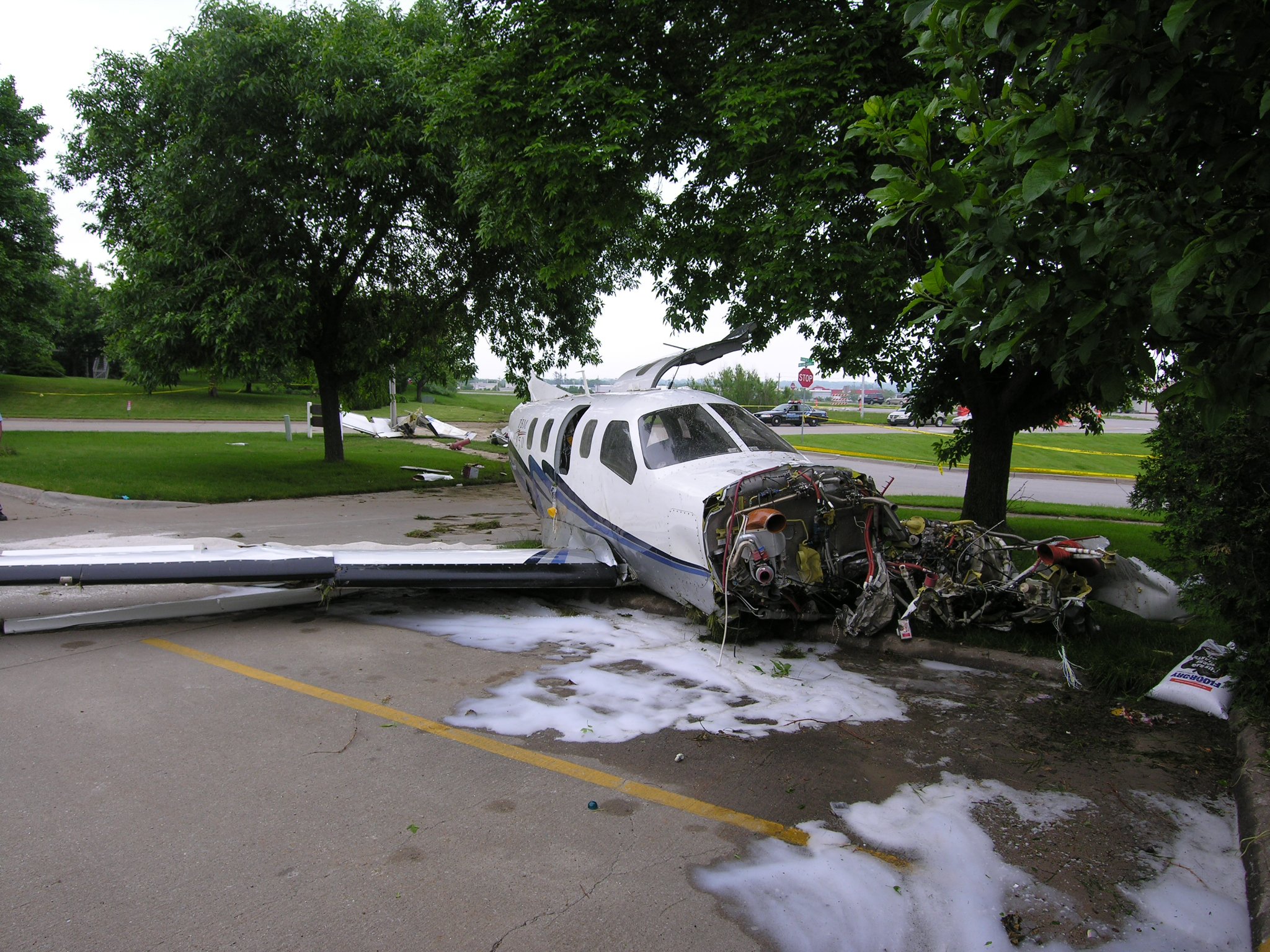
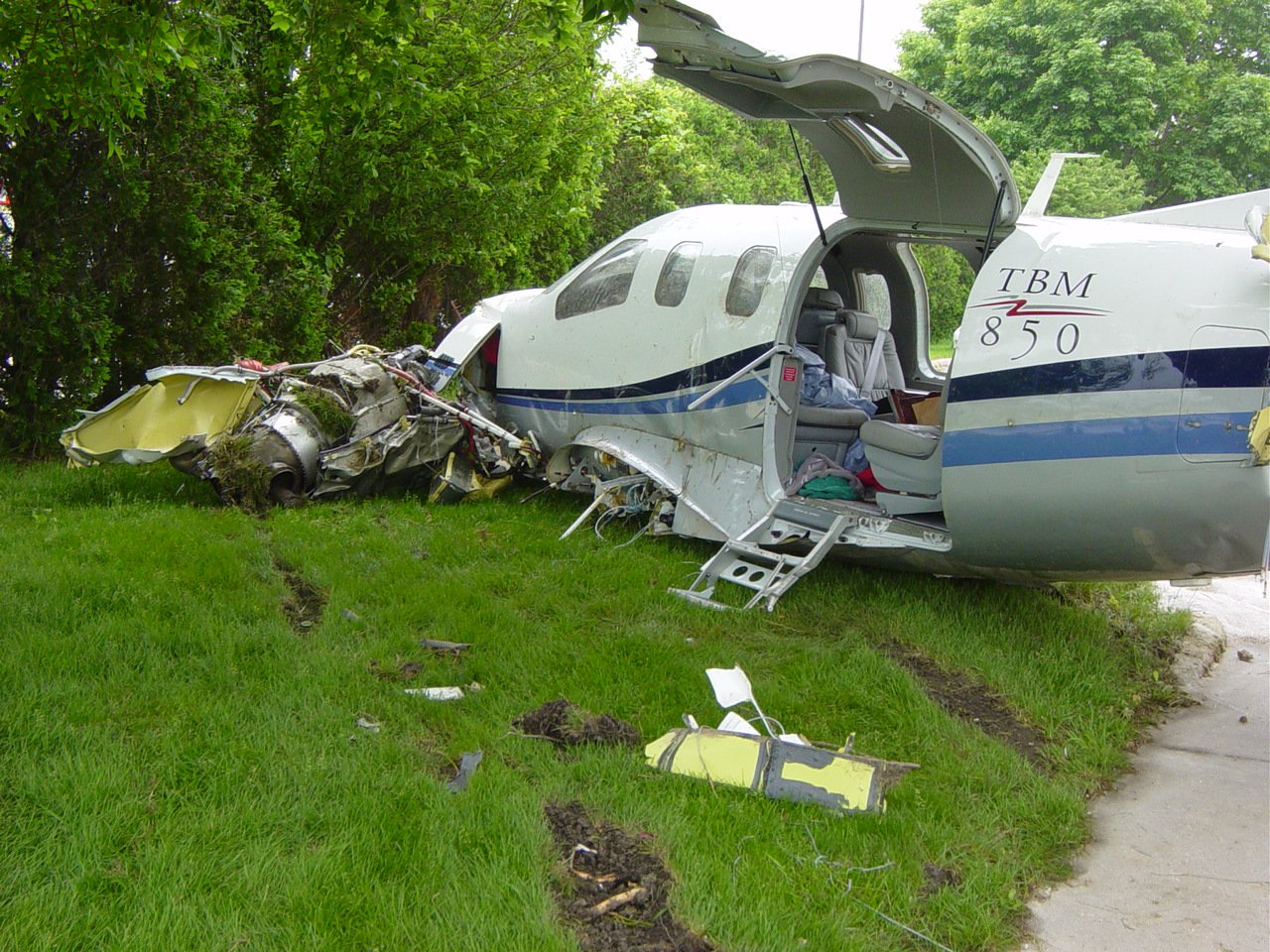
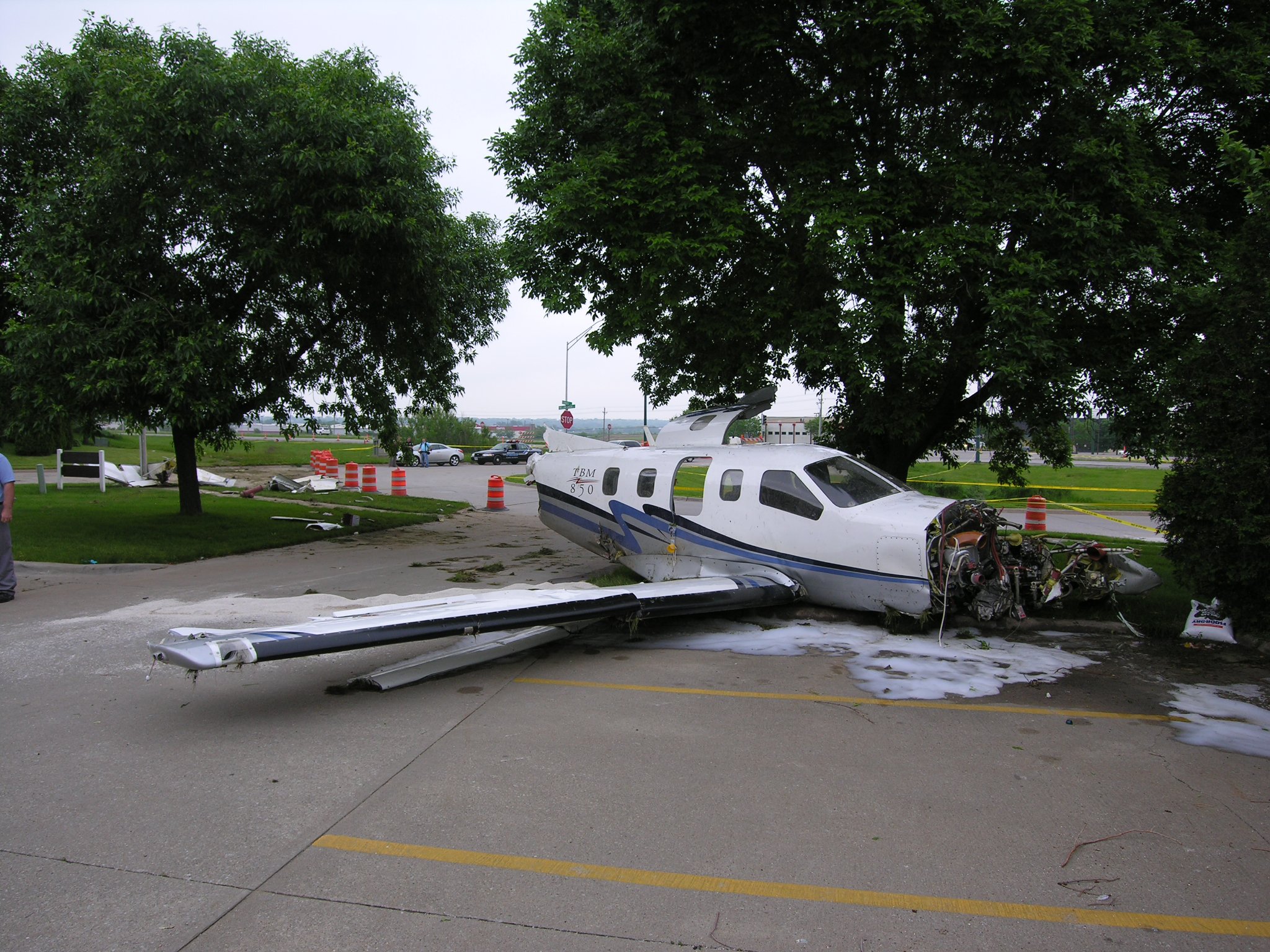
The main wreckage came to rest in the parking lot of an office building, about 640 feet from the initial ground impact point along a heading of 244 degrees. The empennage separated and landed about 100 feet behind the main fuselage. Pieces of the left wing were scattered 90 to 150 feet from the initial impact. The propeller blades showed S-shaped bending and torsional overload fractures. The flaps were in the takeoff position. The landing gear was still down. The DATCON hour meter read exactly 420.0 hours. No mechanical anomalies were found.
Investigation Findings
The NTSB’s investigation established the wind picture clearly through the ASOS data. From roughly 0930 onward, winds at IOW rotated from northwesterly through northerly, then through east-northeast, and ultimately settled from almost due east at speeds that accelerated from single digits to sustained gusts exceeding 30 knots in less than 30 minutes. By the time the pilot called Cedar Rapids Approach for his IFR clearance at 1003, a direct-headwind runway had been available to him the entire time. The approach chart in the wreckage showed he knew runway 07-25 was closed to VFR, which meant he also knew it was open to IFR. He did not use it.
The performance math was significant. The TBM 850 POH’s tailwind correction factor of 30 percent per 10 knots of tailwind is not a conservative suggestion, it is a certification-basis calculation. At the weights and conditions present that morning, with a wet runway and a 20-to-31-knot tailwind, the available runway was marginal at best and potentially inadequate before the first wheel started rolling. The GPS data confirmed the airplane did not become airborne until 3,553 feet of the 3,900-foot runway had been consumed. The airport manager’s observation that the airplane reached the runway departure end at only about 100 feet AGL was consistent with that data. There was no energy margin left for a stall recovery.
The investigation also examined the child restraint situation in detail. Federal Aviation Regulation 91.107 requires every person on board to occupy an approved seat with a safety belt properly secured during takeoff. The single exception is for children who have not yet reached their second birthday, who may be held by a restrained adult. The daughter was 2 years and 10 months old at the time of the accident. The Angel Flight Mission Itinerary emailed to the pilot the night before the accident listed her age. The pilot knew, or had the means to know, that the child was older than two. The mother stated the child had flown unrestrained on every previous Angel Flight the family had taken. The pilot briefed the mother on seat belt use, asked if she knew how they worked, and she confirmed she did. The child was never placed in a restraint.
Each passenger seat in the TBM 850 was equipped with both a seat belt and a shoulder harness. The accident was survivable for both adult occupants, as demonstrated by the fact that both the pilot and the mother walked away with minor injuries. The autopsy found the cause of the child’s death was blunt force trauma of the head. FAA Advisory Circular AC 91-65 notes that 20 percent of fatally injured occupants in general aviation accidents would have survived with a shoulder harness in use, and 88 percent of the seriously injured could have had significantly less severe injuries. The child was neither belted nor harnessed.
Investigators also noted that several of the Jeppesen en route charts recovered from the wreckage were expired by more than a year at the time of the accident, and that the TBM checklist found aboard was marked “For Training Purposes Only” rather than being an approved operating document. Neither item was cited as causal, but both were consistent with a set of decisions that morning that reflected inadequate pre-departure rigor.
NTSB Probable Cause
The pilot’s improper decision to depart with a preexisting tailwind and failure to abort takeoff. Contributing to the severity of the injuries was the failure to properly restrain (FAA-required) the child passenger.
Safety Lessons
Three things went wrong before the wheels ever left the ground. Each one on its own might have been recoverable. Together, they left no margin.
- Tailwind corrections are not advisory. The TBM 850 POH adds 30 percent to every published takeoff distance for every 10 knots of tailwind. That is not a conservative buffer, it is the actual performance number. At 20 knots of tailwind, the published ground roll nearly doubles. At 3,553 feet of runway consumed before liftoff on a 3,900-foot strip, with gusts to 31 knots still pushing from behind, the airplane had no altitude and no energy when it needed both. Runway 07-25 was available under IFR. The pilot had annotated the chart himself. Running the numbers before selecting a runway is not optional.
- A deteriorating trend in the ASOS is a decision, not just information. Between landing and takeoff, the winds at IOW went from 5 knots to sustained 21 knots gusting 36, rotating 90 degrees in direction. That shift happened while the pilot was on the ground. The ASOS data was available by phone at any time on a published frequency. The airport manager saw the screen before the takeoff and noted the wind tee favored the opposite runway. Convective activity was on radar 6 miles east and moving. A go/no-go decision made at engine start is not the last opportunity to make one. The whole taxi out is still a decision in progress.
- Child restraint in a GA cockpit is a regulation, not a preference. FAR 91.107 is unambiguous. A child older than two must occupy an approved seat with a safety belt secured during takeoff. The child’s age was on the mission itinerary the pilot received the night before. Every seat on the TBM 850 had a belt and shoulder harness. The accident was survivable for the adults. The child did not survive. FAA Advisory Circular AC 91-65 puts the survivability benefit of shoulder harness use at 20 percent of fatally injured occupants in GA accidents. In this airplane, on this morning, that number had a name.
Frequently Asked Questions
Q: What caused the TBM 850 to stall on takeoff at Iowa City in 2008?
A: The airplane departed runway 30 into a direct tailwind of 21 knots sustained, gusting to 31 knots. The POH requires a 30 percent increase in takeoff distances for every 10 knots of tailwind. The airplane did not become airborne until 3,553 feet of the 3,900-foot runway had been used, leaving no room to accelerate to a safe climb speed. It stalled at roughly 30 feet AGL and impacted a parking lot beyond the departure end.
Q: Was a headwind runway available at Iowa City Municipal Airport that morning?
A: Yes. Runway 07-25, which would have provided a direct headwind, was 4,335 feet long and closed only to VFR operations during daytime hours under a published NOTAM. The flight was operating on an IFR flight plan, which made runway 07-25 fully available. The pilot had handwritten the VFR closure note on his own approach chart, confirming he was aware of it.
Q: Why did the child passenger die when the pilot and adult passenger survived?
A: The child, who was 2 years and 10 months old, was being held in her mother’s lap and was completely unrestrained during takeoff. FAR 91.107 requires children older than two to occupy an approved seat with a safety belt during takeoff. Every seat in the TBM 850 was equipped with both a seat belt and shoulder harness. The cause of death was blunt force trauma of the head. Both adult occupants survived with minor injuries, indicating the accident was survivable for a properly restrained occupant.
Q: How much did the tailwind affect the TBM 850’s takeoff performance that day?
A: The POH correction factor is a 30 percent increase in takeoff distance for every 10 knots of tailwind. With a 20-knot tailwind, the published sea-level ground roll at maximum takeoff weight of 2,035 feet increases by roughly 60 percent, to over 3,200 feet. Adding the 15 percent wet runway penalty pushes that number close to the full 3,900-foot available runway length, with nothing left over to climb. The GPS-recorded liftoff point at 3,553 feet down the runway was consistent with that calculation.
Q: What are Angel Flight pilot qualification requirements compared to commercial operations?
A: Angel Flight Central requires pilots to have logged a minimum of 250 hours as pilot-in-command and to hold a valid FAA certificate. An instrument rating is listed as “desired” but not required. There is no requirement for a commercial or airline transport pilot certificate. This contrasts with 14 CFR Part 135 on-demand operations, which carry significantly more stringent crew qualification, training, and operational requirements. The accident pilot had 5,688 total hours and 4,388 hours in type, well above minimums, but pilot experience did not substitute for a sound weather and performance decision that morning.