What Happened
On January 6, 2014, at 0706 eastern standard time, a 2001 Mooney M20R, N1046L, departed Boyne City Municipal Airport (N98) in northern Michigan into the darkness of a January morning. The instrument-rated private pilot and his passenger were both killed when the airplane struck trees and terrain roughly 1.07 miles east of the departure end of runway 09. A post-impact fire destroyed most of the cockpit. It was the kind of morning that, had anyone on the ground been able to see clearly through the blowing snow, would have looked unmistakably wrong from the start.
The pilot had flown the Mooney up from Oakland/Troy Airport (VLL) in Troy, Michigan three days earlier, on January 3. He parked it in his hangar at N98 and took on no fuel. According to a family member, the plan was to head home on January 5, but the weather kept them on the ground another day. So the morning of January 6 became the departure day.
At 0614, about an hour before the accident, the pilot logged into a commercial computerized flight planning service and pulled weather data. He also filed an IFR flight plan. The plan called for a 0715 departure, direct to the Grayling VOR (CGG) then direct to VLL, at 5,000 feet, with an estimated time en route of 51 minutes. He filed it. He did not, however, receive an IFR clearance before getting airborne. That detail matters, and we will come back to it.
What the weather briefing contained was this: overcast conditions expected at 3,000 feet with cloud tops at 12,000 feet, visibility 3 to 5 miles in light snow showers and mist, northwest winds gusting to 25 knots. An active AIRMET was current for IFR conditions, specifically calling out ceilings below 1,000 feet and visibility below 3 miles with precipitation, mist, and blowing snow. That AIRMET was not a forecast of conditions that might develop. It was a current advisory describing what was happening in the region at that moment.
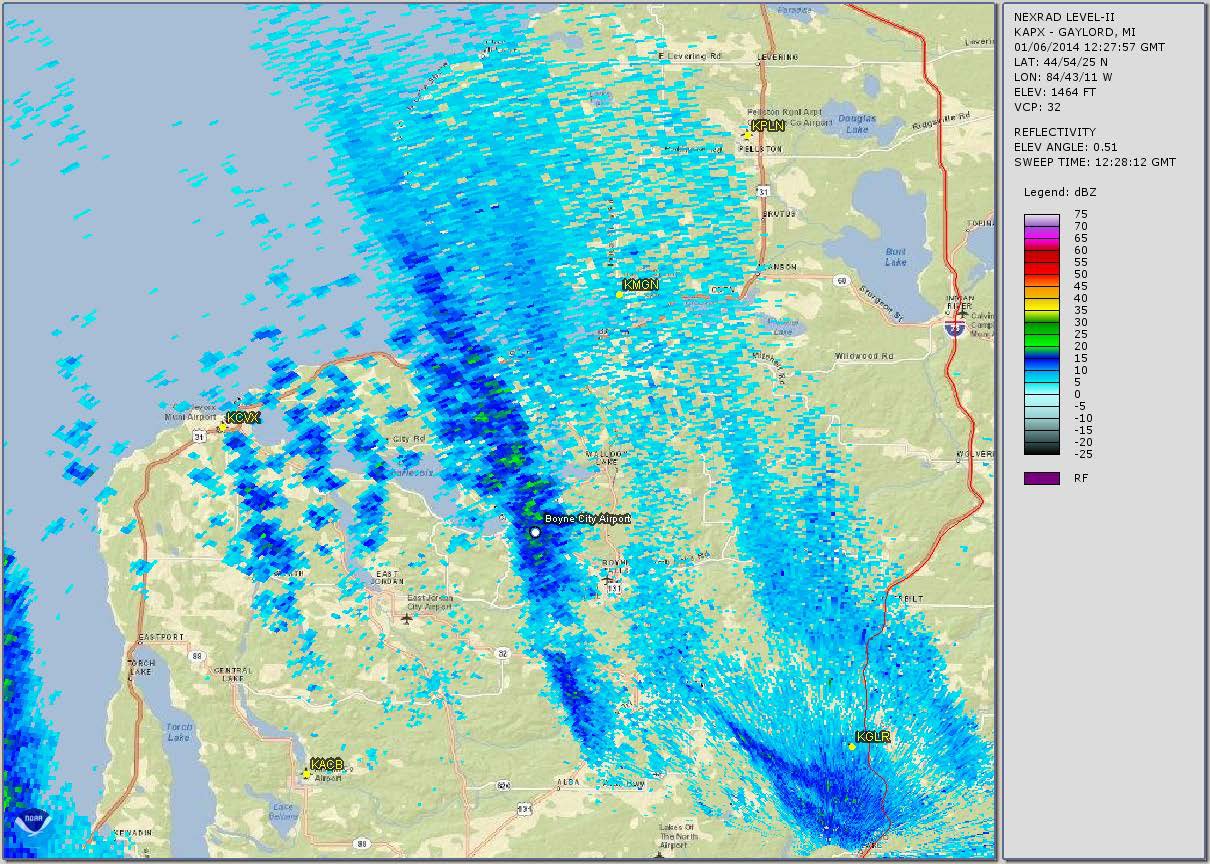
The actual observations from nearby airports confirmed it. Charlevoix Municipal Airport, 16 miles northwest, reported at 0655: wind 340 at 18 knots gusting to 27, visibility 2.75 miles in light snow, ceiling 1,800 feet scattered, 2,500 broken, 2,900 overcast. Twenty minutes later at 0715, the Charlevoix observation had deteriorated to 1.25 miles visibility, ceiling 1,400 feet broken. Harbor Springs, 15 miles north, reported at 0654: visibility 4 miles in light snow, ceiling 1,200 feet broken. These stations were not across the state. They were the airports immediately surrounding Boyne City, and they were reporting IMC or near-IMC conditions in the minutes bracketing the accident.
Witnesses on and near the airport described what they heard and saw. One woman heard the engine running while the airplane was still on the field. She said it sounded like the airplane took off to the east. Two other witnesses said the engine sounded like it “choked up” and “tightened up” during the flight, though others reported hearing normal loud engine sounds. Several witnesses said the sound of the engine eventually shifted, as if the airplane was heading back west, back toward the airport.
It was still dark. It was January in northern Michigan, and the sun would not rise for another 45 minutes. One witness reported the blowing snow was occasionally creating whiteout conditions. Several others said the snow was falling heavily. Because of the snow and darkness, witnesses could not see the airplane itself, only its lights. One witness reported seeing those lights descending at a 45-degree angle. Another said the airplane banked hard, pitched up and down, and then accelerated as it went down.
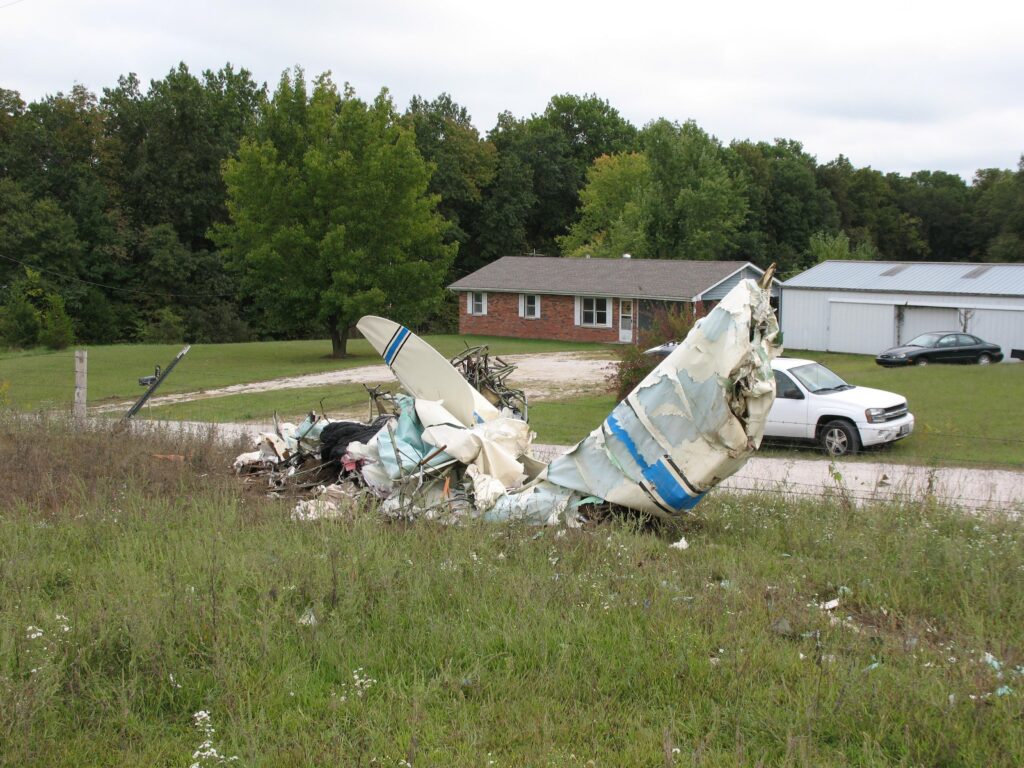
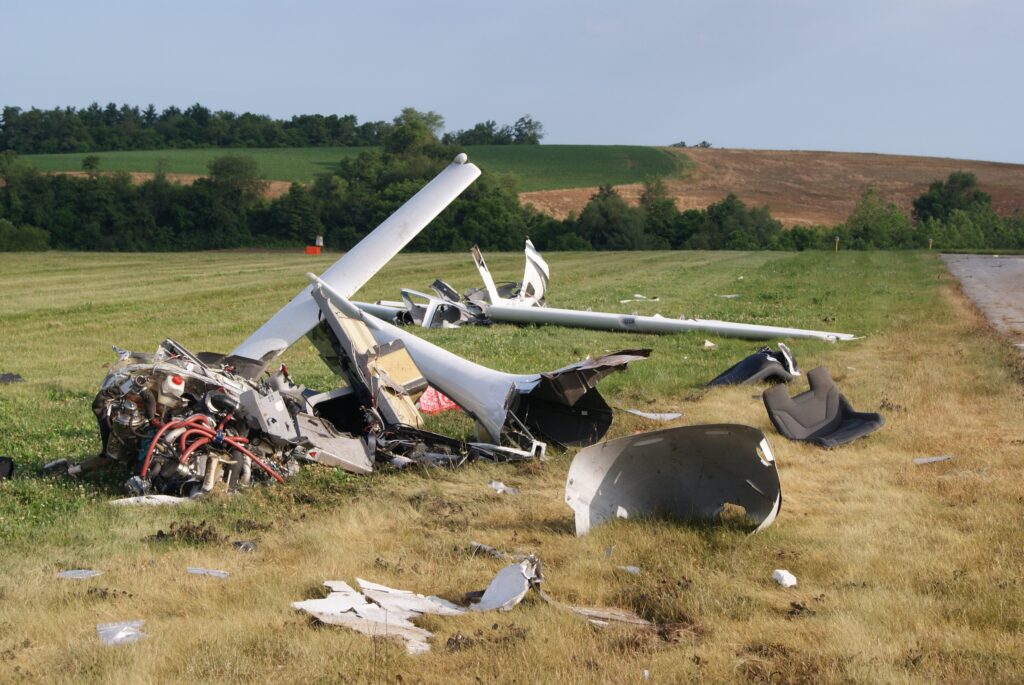
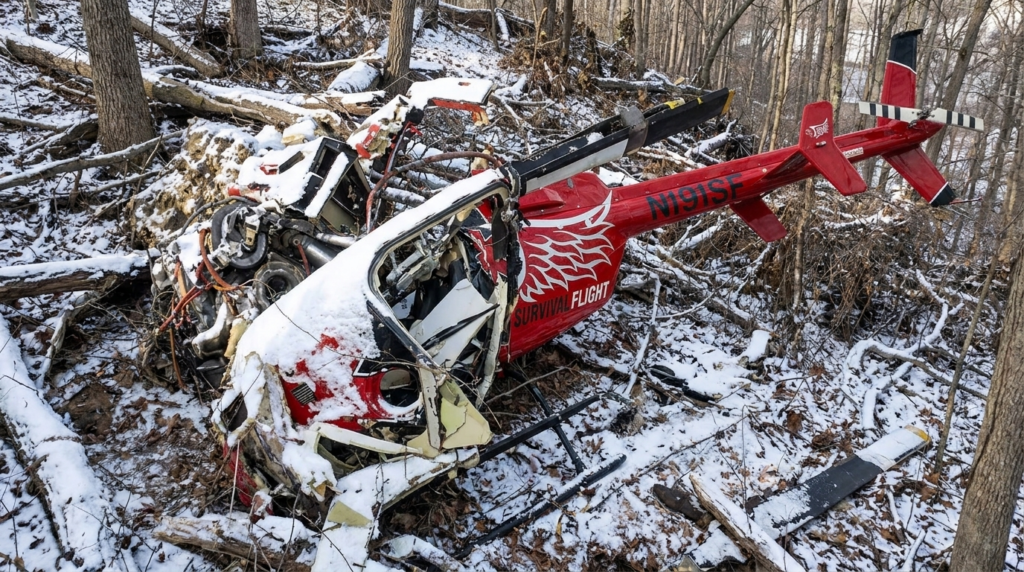
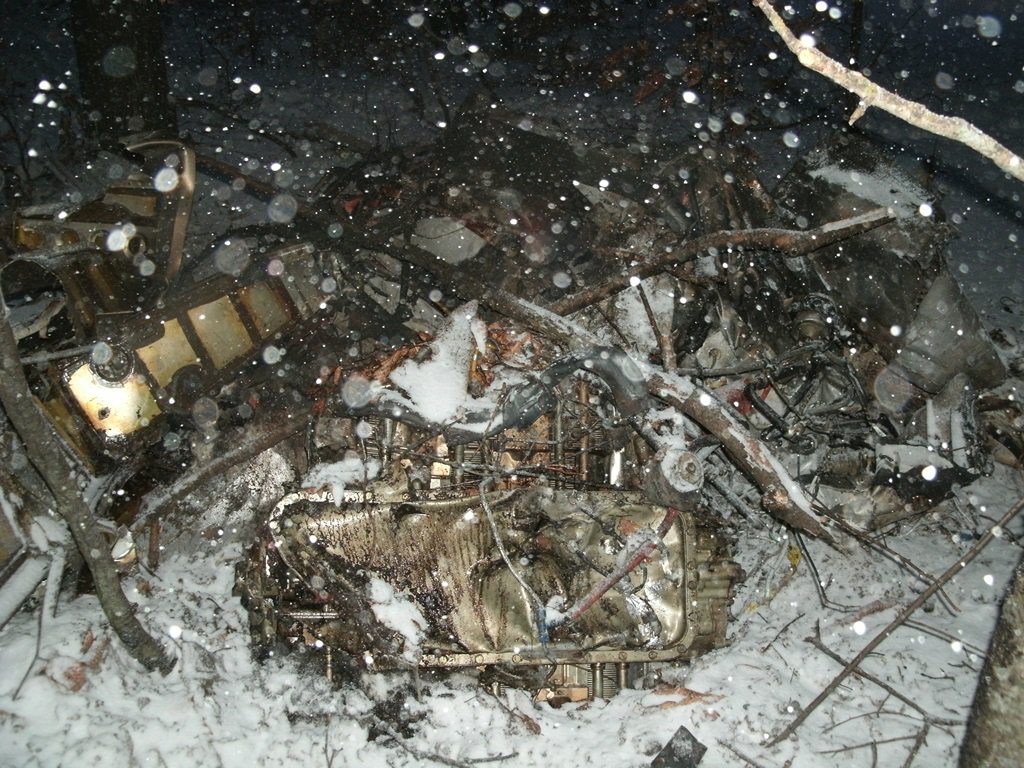
The Mooney came down in a heavily wooded valley about a mile east of the runway. The trees in that valley stood 50 to 80 feet tall. The airplane clipped the tops of those trees on a 300-degree heading, and the broken branches indicated a descent angle of roughly 45 degrees. The distance from the first tree strike to the main ground impact was about 200 feet. The engine came to rest approximately 100 feet northwest of the primary impact point. The propeller was another 50 feet beyond that. Post-impact fire destroyed the cockpit, the instrument panel, and most of the forward fuselage structure.
Investigation Findings
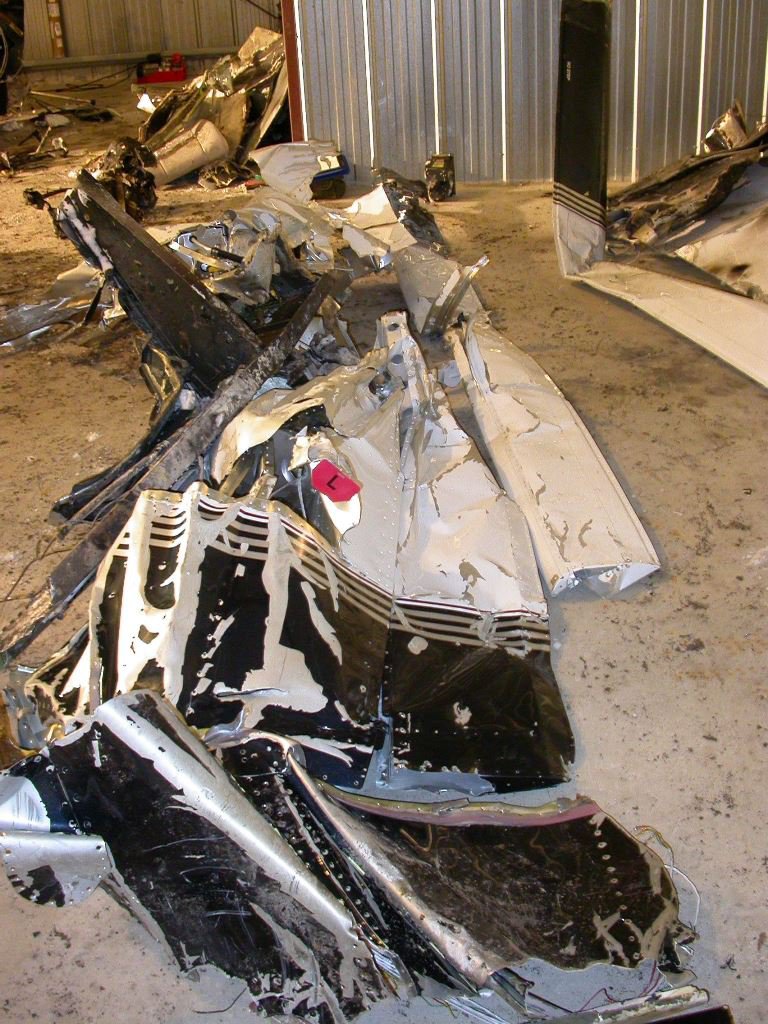
Investigators from the NTSB could not reach the accident site until January 9 because extreme winter weather made access impossible for three days. By the time the team arrived, local law enforcement had already moved the wreckage to a secured hangar at N98. That relocation, while understandable given the conditions, meant the on-site physical evidence was limited to what responders had documented and what remained visible at the impact point itself.
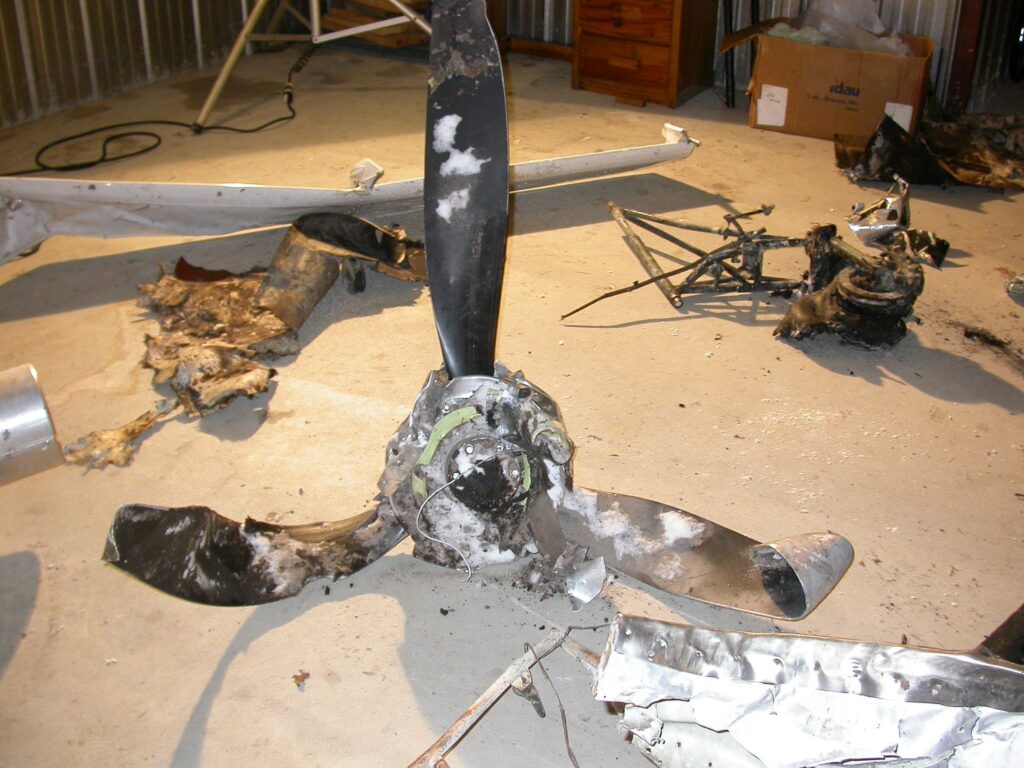
The engine teardown told a clear story: nothing failed before impact. Cylinders 1, 3, and 5 were removed and examined. The intake and exhaust valves were intact. The camshaft, crankshaft, bearing saddles, and pistons all showed no anomalies. The magnetos, fuel pump, vacuum pump, fuel injection servo, oil pump, and induction system were all examined and none of them revealed any deficiency that would have prevented normal engine operation. The propeller damage was consistent with rotation under power at impact. One blade was twisted and bent rearward with its tip curled aft. A second blade had its outboard third curled aft nearly 270 degrees. The blades had chordwise scratching and polishing, the kind of marks left by a propeller moving through the air when it meets something solid. The engine was producing power when that airplane hit those trees.
The landing gear jackscrew position indicated the gear was in transit, neither fully retracted nor fully extended, which was consistent with the airplane being in or shortly after the takeoff sequence. Flight control continuity could not be established to the ailerons due to the extent of impact damage and separation of the push-pull control tubes. Continuity was confirmed from the aft fuselage to the rudder and elevators. The fuel caps on both wings remained in place. The last confirmed fueling at N98 was 63.5 gallons of 100LL purchased on December 8, 2013. Given the three-day stay at the airport with no additional fuel records, investigators could not confirm the exact fuel state at departure, though no fuel-related anomaly was identified as causal.
On the communications side, the pilot had filed an IFR flight plan but had not received an IFR clearance. Local pilots familiar with N98 reported that radio contact with ATC from the ground at Boyne City was extremely difficult, and that most IFR departures from that airport involved picking up the clearance once airborne. The airplane was also below radar coverage for the area, so there was no ATC track, no radio contact, and no recorded altitude data for any portion of the flight. The only evidence of what happened after the airplane left the ground came from witnesses on the ground who could hear the engine and, through breaks in the snow, catch glimpses of the airplane’s position lights.
The pilot held a private certificate with single-engine land and instrument airplane ratings. His third-class medical had been issued just two weeks earlier, on December 23, 2013. On his medical application, he reported 1,400 total hours with 50 hours in the previous six months. An insurance application he completed in August 2013 reported 1,572 total hours, 1,272 of those in the Mooney M20R specifically. His logbooks were never located during the investigation, so those numbers could not be verified. Toxicology was negative for all substances.
NTSB Probable Cause
The pilot’s failure to maintain control of the airplane as he attempted to return to the airport after encountering dark night conditions and heavy snow showers.
Safety Lessons
This accident sits at the intersection of several factors that individually might have been manageable, but together created a chain that broke in the worst possible way. The lessons here are not abstract.
- An IFR rating does not substitute for an IFR clearance. The pilot held an instrument rating and filed an IFR flight plan, but he departed without receiving a clearance. At N98, local pilots routinely picked up clearances in the air because ground contact with ATC was unreliable. That workaround works in benign conditions. On a dark January morning with an active AIRMET for ceilings below 1,000 feet and visibility below 3 miles, it put the pilot in the clouds without altitude separation, without a transponder squawk, and without anyone tracking his position. The instrument-rated pilot’s protection in IMC is the full IFR system, not just the rating. The rating without the clearance is not a substitute.
- The AIRMET was not a possibility, it was a description. The briefing the pilot received an hour before departure included an active AIRMET for ceilings below 1,000 feet and visibility below 3 miles. The Charlevoix observation at 0715, right at his planned departure time, put visibility at 1.25 miles with a 1,400-foot broken ceiling. That is not marginal. That is solidly IMC. When an AIRMET is current for the departure area, the local observations at stations 15 to 16 miles away are the ground truth, and the pilot had access to that data before he started the engine.
- Spatial disorientation at night in snow is nearly unrecoverable without instruments and a plan. The witnesses described what instrument pilots recognize as the onset of a graveyard spiral or an unusual attitude from which the pilot could not recover. Dark night, no horizon, heavy snow reducing any visual reference to two position lights, and gusting winds altering the feel of the controls. Even experienced instrument pilots can lose control rapidly in those conditions without maintaining strict instrument scan discipline from the first moment of departure. The airplane was 1.07 miles from the airport. The loss of control happened before the pilot could climb out of the trees and into the structure of the IFR system that might have saved him.
Frequently Asked Questions
Q: Did the pilot receive a weather briefing before the flight?
A: Yes. At 0614, about an hour before the accident, the pilot used a commercial computerized flight planning service to obtain weather data. The briefing included local observations from nearby airports, area forecasts, winds aloft, SIGMETs, and an active AIRMET for IFR conditions with ceilings below 1,000 feet and visibility below 3 miles with precipitation, mist, and blowing snow. He had the information. The decision to depart anyway is what the NTSB analysis centers on.
Q: Why did the pilot depart without an IFR clearance?
A: Radio contact with ATC on the ground at Boyne City Municipal Airport (N98) is unreliable due to terrain and distance from radar and communication facilities. Local pilots familiar with the airport reported that picking up IFR clearances in the air after departure was standard practice there. The NTSB noted this as a contributing factor to the accident sequence, since departing without a clearance meant the pilot entered IMC conditions without ATC tracking, without an assigned squawk, and without the altitude structure of the IFR system.
Q: Was the engine failure a factor in the accident?
A: No. The post-accident engine examination found no anomalies that would have prevented normal operation. The propeller damage, including blade twisting, bending, and chordwise scratching, was consistent with the engine producing power at the time of impact. Witness accounts also described a normal, loud engine sound from the airplane throughout most of the flight. The accident was a loss of control event, not a mechanical failure.
Q: What does spatial disorientation look like in a dark night snow departure?
A: Without a visible horizon, the inner ear cannot reliably detect whether the airplane is in a bank or a climb or a descending turn. In heavy snow at night, the only visual reference outside the cockpit becomes the position lights, which tell you almost nothing about airplane attitude. Witnesses described the accident airplane banking hard, pitching up and down, and then accelerating downward, which is consistent with a pilot responding to false vestibular cues rather than instrument indications. Recovery requires an immediate transition to full instrument scan and the discipline to trust the instruments over what the body is feeling.
Q: How far did the airplane travel before hitting the trees?
A: The wreckage was found 1.07 miles east of the departure end of runway 09 at N98. Witnesses initially heard the engine heading east from the airport. Some later reported the sound shifted back toward the west, suggesting the pilot was attempting to return to the airport. The airplane impacted the tops of 50 to 80-foot trees in a wooded valley at an approximately 45-degree descent angle on a 300-degree heading, which is consistent with a westbound turn back toward the airport that went wrong.