What Happened
On June 7, 2009, a 1978 Gulfstream American Corporation AA-5B Tiger, registration N448DM, departed Lake Elmo Airport (21D) in St. Paul, Minnesota, at approximately 1643 central daylight time. The pilot, a 45-year-old private pilot who held no instrument rating, was flying with one passenger toward Sheboygan County Memorial Airport (KSBM) in Sheboygan, Wisconsin. Neither of them would survive. The airplane was destroyed on impact with terrain near Humbird, Wisconsin, at approximately 1745, with both occupants fatally injured.
The morning started with a phone call. At 1043, roughly six hours before wheels-up, the pilot contacted the Lansing Automated Flight Service Station to get a weather briefing for a VFR cross-country. The briefer did not give him good news. There was an active weather advisory for widespread instrument meteorological conditions that covered the entire planned route from St. Paul to Sheboygan. Ceilings along the route were sitting between 400 and 1,200 feet above ground level. There were areas of rain showers and isolated thunderstorms, with cloud tops reaching 34,000 feet. The briefer told him VFR flight was not recommended. The pilot’s response was that he would call back in a couple of hours to see if things improved.
At 1558, 45 minutes before departure, he called the Washington AFSS for an updated briefing. The picture had not changed in his favor. The departure airport at Lake Elmo was reporting an overcast ceiling of 1,300 feet agl with 10 miles visibility. Along the route, overcast ceilings ranged from 900 to 1,500 feet agl. The forecast called for ceilings of 1,500 to 2,500 feet agl, with layered clouds reaching FL200, widely scattered embedded light rain showers, and isolated thunderstorms. Over the course of that 17-minute briefing, the briefer told him VFR flight was not recommended on four separate occasions. The pilot did not file a flight plan. He departed anyway.
Radar picked up a single VFR beacon track originating from 21D starting at 1643:31. The track showed N448DM heading south-southeast, cruising between 1,900 and 2,000 feet mean sea level. That altitude band matters. The terrain in central Wisconsin sits at roughly 1,000 to 1,200 feet msl, which put the airplane only 700 to 1,000 feet above the ground as it pressed eastward. At 1708:18, radar painted its last return over Durand, Wisconsin, at 1,900 feet msl. That was 42.6 nautical miles west of where the wreckage would later be found. The airplane had descended to the lower limit of radar coverage in that area, and contact was never reestablished.
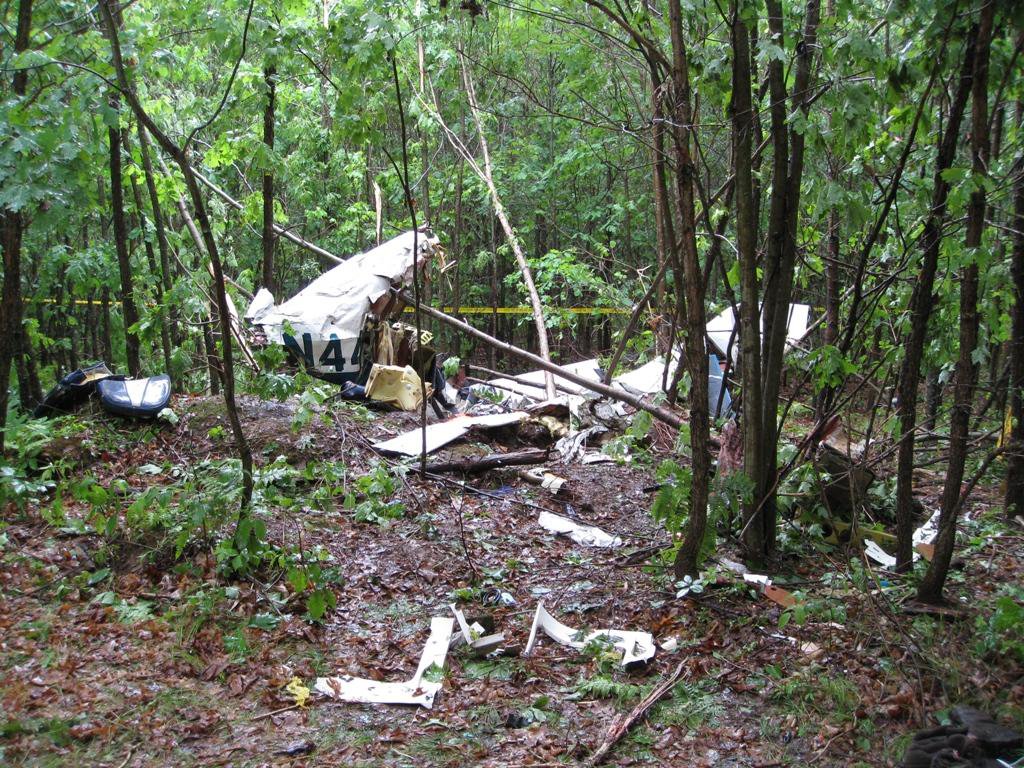
Witnesses near Humbird heard the airplane before anyone saw it, which is to say nobody saw it at all. The cloud ceiling was low, fog had settled in, and light precipitation was falling. What they heard was an engine running at high speed. Then the engine sound increased and decreased several times, as if the airplane was turning. Then they heard it hit the ground. Local law enforcement and property owners began searching immediately. They found the wreckage at approximately 2045, nearly three hours after the impact.
Investigation Findings
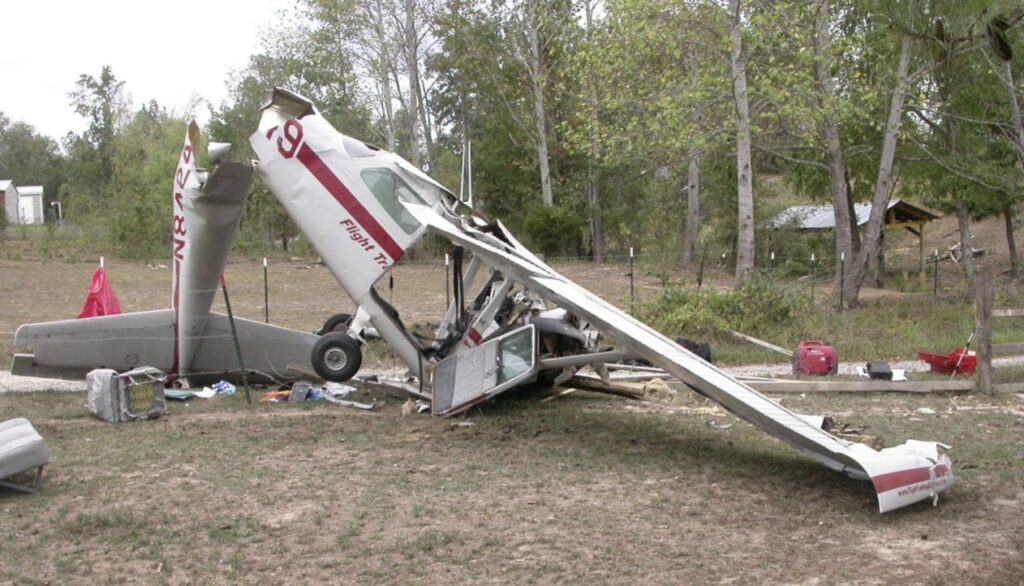
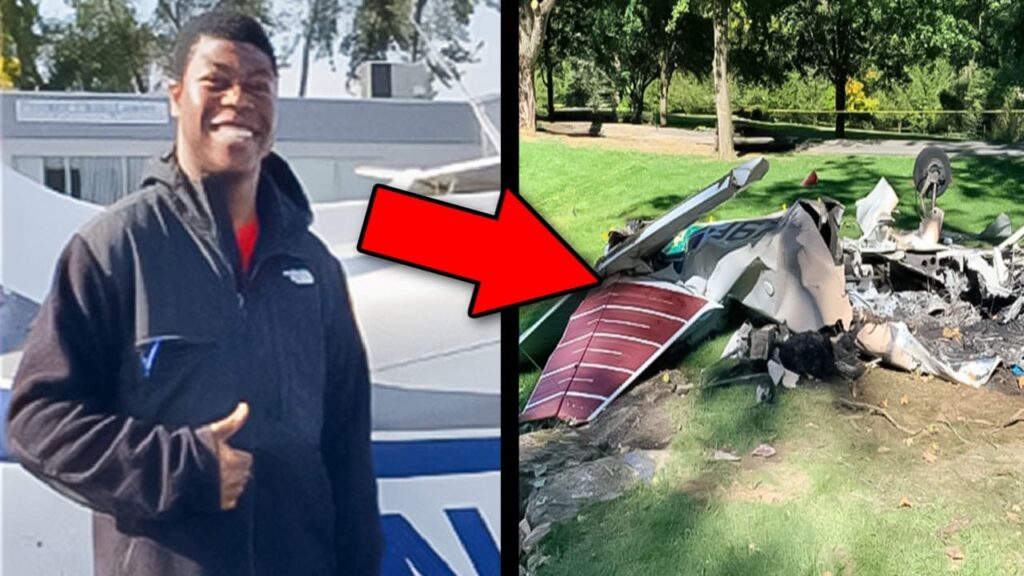
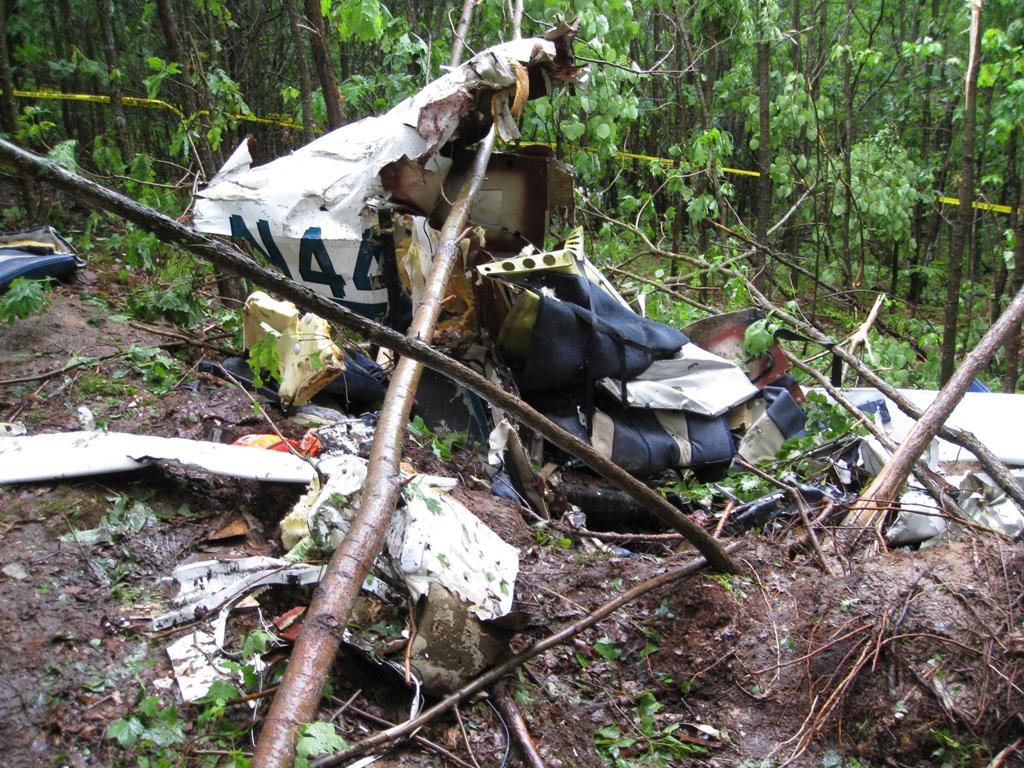
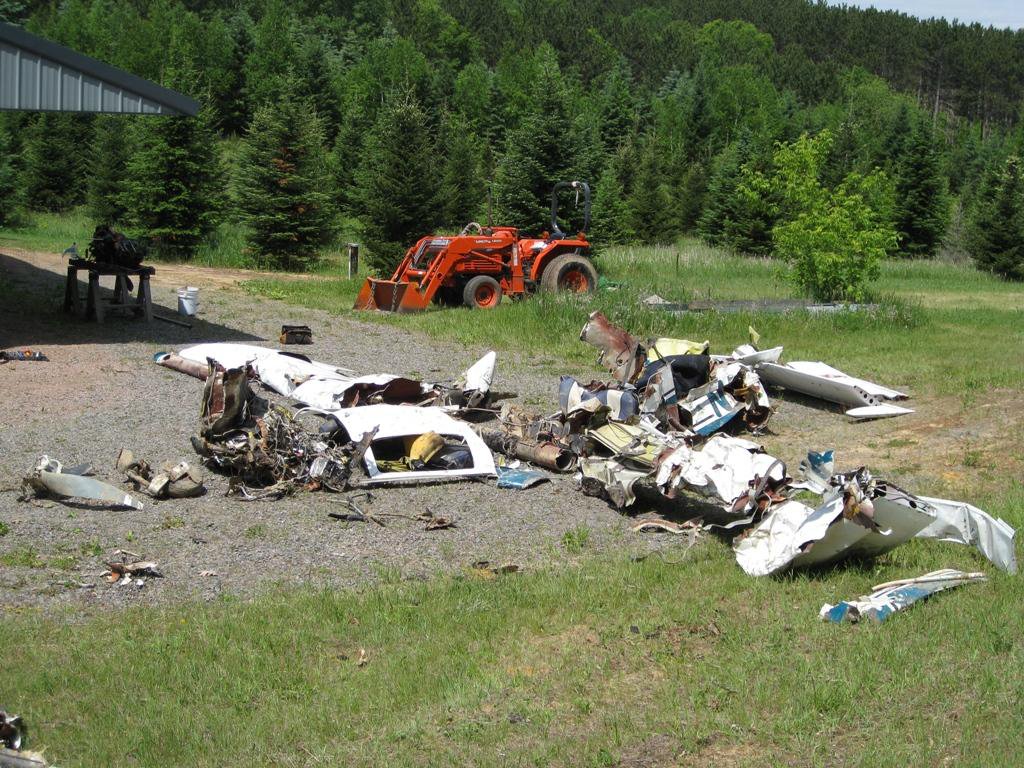
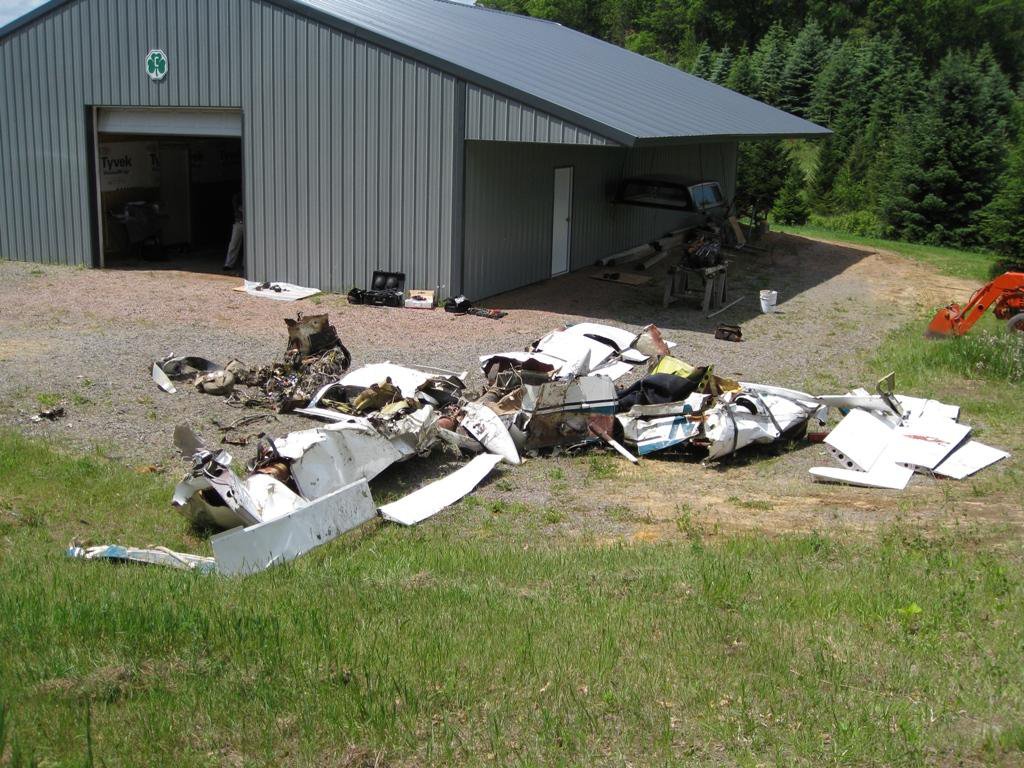
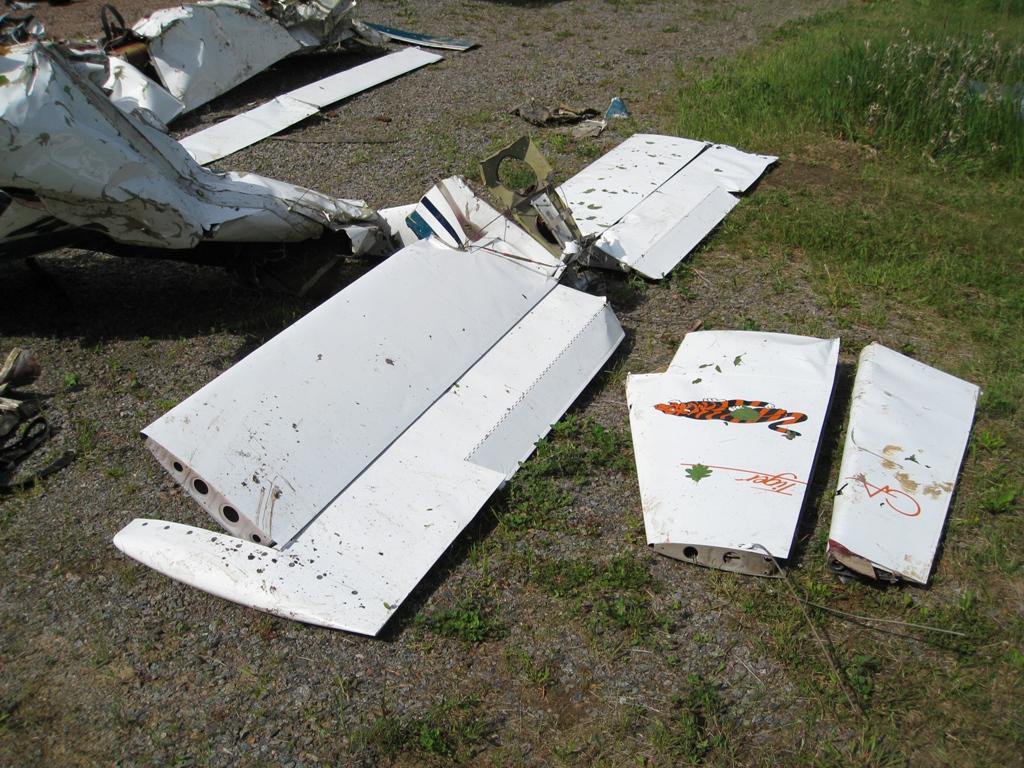
The wreckage was spread across hilly, heavily wooded terrain in a debris path approximately 461 feet long, oriented on an easterly heading. The distribution of components told a clear story. The outboard half of the right wing was at the beginning of the debris path. The vertical stabilizer was 423 feet west of the main wreckage. The cockpit canopy was 357 feet out. The right aileron and right flap were roughly 400 feet from the main wreck. Both elevators and their stabilizers were found 89 feet west of the main wreckage. The main wreckage itself sat in an impact crater approximately 3 feet deep and 10 feet wide. Damage to the overhead tree canopy was limited, which was consistent with a near-vertical descent path. In-flight breakup at low altitude.
The airframe told investigators how the airplane came apart. Damage to the wing and empennage load-bearing components was consistent with a positive-g flight maneuver. All structural component failures were consistent with overload separations, meaning the structure didn’t fail on its own. The loads imposed on the airframe exceeded what it was built to handle. The airplane was in one piece when it entered the trees. The loads are what took it apart. Flight control cable continuity could not be confirmed due to multiple cable separations, but all of those separations were also consistent with overload, not a pre-existing break. The engine showed no evidence of pre-impact failure. Internal continuity was confirmed when investigators rotated the crankshaft. Compression was present on all cylinders except number one, which had a separated exhaust pushrod from impact damage. Both propeller blades showed blade twisting, lengthwise bending, and leading-edge rotational scoring, the signature of a propeller under power at impact. The vacuum pump was functionally tested and showed no pre-impact failure. The gyroscopic instruments, both the directional gyro and the attitude indicator, were disassembled and showed rotational scoring on their gyros, confirming they were spinning when the airplane hit the ground.
The pilot had 271.6 total flight hours. Of those, 189.6 were as pilot-in-command, and 171.5 were specifically in the AA-5B Tiger. He had accumulated 4.2 hours in simulated instrument conditions, all of it during primary flight training in early 2005. He had zero hours in actual IMC. His most recent logbook entry with any instrument time was dated February 10, 2005, more than four years before this flight. He had logged 54.2 hours in the past year and 8.4 hours in the prior 30 days. His last flight review was completed February 15, 2009. Toxicology found no alcohol, drugs, or other impairing substances in either occupant.
NTSB Probable Cause
The pilot’s decision to attempt a visual flight rules flight into an area of known instrument meteorological conditions, which resulted in a loss of control due to spatial disorientation.
Safety Lessons
Two weather briefings, four explicit “VFR not recommended” advisories, a 17-minute conversation with a briefer, and the pilot still departed. That is not a story about one bad decision. It is a story about a chain of smaller decisions that each made the next one easier to rationalize. Here is what this accident teaches.
- A weather briefing is only useful if you are willing to act on it. The pilot received accurate, specific, repeated guidance that the route was not suitable for VFR flight. Ceilings of 400 to 1,200 feet agl in the morning, 900 to 1,500 feet agl at departure time, with embedded thunderstorms and active IFR advisories covering the entire route. Calling back two hours later did not change the picture. The briefer told him that too. The temptation to find reasons to go is real, especially when the departure airport looks flyable at 1,300 feet overcast and 10 miles visibility. But a VFR departure into a route with widespread IMC downstream is not a marginal-weather decision. It is a no-go decision dressed up as a marginal-weather decision.
- Non-instrument-rated pilots have no usable options once visual references disappear. The pilot had 4.2 hours of simulated instrument time from 2005 and no actual IMC experience. The gyroscopic instruments were spinning when he hit the ground, which means he had the tools in front of him but not the trained capacity to use them under the physiological stress of spatial disorientation. The human vestibular system generates false sensations within 20 seconds of entering IMC in a maneuvering aircraft. Recovery requires total reliance on instruments and the practiced muscle memory to override the body’s signals. Neither develops in 4.2 hours of hood work four years prior. Cruising at 1,900 feet msl, somewhere between 700 and 1,000 feet above terrain, there was no altitude available for recovery once control was lost.
- An IFR-equipped airplane is not an IFR airplane without an IFR pilot. N448DM was equipped for instrument operations. It had a vacuum system, gyroscopic instruments, and the hardware for IFR flight. The investigation confirmed all of it was functioning. But equipment certification and pilot certification are two different things. The airplane was capable of the flight. The pilot, through no fault of character and every fault of training gap, was not. An airplane equipped for IFR flown by a VFR-only pilot in IMC is not a safer situation than an airplane without the equipment. It may actually be more dangerous, because the presence of those instruments can create confidence that the skills to use them simply do not exist.
Frequently Asked Questions
Q: What is spatial disorientation and why is it fatal for VFR pilots in IMC?
A: Spatial disorientation occurs when the vestibular system, the inner ear and motion-sensing organs, generates sensations that conflict with what the flight instruments show. In IMC, with no visual horizon, the brain relies on those sensations and they are wrong. A pilot can feel wings-level while in a 30-degree bank. A pilot can feel a climb while in a descending spiral. Without instrument training and practice, the instinct is to trust the body over the gauges. That instinct is lethal. In this accident, the near-vertical descent path and the in-flight breakup are the physical signature of an unrecovered spiral dive, the classic spatial disorientation outcome in VFR-into-IMC accidents.
Q: How long does a VFR pilot typically survive after entering IMC?
A: The FAA and research literature have long cited an average of approximately 178 seconds, roughly three minutes, from the time a non-instrument-rated pilot enters IMC to loss of control. That figure reflects how quickly spatial disorientation develops and how rapidly an untrained pilot exhausts recovery options. In this accident, the last radar return was 42.6 nautical miles from the crash site. At cruise speeds around 130 knots, the airplane covered that distance in roughly 20 minutes, meaning the pilot was flying in deteriorating conditions for an extended period before the final loss of control.
Q: What is an in-flight breakup and what does the wreckage pattern tell investigators?
A: An in-flight breakup means the airframe separated into multiple pieces while still airborne, before ground impact. Investigators reconstruct what happened by mapping where each piece landed relative to the main wreckage. In this case, the 461-foot debris path, with major components like the right wing half and vertical stabilizer found hundreds of feet from the main wreck, indicated the structure failed in flight. The damage pattern, positive-g overload signatures on the wing and empennage, pointed to an aircraft that exceeded its structural load limits during a high-speed pull from a dive. That sequence, uncontrolled dive followed by structural failure, is the end-state of an unrecovered spatial disorientation event.
Q: Was the pilot legally allowed to depart given the weather briefings he received?
A: Under 14 CFR Part 91, VFR flight is prohibited when conditions are below VFR minimums, which in controlled airspace generally means a ceiling below 1,000 feet or visibility below 3 miles. But the departure airport at Lake Elmo reported a 1,300-foot overcast and 10 miles visibility at the time of departure, which technically met basic VFR requirements at the departure point. The weather advisory covering the route was advisory in nature, not a regulatory prohibition. So the pilot was not necessarily in violation of the letter of the regulations at the moment of takeoff. The active IFR advisory and the repeated “VFR not recommended” advisories were guidance, not hard stops. That gap between legal and survivable is exactly where this accident lived.
Q: What is the Gulfstream American AA-5B Tiger and how does it perform in IMC?
A: The AA-5B Tiger is a four-place, low-wing, all-metal single-engine airplane powered by a 180-horsepower Lycoming O-360. It cruises at approximately 130 knots and has a certified maximum takeoff weight of 2,400 pounds. N448DM was equipped for IFR operations, meaning it had the vacuum system, gyroscopic instruments, and avionics required for instrument flight. The airplane itself is entirely capable of being flown in IMC by a rated, current instrument pilot. The issue in this accident was not the airplane’s capability. It was the absence of a trained, current instrument pilot in the left seat.