What Happened
On March 16, 2011, at 10:29 in the morning, a Beech Super King Air 200, registered N849BM, lifted off runway 30 at Long Beach Airport in Long Beach, California, and never made it past 140 feet. Five of the six people on board died. The sixth sustained serious injuries. What the witnesses saw in the next eleven seconds would stay with them for a long time.
The day had started with small delays. The pilot, a 43-year-old commercial pilot with 2,073 total hours and 463 hours specifically in the King Air 200, had filed an IFR flight plan at around 0700 for a 510-nautical-mile trip to Salt Lake City, Utah. Departure was planned for 0830. But during preflight, he ran into radio transmission problems. He called the owner’s Aviation Manager around 0845, and the two of them eventually walked over to the adjacent building to find the Director of Maintenance for West Coast Aircraft Maintenance. The fix turned out to be the transmission switch position on the pilot’s oxygen mask. Simple. The departure slipped to just before 1020.
Nobody watched the pilot conduct the preflight inspection that morning. The Aviation Manager was present on the ramp but did not observe it. About five weeks earlier, in mid-February, the Aviation Manager had accompanied the pilot on a trip to Bellingham, Washington, and back. On that occasion, he helped fuel the airplane while the pilot preflighted. He noticed the pilot draining one or more of the airplane’s 12 fuel sump drains, but he was not sure how many, and he noted that the pilot was draining while fueling was still in progress. Standard practice calls for waiting at least 20 to 30 minutes after fueling before draining sumps, to give any water time to settle to the bottom of the tanks before sampling. On the morning of the accident, no one saw whether any sumps were drained at all.
With five passengers now aboard instead of the original two, the pilot taxied to runway 30 at 1020. A witness on the field saw the airplane sit at the departure end for a few minutes doing engine run-ups. At 1027, the local controller cleared N849BM for takeoff. Multiple witnesses watched the ground roll and said it looked normal. Then the airplane rotated and started to climb.
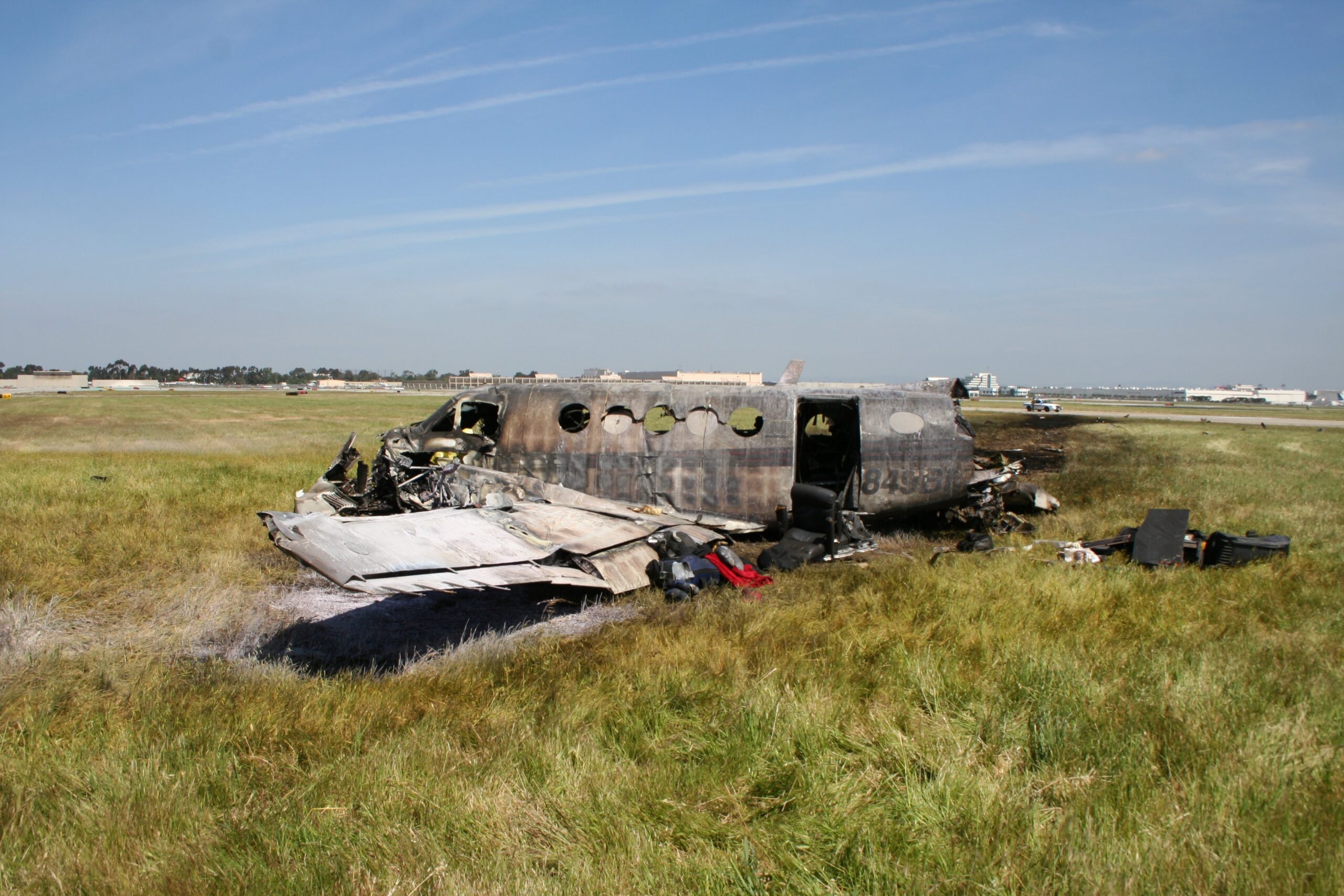
Somewhere around the midpoint of the 10,000-foot runway, at approximately 140 feet above the ground and a groundspeed of about 130 knots, things changed. The airplane stopped climbing and began to yaw left. One witness said it sounded like one of the propellers had feathered, or gone to flat pitch, or even gone into beta mode, a full-power fan noise rather than an engine sound. Another said the noise was propeller noise, not engine sound. A fourth witness thought the left propeller looked like it was windmilling. A security camera at the airport captured the sequence, and at the same moment the yaw began, a dark grayish area appeared behind the airplane, consistent with smoke.
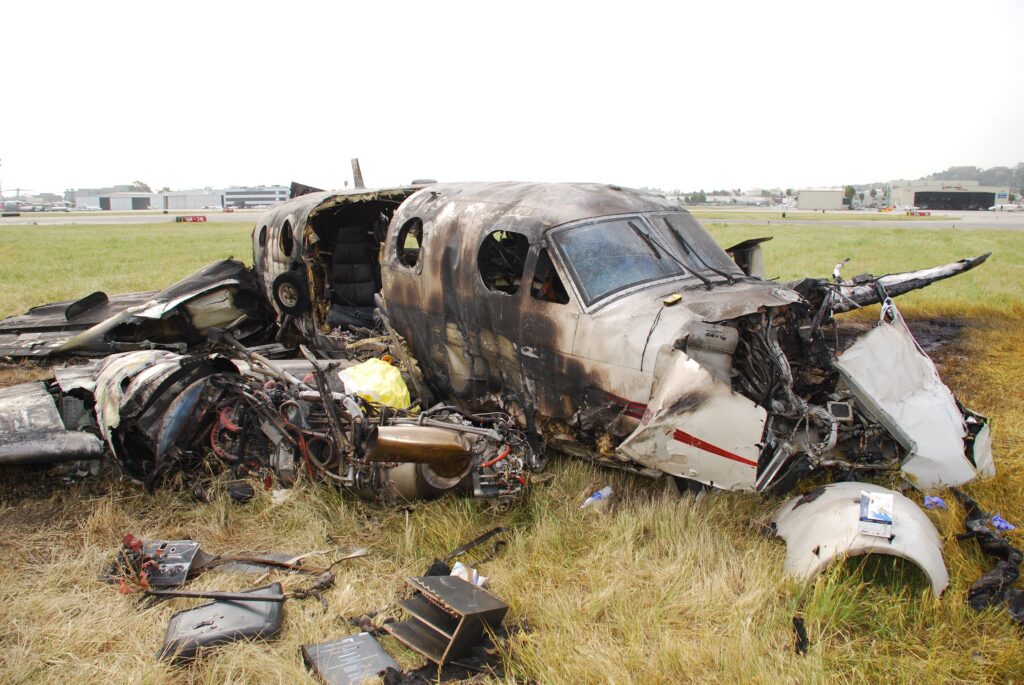
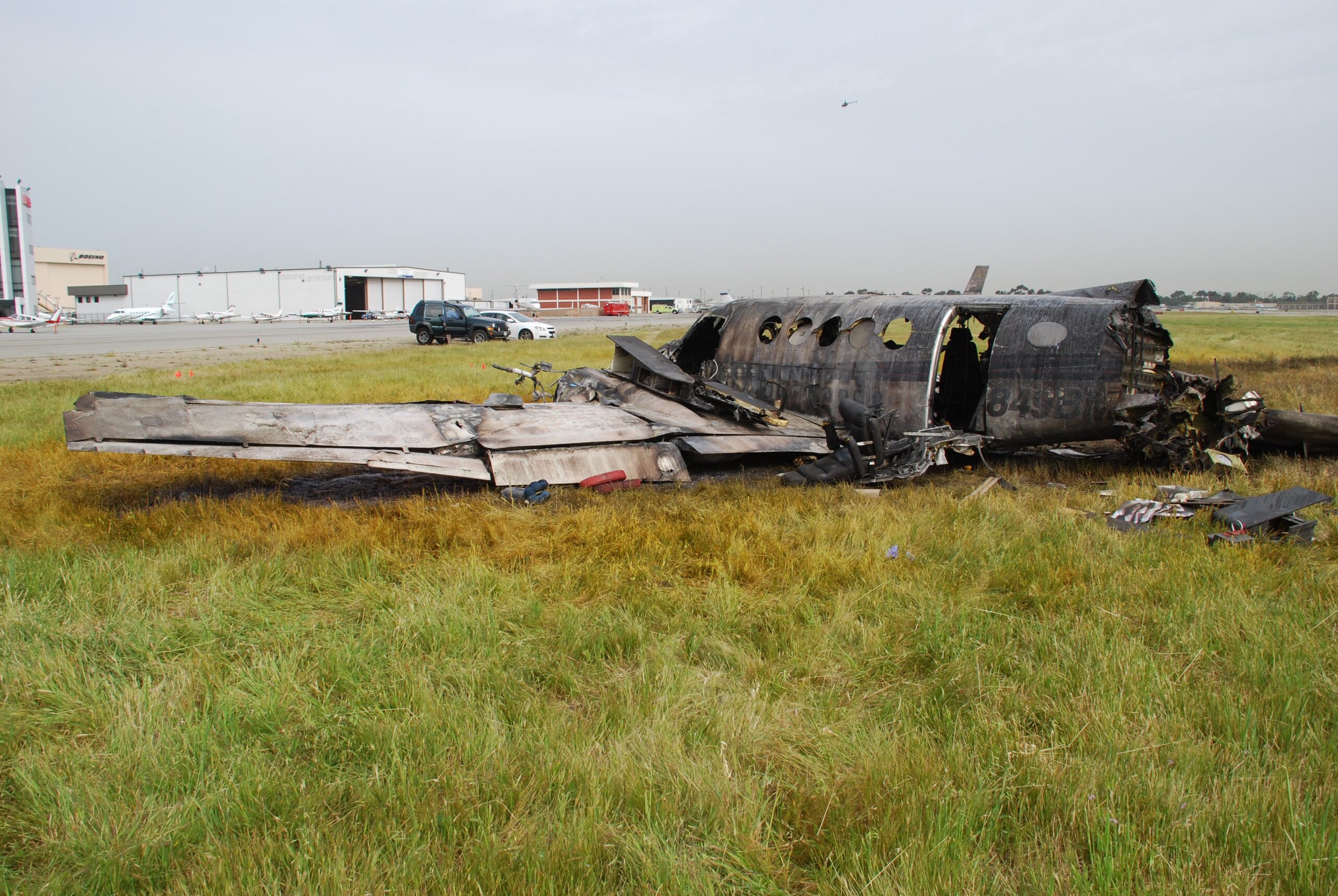
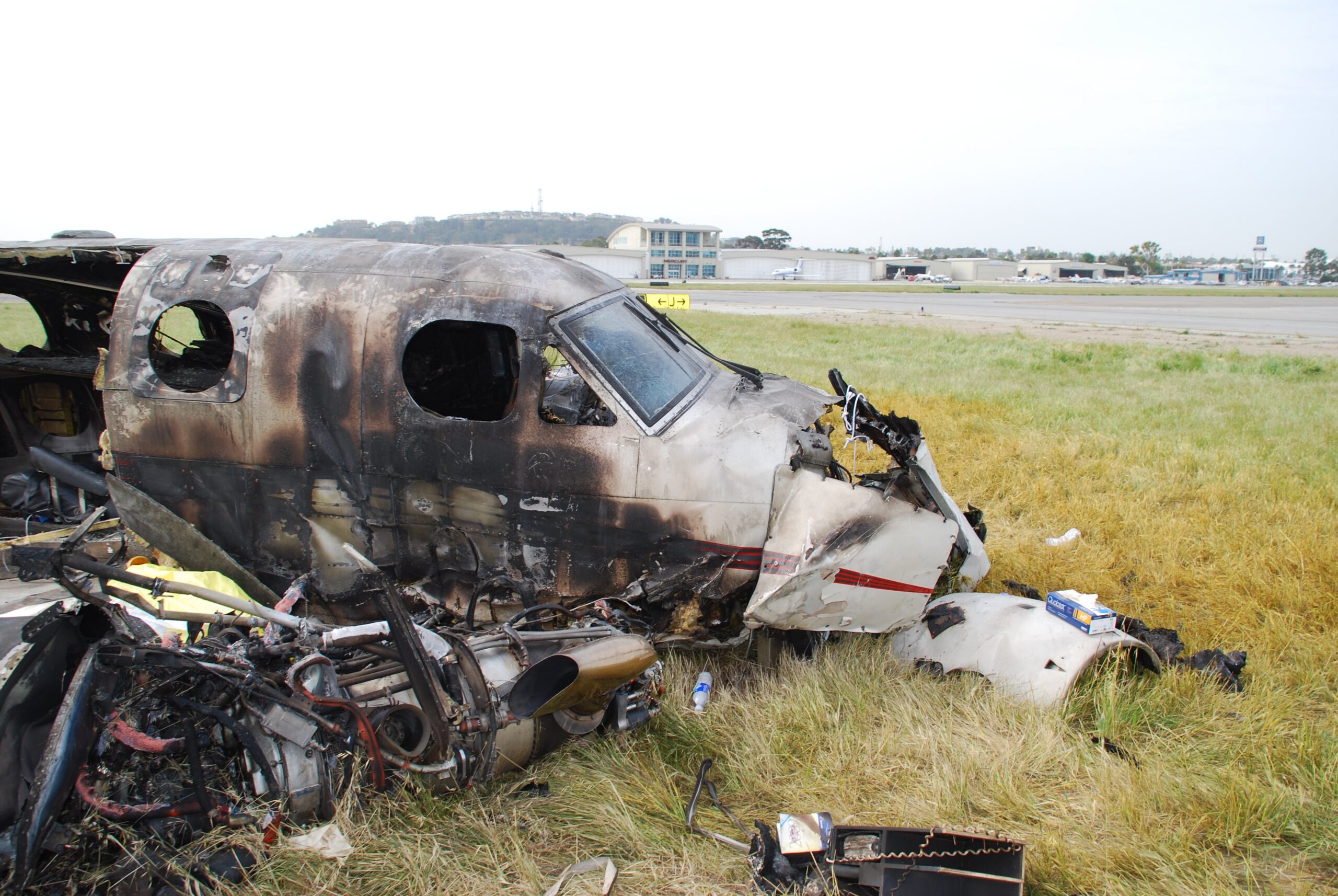
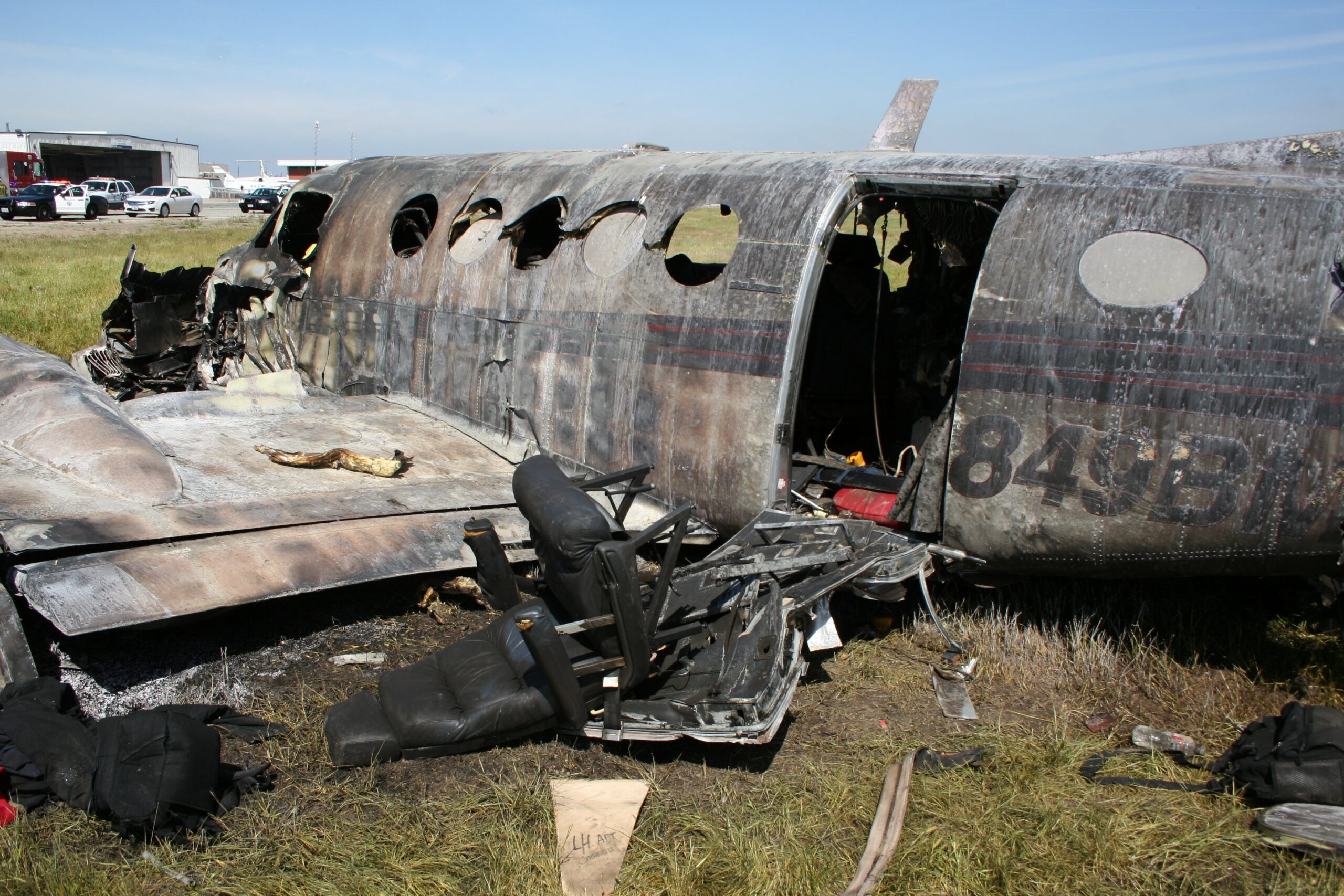
The yaw progressed into a left skid. The wings wobbled. The fuselage fishtailed. One witness said it looked like the airplane was going sideways. As the bank angle increased toward 45 to 90 degrees, the nose dropped toward nearly vertical. The Director of Maintenance for West Coast Aircraft Maintenance was in his office about 2,000 feet from the departure runway. He heard a loud pop and then immediately another loud pop. He knew the sound was wrong, rushed to the doorway, and arrived in time to see the airplane just before it hit the ground. Just before impact, several witnesses said the bank and pitch began to flatten slightly, and one reported hearing an engine power up and the nose jerk upward. It wasn’t enough. N849BM impacted the ground about 1,500 feet from the midpoint of runway 30. Fire erupted immediately. Airport fire and rescue arrived in three to five minutes.
Investigation Findings
Post-accident examination of the airframe, both engines, and both propeller assemblies found no pre-impact mechanical anomalies. The damage to the two engines was nearly symmetrical, a finding the engine manufacturer’s representative said was consistent with both engines operating at similar, low-to-middle power settings at the time of impact. The propeller damage told the same story. Both assemblies showed similar bending, twisting, and leading-edge damage, and the tip damage across all blades was relatively mild, which the propeller manufacturer’s representative said could indicate low power at impact, or could reflect the steep nose-down attitude at the moment of ground contact. Either way, there was no evidence that either engine had failed in any permanent or structural sense.
The fuel system told a more complicated story. The King Air 200’s fuel system is split into two completely separate systems, one per wing, each feeding its respective engine through an inverted L-shaped nacelle tank with a 57-gallon capacity. Both nacelle tanks were breached in the impact sequence and contained no recoverable fuel. The left auxiliary tank appeared intact but was empty. The right auxiliary tank and one intact right wing cell held about 30 gallons of fluid that visually showed no contamination. Five fuel samples from the truck that had fueled the airplane two days earlier were sent to the U.S. Air Force Fuels Engineering Research Laboratory at Wright-Patterson Air Force Base. All five came back clean. The contamination, if present, was already inside the airplane.
The investigation then focused on how water could have gotten into the nacelle tank, and specifically what happens during a takeoff rotation if water is sitting at the bottom of that tank. The Director of Maintenance for West Coast Aircraft Maintenance explained the geometry clearly: the nacelle tank feeds the engine from a port at its base. When the airplane pitches up during rotation, water pooled at the bottom of the tank shifts aft, directly over the fuel intake port. That slug of water flows through the fuel lines and into the engine’s 14 fuel nozzles, where it extinguishes the burner. The engine stops producing power, its torque drops from 2,230 foot-pounds toward about 220 foot-pounds, and the automatic feathering system begins driving the propeller blades toward the feathered position. Then uncontaminated fuel follows the water slug, the engine’s residual heat reignites it, and the engine comes back. Each relight attempt produces a pop and a puff of grayish-white smoke. The two pops the Director of Maintenance heard from 2,000 feet away were consistent with exactly that sequence. Additionally, the investigation found that the pilot’s previous employer, West Coast Charters, where he had accumulated most of his King Air 200 time, did not require its pilots to drain the fuel sumps before flights. Maintenance personnel drained them at some unspecified interval instead. An FAA inspector discovered this about a year after the accident during a Part 135 checkride when the line pilot he was evaluating skipped the sump drains entirely and explained that pilots didn’t do that, mechanics did.
The airplane was also approximately 653 pounds over its maximum gross takeoff weight of 12,500 pounds at the time of the accident. Six adult males totaling 1,115 pounds and 230 pounds of baggage, combined with a full fuel load of 3,645 pounds, pushed the calculated takeoff weight to roughly 13,153 pounds. The investigation determined that the excess weight, while significant, would not by itself have prevented the pilot from maintaining directional control had he responded correctly. The more relevant number was the airspeed when the left engine lost power: approximately 130 knots groundspeed, more than 40 knots above the King Air 200’s published Vmc of 86 knots. Vmc is the minimum airspeed at which the rudder can overcome the asymmetrical yaw from a failed engine with the operating engine at full power. At 130 knots, the rudder had more than enough authority. The airplane was controllable. But control requires a response, and the response requires training and recognition.
NTSB Probable Cause
The pilot’s failure to maintain directional control of the airplane during a momentary interruption of power from the left engine during the initial takeoff climb. Contributing to the accident was the power interruption due to water contamination of the fuel, which was likely not drained from the fuel tanks by the pilot during preflight inspection as required in the POH.
Safety Lessons
Five people died because of a momentary engine hiccup that lasted a matter of seconds at an airspeed well above the airplane’s minimum control speed. The airplane was recoverable. Several factors compounded in a way that removed the margin that should have been there.
- Drain the sumps yourself, every time, and wait the full interval. The King Air 200 POH requires all 12 fuel sump drains to be checked before every flight. The reason they have to be checked by the pilot, not delegated to a mechanic at some unspecified interval, is that the pilot is the last person with the opportunity to catch water before it reaches the nacelle tank. The recommended practice is to wait at least 20 to 30 minutes after fueling before draining, so any water has time to settle to the bottom of the tanks. Draining while the fuel truck is still connected accomplishes almost nothing. If the culture at your previous operator was to skip this step, that culture was wrong, and it transferred with you.
- Know your airplane’s Vmc and what it actually means in your hands. The King Air 200’s Vmc is 86 knots. The left engine lost power at approximately 130 knots. That is a 44-knot margin, which means the rudder had significant authority. The airplane was not uncontrollable; it was not being controlled. Single-engine response in a twin-engine turboprop, especially at low altitude during the initial climb, is a perishable skill. The NTSB noted that no documentation was found indicating the pilot had ever trained in a full-motion King Air simulator. Simulator training is not required, but there is a meaningful difference between knowing the procedure intellectually and having executed it under load, at night, or in a full-motion environment that actually taxes your reflexes and scan.
- Weight and balance errors compound every other problem. The airplane was 653 pounds over max gross takeoff weight. That excess weight did not cause this accident, but it eroded the performance margins that might have bought more time. An overloaded aircraft climbs more slowly, accelerates more slowly, and has less energy to spend on recoveries. Every pound over gross is a pound of margin you do not have when something else goes wrong. And something always eventually goes wrong.
Frequently Asked Questions
Q: What caused the King Air 200 to crash at Long Beach in 2011?
A: Water contamination in the left nacelle fuel tank caused a momentary power interruption during the initial takeoff climb. When the airplane rotated, water pooled at the bottom of the tank was drawn into the left engine, extinguishing the burner briefly. The engine recovered on its own within seconds, but the pilot did not maintain directional control during the interruption, and the airplane entered a left yaw, left bank, and then a near-vertical nose-down attitude before striking the ground approximately 1,500 feet from the midpoint of runway 30.
Q: How does water get into a King Air’s fuel tanks if the fuel truck tests clean?
A: The most common source is condensation, not contamination at the source. When a fuel tank is not completely full, there is an air cavity above the fuel. Because the tanks are vented, air moves in and out as temperatures rise and fall through the day and as the airplane climbs and descends. That air carries moisture, which condenses on the inside surfaces of the tank and settles to the bottom. The FAA’s Advisory Circular 20-43C describes this as a continuous accumulation process. Regularly draining the sumps is the primary defense, which is exactly why the King Air 200 POH requires all 12 sumps to be drained before every flight.
Q: Why couldn’t the pilot recover if the airplane was 44 knots above Vmc?
A: The rudder had authority, which means the airplane was physically controllable. But control requires recognition, decision, and physical input in a very compressed time window at low altitude. The NTSB found no evidence the pilot had trained in a full-motion King Air simulator, where engine-out scenarios at low altitude are practiced under load. The surprise of an asymmetric power event at 140 feet AGL, combined with the propeller noise and rapid yaw, likely exceeded the pilot’s practiced response envelope. The airplane transitioned from yaw to left bank to near-vertical in approximately nine seconds.
Q: How much over gross weight was the King Air at takeoff, and did it matter?
A: The airplane was estimated to be approximately 653 pounds over its 12,500-pound maximum gross takeoff weight, carrying six adult males totaling 1,115 pounds and 230 pounds of baggage on a full fuel load. The NTSB determined that the excess weight was not the cause of the loss of control and would not by itself have prevented directional control from being maintained. However, it did reduce climb performance and overall margins, which means there was less room for any other problem to develop.
Q: What is the automatic feathering system on the King Air 200, and how did it affect this accident?
A: The King Air 200’s automatic feathering system is designed for use during takeoff and landing. If an engine’s torque drops from its maximum of 2,230 foot-pounds down to approximately 220 foot-pounds, the system automatically begins driving the propeller blades toward the feathered position. During the accident sequence, when the left engine lost power due to the water slug, its torque dropped rapidly, which triggered the automatic feathering system and began changing the propeller blade angle. This is what witnesses heard as the unusual propeller noise and what one witness described as the propeller going to flat pitch or beta. The blade angle change increased drag asymmetrically and contributed to the left yaw.