What Happened
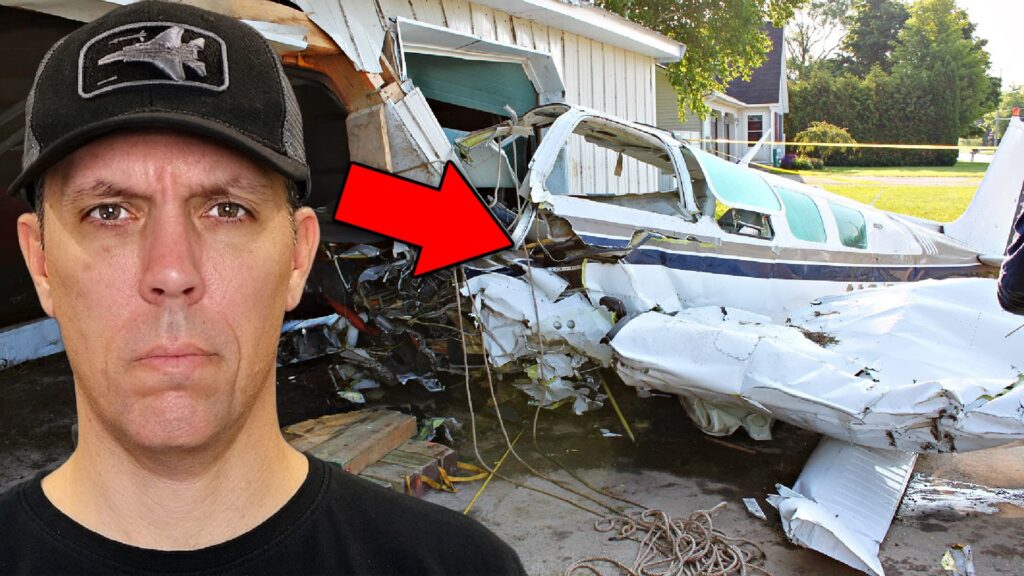
On June 24, 2011, at approximately 1935 eastern daylight time, a Beech A36 single-engine airplane, N88MN, departed controlled flight and struck terrain and a residential garage on the north perimeter of Charlevoix Municipal Airport in Charlevoix, Michigan. The private pilot and one passenger were killed. A second passenger sustained serious injuries. One dog perished at the scene. Another dog was found wandering the neighborhood the following day. The airplane, registered to Microjet, LLC, of Fort Wayne, Indiana, was destroyed.
The flight had departed Smith Field Airport in Fort Wayne, Indiana, around 1730, with an IFR flight plan filed to Boyne City Municipal Airport, N98. Boyne City had no instrument approach. So when the pilot arrived in the area and found the weather uncooperative, he had already burned through his primary destination. At 1848, he contacted Minneapolis ARTCC and requested to divert to Boyne Mountain Airport, BFA, in Boyne Falls, Michigan, and fly the RNAV GPS approach to runway 35. He was cleared to ELBOT, the initial approach fix. Somewhere on that approach, things didn’t come together. At 1917, he was back on the radio telling Minneapolis he was executing the missed approach at BFA and requesting the RNAV GPS approach to runway 27 at Charlevoix Municipal, CVX. He was cleared to COKOS, the initial approach fix for that procedure. At 1920, he was cleared for the approach. At 1926, he was given a frequency change to the CVX advisory frequency, which he acknowledged.
Witnesses inside the CVX terminal building overheard the pilot call on the CTAF announcing he was flying the GPS runway 27 approach. They reported the ceiling was 200 feet above ground level and visibility was 1 mile. The RNAV approach to runway 27 at CVX had a minimum descent altitude of 1,100 feet MSL, which put the MDA at roughly 431 feet AGL given the field elevation of 669 feet MSL. The straight-in weather minimums were a 500-foot ceiling and 1 mile visibility. The airplane broke out of the clouds approximately halfway down runway 27. That’s inside the numbers on a non-precision approach, which means the pilot descended past the MDA before acquiring the runway environment. He added power and began a left turn, then turned back to the right around a water tower located southwest of the airport. The airplane stayed at approximately 200 feet AGL throughout. He then entered a right downwind leg for runway 27.
A witness at a baseball field roughly a quarter mile west of the accident site had already seen the airplane appear from the clouds heading west at about 200 feet AGL during the approach, positioned between the runway and the field. He turned back to the game. A few minutes later, the airplane came back over the baseball field, this time heading east at low altitude and slow airspeed, beginning a right turn toward the airport. The witness saw the nose pitch up. Then the tail dropped. The airplane rolled left, appeared to go out of control, and fell. It came to rest upright, partially inside a three-stall attached garage at a residence just north of the airport perimeter. The initial ground scar, 75 feet from the main wreckage, contained the left wingtip fuel tank fairing and pitot tube. The wreckage was oriented on a magnetic heading of 090 degrees.
Investigation Findings
Post-accident examination of the airframe and engine found no evidence of any pre-impact failure or malfunction. The engine crankshaft rotated by hand with mechanical continuity confirmed throughout, except for the number 6 exhaust valve and rocker arm, which showed damage consistent with the impact sequence. All three magnetos produced sparks on all leads when rotated. The three propeller blades remained attached to the hub, with leading edge damage, chordwise scratching, two missing blade tips, and significant twist and aft bend, all consistent with the engine producing power at impact. Flight control continuity was established from all control surfaces back to the cockpit. The flap actuators on both wings were found in the retracted position. The landing gear was extended. The throttle, mixture, and propeller controls were all full forward.
The pilot held a private certificate with single-engine land and instrument airplane ratings. His FAA third-class medical from May 2010 listed 1,300 total hours. His recovered logbook, the third volume, began in February 2004 with no carry-forward total from previous books. The last entry was June 19, 2011, five days before the accident. He had recorded two prior flights to CVX with the notation “GPS” in the flight log, the most recent on May 29, 2009, more than two years before the accident. His most recent instrument proficiency check was completed June 25, 2010, and he had logged 19 instrument approaches since that check. No paper approach plates were found in the airplane. An Apple iPad recovered from between the left front seat and fuselage sidewall contained a functional ForeFlight installation with an approach plate for the CVX RNAV GPS runway 27 procedure, dated current for the date of the accident.
The weather at CVX told the story in three snapshots. At 1914, the AWOS reported a broken layer at 400 feet and an overcast at 700 feet, with visibility 1.75 miles in mist. At 1935, the time of the accident, the overcast had dropped to 200 feet with visibility 2 miles in rain and winds gusting to 15 knots. By 1954, the overcast remained at 200 feet. The circling minimums for the CVX RNAV runway 27 approach required a 700-foot AGL ceiling and 1 mile visibility. At the time the pilot was maneuvering, the ceiling was 200 feet AGL, well below the circling minimums, and the weather was still deteriorating. No AIRMETs or SIGMETs were active for the area at the time of the accident, which is itself a reminder that the absence of a formal product does not mean the weather is flyable.
NTSB Probable Cause
The pilot’s inadequate airspeed while maneuvering at low altitude, which resulted in an aerodynamic stall. Contributing to the accident was the pilot’s decision to not execute a missed approach in weather conditions below minimums.
Safety Lessons
Three things converged on the evening of June 24, 2011, and none of them had to be fatal on their own. Together, they left no margin.
- The missed approach is not optional. The CVX RNAV GPS runway 27 approach had straight-in minimums of 500 feet and 1 mile visibility. The circling minimums required 700 feet and 1 mile. The ceiling at accident time was 200 feet. The published missed approach procedure was unambiguous: climbing left turn to 3,000 feet direct COKOS and hold. When the runway environment isn’t in sight at MDA with the required visibility, you climb, you follow the published procedure, and you declare your options to ATC. What happened instead was a decision to continue maneuvering in VMC that didn’t exist, at an altitude that left no room for anything to go wrong.
- Slow flight at low altitude kills faster than almost anything else in a piston single. Witnesses described the nose pitching up and the tail dropping during the downwind-to-base turn at approximately 200 feet AGL. That’s the classic picture of an accelerated stall in a turn at slow airspeed, close to the ground, with no altitude to recover. The pilot had been maneuvering around the airport for several minutes, below 200 feet, in deteriorating rain and low visibility. Stall speed in a coordinated turn increases with bank angle. At 30 degrees of bank, stall speed goes up by about 7 percent. At 45 degrees, it’s closer to 19 percent above the wings-level figure. In a slow, low-energy maneuvering situation, a steeper-than-intended bank during the turn to final compresses that margin to nothing.
- Currency is not proficiency, and two years between approaches to a specific airport matters. The pilot was current on instruments, 19 approaches logged since his IPC. But his last recorded flight into CVX was May 2009, more than 26 months before the accident. He had already executed a missed approach at BFA that evening, which means the weather was already pushing back hard. The decision to then attempt a second approach to a different airport with a 200-foot ceiling, without paper plates and with an iPad as the only approach reference, reflected a level of confidence that the conditions and the pilot’s recent experience at CVX did not support. The approach to CVX and the missed approach procedures were not instinctive. They required active management in a cockpit that was already overloaded.
Frequently Asked Questions
Q: What are the circling minimums for the CVX RNAV GPS runway 27 approach, and why did they matter in this accident?
A: The circling minimums for the CVX RNAV GPS runway 27 approach required a 700-foot AGL ceiling and 1 mile visibility. At the time of the accident, the ceiling had dropped to 200 feet AGL with 2 miles visibility in rain. The pilot exited the clouds halfway down the runway, well below the straight-in MDA, and then attempted to maneuver in the traffic pattern at approximately 200 feet AGL. Those conditions were 500 feet below circling minimums. The regulations prohibit initiating or continuing a circling approach below published minimums for a reason: there isn’t enough visual reference or obstacle clearance to safely maneuver the airplane.
Q: Can a pilot legally continue an instrument approach and land when the weather is below minimums?
A: No. Under 14 CFR Part 91.175, a pilot may not descend below the MDA or decision altitude unless the aircraft is continuously in a position to make a normal landing, the flight visibility is not less than that prescribed for the procedure, and the runway environment is clearly visible. If any of those conditions aren’t met at MDA, the regulations require execution of the missed approach. In this case, the ceiling was 200 feet, which was below both the straight-in MDA and the circling minimums. The correct action was the published missed approach: climbing left turn to 3,000 feet direct COKOS and hold.
Q: How does stall speed change in a banked turn, and why does it matter during low-altitude maneuvering?
A: Stall speed increases in a banked turn because the wings must generate additional lift to support the airplane’s weight while also providing the centripetal force needed to turn. At 30 degrees of bank, stall speed increases by approximately 7 percent over the wings-level figure. At 45 degrees, it’s about 19 percent higher. At 60 degrees, stall speed is roughly 41 percent above the normal figure. During the downwind-to-base turn at CVX, the airplane was at approximately 200 feet AGL at slow airspeed. Even a moderately steep bank in that configuration can push the wing past its critical angle of attack before the pilot has time to recognize and respond, and at 200 feet there’s no altitude for recovery.
Q: The pilot had 19 instrument approaches since his IPC. Was he not current for the flight?
A: He was legally instrument current under 14 CFR Part 61.57, which requires 6 instrument approaches within the preceding 6 calendar months. Currency and proficiency are not the same thing. The pilot’s most recent flight to CVX was May 2009, more than two years before the accident. He had already executed one missed approach that evening at a different airport. His approach to CVX placed him in a situation that required managing a non-precision approach to MDA, recognizing conditions below minimums, executing a published missed approach procedure, and then either requesting vectors or diverting. That’s a high cognitive load in deteriorating weather at night, in an airplane with an unfamiliar GPS database configuration. Being current tells you a pilot has logged the approaches. It doesn’t tell you how well-rehearsed the decision-making and procedural flow actually is.
Q: Could a different alternate or fuel stop have prevented this accident?
A: Possibly. The pilot’s original destination, Boyne City Municipal, had no instrument approach. When the weather closed in, his options narrowed immediately to airports with approaches. He diverted to Boyne Mountain, executed a missed approach there, then requested the CVX approach. By the time he was maneuvering at CVX, he had been airborne for over two hours, had already missed one approach, and was dealing with a ceiling that had dropped to 200 feet and was still falling. An alternate filed with a serviceable instrument approach and weather significantly above minimums would have given him somewhere to go. The IFR alternate requirements under Part 91 don’t mandate a filed alternate for domestic flights, but the operational logic behind those requirements is exactly the situation that developed here: the destination goes below minimums and you need somewhere else that doesn’t.