What Happened
On the evening of October 24, 2008, a Piper PA-24-260, N8820P, departed Asheville Regional Airport in North Carolina at approximately 1726, bound for Orange County Airport in Orange, Virginia. The private pilot had filed an IFR flight plan, with Charlottesville-Albemarle Airport listed as the alternate. He had accumulated approximately 1,070 total hours, including 82 hours of actual instrument time and 71 hours in the PA-24 make and model. His most recent instrument proficiency check was about six months prior, in April 2008. A passenger was on board. Neither would survive the night.
The airplane climbed to its cruise altitude of 7,000 feet msl and proceeded northeast toward Orange County. About nine minutes before the accident, the pilot requested the GPS-8 instrument approach to OMH. Six minutes out, ATC cleared the flight to descend to 4,000 feet. The 1853 weather observation at Charlottesville showed a broken ceiling at 1,900 feet and an overcast at 2,600 feet. At OMH, conditions were nearly identical. Two minutes into the descent, the pilot came back on frequency and told ATC that visibility at Orange County was right at minimums. He requested a diversion to Charlottesville for the ILS runway 3 approach. ATC approved, issued a heading of 360 degrees, and cleared him for the approach roughly two minutes later. Sunset had occurred at 1823, so the airplane was descending through the dark, in IMC, in an area where AIRMETs were current for mountain obscuration and occasional moderate turbulence below 12,000 feet.
Radar data told the story of what happened next. For the first several minutes of the descent, the airplane came down at roughly 600 feet per minute at a calibrated airspeed near 178 mph, just inside the green arc. When the pilot turned north toward Charlottesville, the descent rate jumped. Over a 40-second window, the airplane plunged at 2,600 fpm, then climbed at 650 fpm. The airspeed during the diversion turn climbed to between 190 and 196 mph. The airplane’s maximum structural cruise speed, Vno, was 180 mph. The airplane was now above Vno, descending in turbulence, in the dark, in IMC. The last four radar returns, spanning 13.8 seconds, showed a 180-degree right turn with a diameter of roughly half a mile, and a final descent rate that the NTSB calculated at somewhere between 5,200 and 33,200 feet per minute. Three mayday calls were broadcast in rapid succession on the ATC frequency. No further transmissions were received.
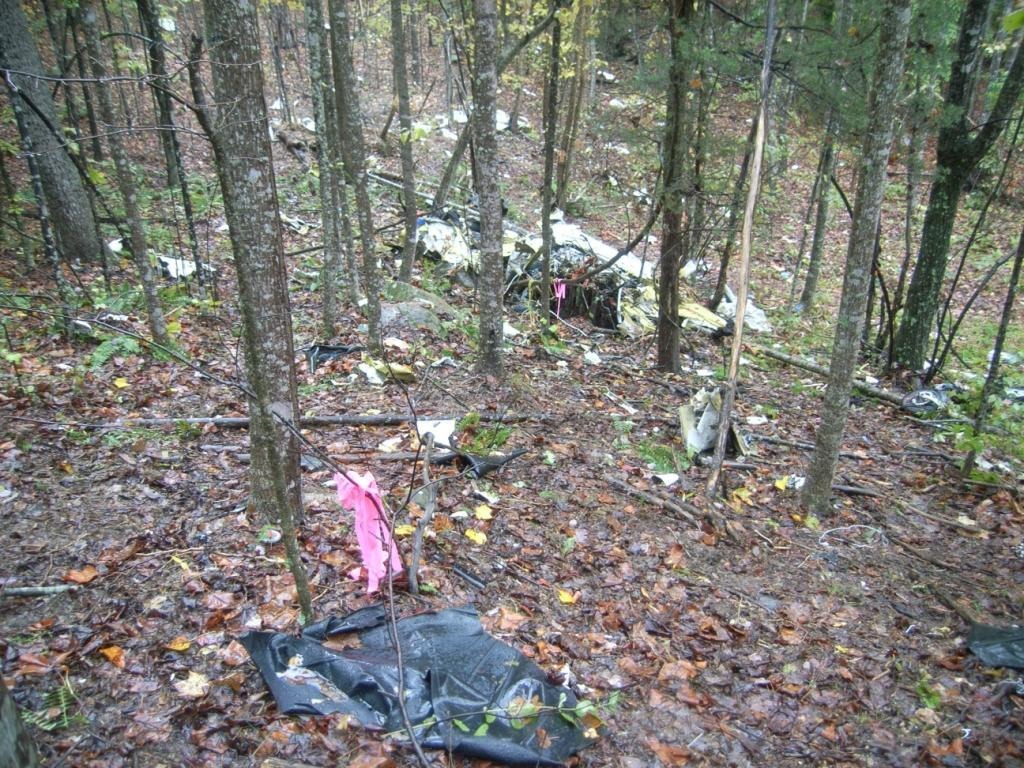
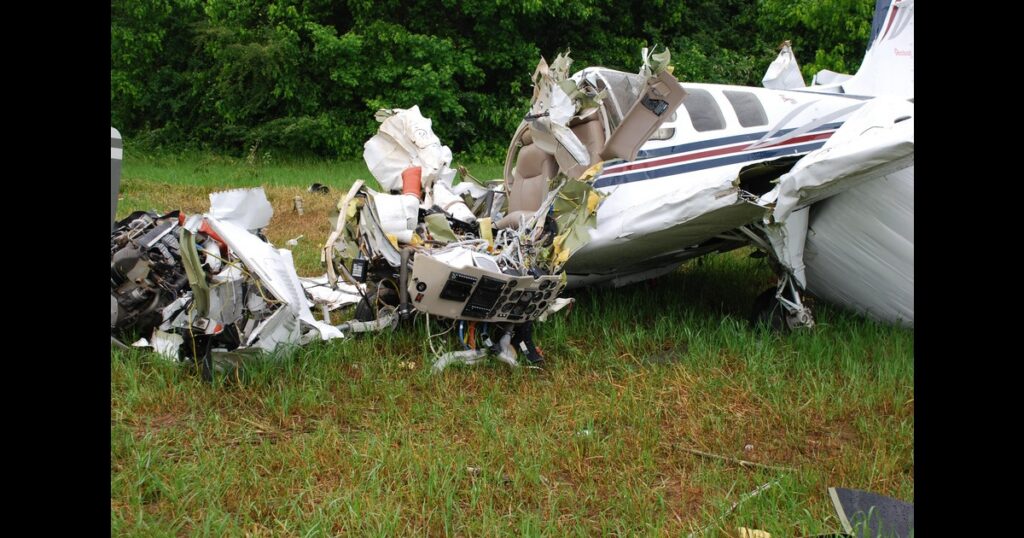
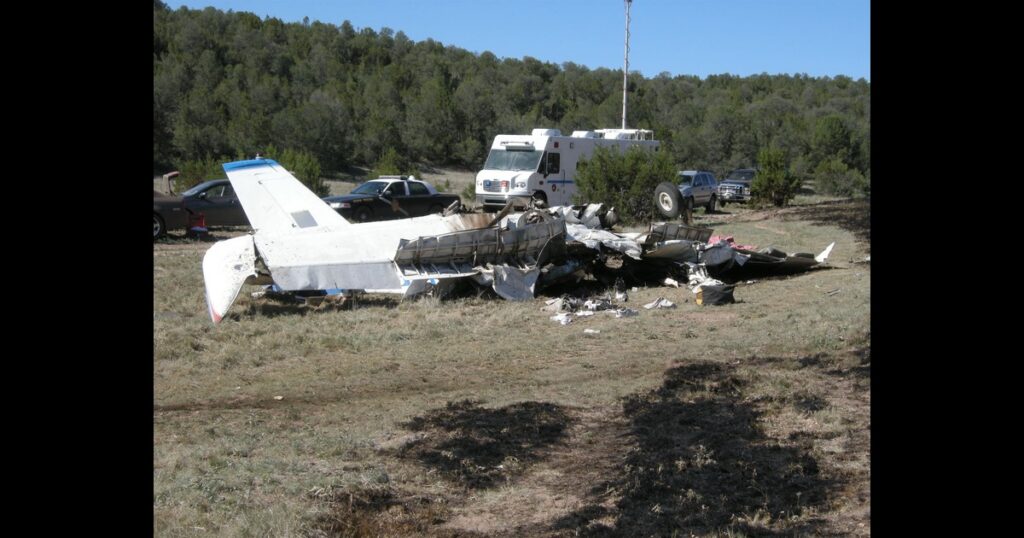
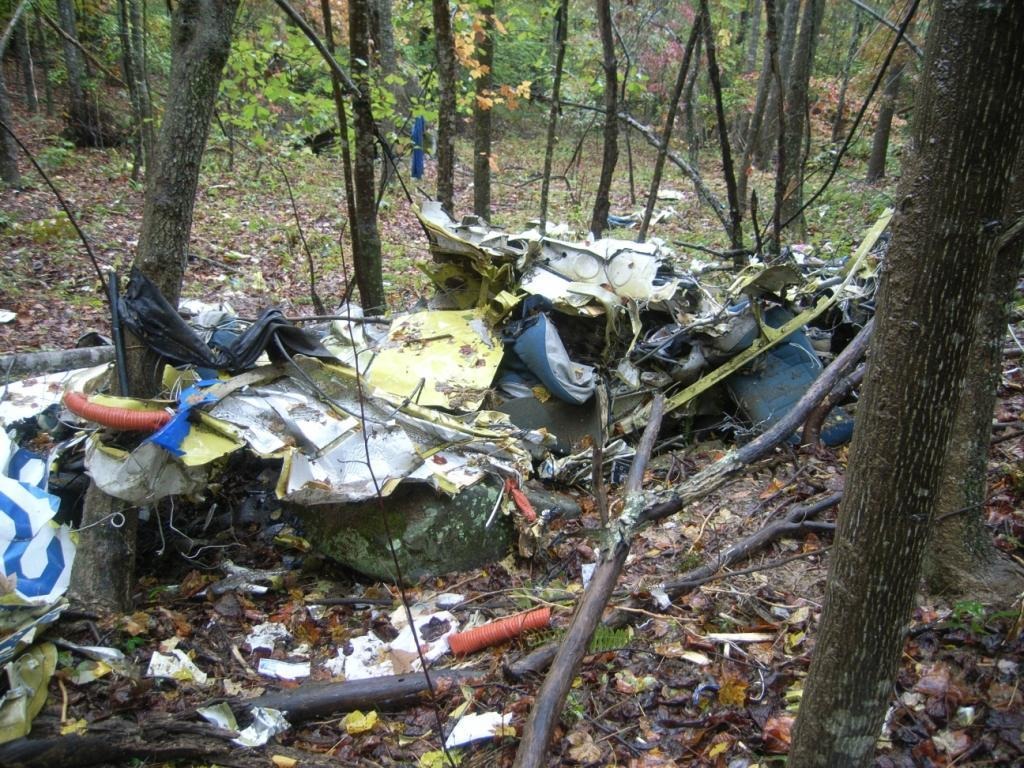
The airplane hit trees at approximately 50 feet above ground level and impacted terrain 12 miles south of Charlottesville-Albemarle Airport. The debris field was 400 feet long and 100 feet wide. The pilot and his passenger were fatally injured. And the very first items in that debris field, before any trees were struck, before any ground contact was made, were pieces of the stabilator.
Investigation Findings
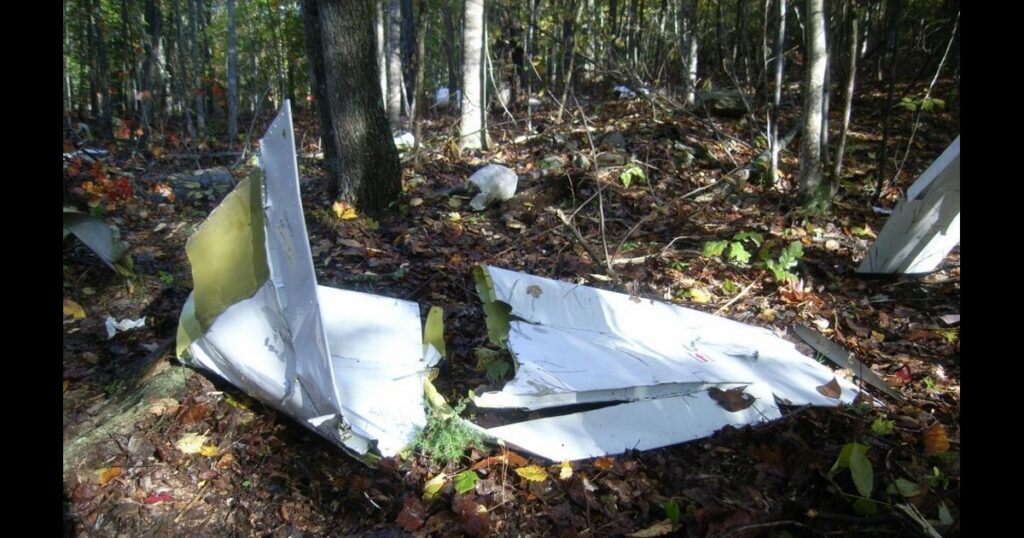
The debris path began with the outboard 3 feet of the right stabilator, followed 15 feet later by a corresponding segment of the left stabilator, and then the inboard 3 feet of the left stabilator another 70 feet beyond that. None of these components showed impact damage. The trees around them were undisturbed. The stabilators had separated from the airplane in flight, before it ever reached the trees. NTSB materials laboratory examination of the fractures confirmed it: the left stabilator spar had fractured just outboard of the butt line 36 rib, with compression buckling on both upper and lower spar surfaces. The left stabilator had folded downward at approximately 45 degrees. The right stabilator had fractured between the BL 36 and 48 ribs, with deformation consistent with upward loading. The stabilators had come apart under aerodynamic loads.
What the investigation found inside those stabilators explained why. On the left stabilator, the nose ribs were attached to the lower nose skin with blind rivets instead of the MS20470 solid rivets specified by Piper’s design drawings. Most of those blind rivets showed no bulbed or expanded sections at all. They had either been minimally drawn or not drawn at all, meaning they were providing essentially no structural function. The nose skin showed bare aluminum where paint was missing, with no evidence of primer or chromate conversion coating as required by Piper’s finish specification. Fracture patterns on the leading edge included what the materials lab described as “star” or “X” fractures, the kind associated with repetitive cyclic bending. The right stabilator, by contrast, had the correct solid rivets in the right locations, but significant material had been ground away from the heads of several rivets on at least one nose rib and on the main spar upper cap. The two replacement stabilators had been installed during the October 2006 annual inspection, sourced through Webco Aircraft Company of Newton, Kansas. In March 2008, the FAA had issued an Unapproved Parts Notification against Webco Aircraft, finding that the company had maintained and altered aircraft components contrary to the regulations. The UPN did not specifically cite stabilators, but the picture it painted of Webco’s practices was consistent with what the lab found inside N8820P’s flight controls.
There were additional compounding factors. Piper Service Letter 687, issued in June 1974, specified a modification to the stabilator balance weight assembly and the installation of stabilator tip weights. That service letter, when performed in conjunction with the earlier Rudder Balance Weight Kit, would have restored the airplane’s original Vne of 227 mph CAS. Without it, the airplane’s Vne was restricted to 203 mph and its Vno to 180 mph. Maintenance records confirmed that Service Letter 687 had never been accomplished on N8820P. The balance weight assembly pulled from the wreckage weighed 79.75 ounces. The service letter called for it to weigh between 56 and 63 ounces, with four half-inch holes drilled through the center balance weight. No holes were present. The stabilator tip weights were also absent. The airplane had been flying with a stabilator configuration that made it more susceptible to flutter at higher airspeeds, with a Vno of 180 mph, into an area of moderate to severe turbulence, at calibrated airspeeds between 190 and 196 mph, at night, in IMC. And underneath the paint on the left stabilator’s leading edge, the nose ribs were held in place by rivets that weren’t doing their job.
NTSB Probable Cause
The pilot’s failure to maintain aircraft control due to an improper repair to the stabilator, which resulted in an in-flight failure of the stabilator. Contributing to the accident was the descent in turbulence, at airspeeds above the maximum structural cruise speed.
Safety Lessons
Three threads run through this accident, and each one could have broken the chain on its own. Together they left no margin at all.
- Vno is not a suggestion in turbulence. The green arc on the airspeed indicator ends at Vno. For N8820P, that was 180 mph CAS. The airplane was descending at 190 to 196 mph when the stabilators failed. The FAA is explicit: do not exceed Vno except in smooth air. An AIRMET for occasional moderate turbulence was current for the entire route of flight that evening. Descending at 10 to 16 mph above Vno in those conditions meant the airplane was operating in a regime where structural damage from a single gust was not just possible but foreseeable. Know your Vno, brief it before every IFR flight in turbulence-prone areas, and treat the top of the green arc as a hard ceiling the moment the air gets bumpy.
- Service bulletins and service letters on structural modifications deserve the same scrutiny as ADs. Piper reduced the PA-24-260’s Vne in 1972 specifically because improper maintenance on the stabilator could compromise flutter margins. The company issued a service letter two years later that described the path back to the original speed limits. Neither the installing shop in 1972 nor any subsequent owner completed that service letter over the following 36 years. Before acquiring a used aircraft, have an A&P dig through the service bulletin and service letter compliance history for the entire empennage. If a manufacturer explicitly tied a speed restriction to a specific modification, verify that the modification is present, documented, and correctly installed.
- Parts provenance matters as much as parts presence. The stabilators installed on N8820P in 2006 came from a supplier that the FAA would flag eight months before the accident for maintaining and altering components contrary to regulations. The blind rivets on the left stabilator nose skin, installed where solid rivets were specified, were either barely set or not set at all. That deviation was invisible from the outside. When replacement structural components, especially primary flight controls, are installed during a used aircraft transaction or annual inspection, ask where they came from, verify part numbers against the type certificate data sheet, and confirm that the work order documents the source. If records are incomplete, treat the component as unairworthy until proven otherwise.
Frequently Asked Questions
Q: What is the Vno on a Piper PA-24-260, and why does it matter in turbulence?
A: The PA-24-260 Vno, or maximum structural cruise speed, was 180 mph calibrated airspeed for aircraft without the Service Letter 687 stabilator modification. Vno marks the top of the green arc on the airspeed indicator. Above that speed, a single gust can produce loads that exceed the airplane’s limit load factor and cause permanent structural deformation. FAA guidance is explicit that pilots should not exceed Vno except in smooth air. N8820P was descending at 190 to 196 mph in an area of moderate to severe turbulence when its stabilators failed.
Q: What caused the Piper PA-24 stabilator to fail in flight?
A: The NTSB found that the left stabilator had been improperly repaired or refurbished using blind rivets in place of the MS20470 solid rivets specified by Piper’s design drawings. Most of those blind rivets showed no evidence of being properly set. The nose skin also lacked required primer and chromate conversion coating, and the fracture surfaces showed patterns consistent with repetitive cyclic bending over time. Under aerodynamic loads produced by the turbulence encounter at above-Vno airspeeds, the left stabilator’s nose section deformed and the spars fractured. The right stabilator failed as well. Both separated from the airplane before it reached the trees.
Q: What is Piper Service Letter 687 and why was it important on the PA-24-260?
A: Piper Service Letter 687, issued in June 1974, described the installation of stabilator tip weights and stabilator hinge reinforcements, along with a modification to the balance weight assembly. When accomplished together with the earlier Rudder Balance Weight Kit (SB 362A), this modification restored the PA-24-260’s original Vne of 227 mph CAS. Without it, the Vne remained restricted to 203 mph and the Vno to 180 mph. The accident airplane had never complied with Service Letter 687. Its balance weight assembly was 79.75 ounces, nearly 17 ounces heavier than the modified specification, and the stabilator tip weights were absent. This configuration made the airplane more vulnerable to flutter-related failures at higher airspeeds.
Q: How did ATC radar data help reconstruct what happened to N8820P?
A: Ground-based radar returns, spaced 4.6 seconds apart, captured the final 13.8 seconds of flight. The corrected barometric altitudes for the last four returns were 3,700, 3,300, 2,600, and 0 feet msl. Instantaneous descent rates derived from those values ranged from approximately 5,200 to 33,200 feet per minute. The radar also showed a roughly 180-degree right turn with a diameter of about half a mile during those final seconds. Combined with atmospheric wind data, the radar track allowed investigators to calculate the airplane’s calibrated airspeeds throughout the descent, which showed it was operating above Vno during the diversion turn toward Charlottesville.
Q: What should pilots look for when buying a used Piper Comanche with replaced stabilators?
A: Verify that replacement stabilators carry the correct part numbers for the specific PA-24 variant. Confirm compliance with AD 72-22-05 and Piper SBs 362 and 362A regarding Vno and Vne placarding and the rudder balance weight kit. Check whether Piper Service Letter 687 was accomplished, including the stabilator tip weights and the modified balance weight assembly, since compliance determines which Vne applies to the airplane. Request complete documentation of the parts source for any replaced stabilators, and if records are incomplete or the source is unknown, have a qualified A&P inspect the internal construction of the stabilators, including rivet type and installation quality, before the next flight.
Sources and References