What Happened
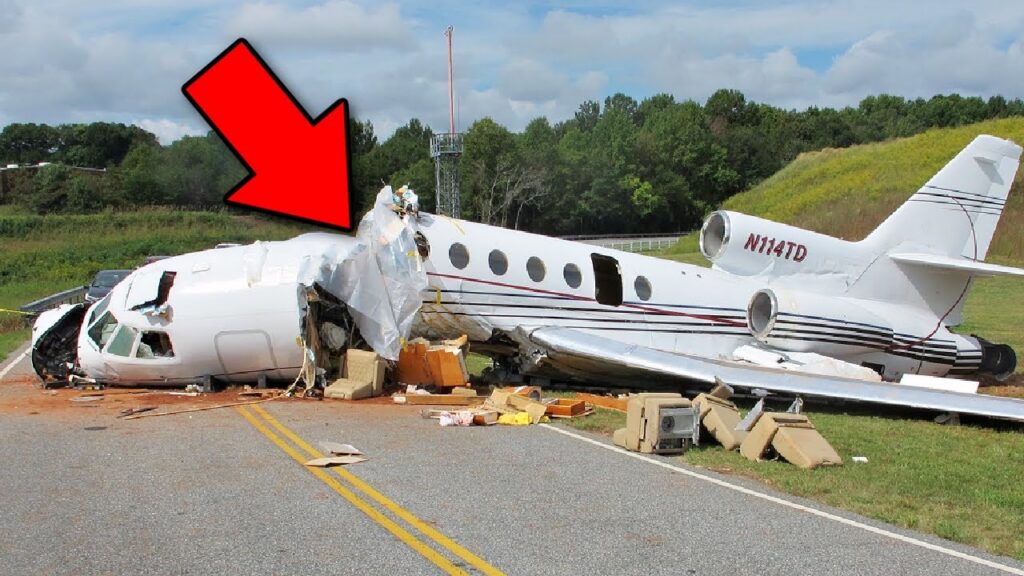
On September 27, 2018, a Dassault Falcon 50, N114TD, overran the runway at Greenville Downtown Airport in South Carolina. Both pilots were killed, and the two passengers were seriously injured. The airplane was substantially damaged after crossing the runway end and descending an embankment.
The on-demand charter flight had departed St. Pete-Clearwater International Airport in Florida at 12:30 p.m. eastern daylight time. During the approach to Greenville, the crew struggled to understand navigation fixes provided by air traffic control. The cockpit recording did not capture a prelanding checklist or a discussion of a known brake-system problem.
The Falcon touched down at about 1:45:34 p.m. Controllers described a normal landing at a standard touchdown point. Airport video supported that account and showed deployment of the thrust reverser and airbrakes. The accident sequence did not begin with an observed late touchdown or an airplane arriving off the runway.
Four seconds after touchdown, the pilot said the brakes were not operating. Both pilots repeated comments about the lack of braking as the airplane continued along the runway. The thrust reverser was deployed, but the airplane did not decelerate enough to stop.
It left the runway near the departure end, crossed grass, and went down a roughly 50-foot embankment. The wreckage came to rest on the airport perimeter road about 425 feet from the runway. The fuselage separated behind the cockpit. There was no fire.
The normal brake problem had been encountered before. A pilot who flew four earlier flights said the brakes worked at low speeds, around 15 to 20 knots, but did not work at higher speeds with the normal system selected. Moving the brake selector to the emergency system restored braking. The accident pilot had been second-in-command on all four of those flights.
Investigation Findings
The Falcon had two independent hydraulic systems that could supply braking. System 1 powered normal braking with antiskid protection. System 2 powered emergency and parking braking. The cockpit brake switch selected the normal system in the “#1-ON” position and emergency braking without antiskid in the “2-OFF” position.
After the accident, investigators found the selector in the normal-braking position and the parking-brake handle stowed. A nearby placard, dated the day of the accident, marked an antiskid-related item inoperative. The NTSB found it likely that the crew had tried to land using the known malfunctioning normal system and had not configured the available alternative to stop.
The antiskid system had physical discrepancies. A left inboard wheel-speed transducer had a broken solder joint, and wiring to the right outboard transducer was reversed. Functional testing confirmed failure of the left inboard transducer. The Board concluded that the discrepancies likely caused the normal brake system’s failure during landing.
The airplane’s broader maintenance status was also unresolved. It had spent about four years in storage. A work order to return it to service included multiple inspections and 103 discrepancies. At the time of the accident, that work was only about 60 percent complete, and the maintenance logs did not contain an entry returning the airplane to an airworthy condition.
The landing gear overhaul was also overdue under the interval described in the report. The last overhaul had been performed in July 2002. Based on the calendar interval and grace period, another overhaul should have been completed no later than December 2014. The return-to-service work order did not include it.
The previous pilot had reported the braking defect to the director of maintenance. The airplane nevertheless made the accident flight after four earlier flights with only part of the required maintenance complete. The NTSB identified the operator’s decision to allow that flight as causal, alongside the crew’s failure to use the emergency or parking brake systems as described in the flight manual.
The report also documented substantial crew-qualification concerns. The pilot held an airline transport certificate, but his Falcon 50 type rating was limited to second-in-command privileges. The other pilot held a private certificate with single- and multiengine land ratings, but no instrument rating or type ratings. These facts should be stated specifically rather than compressed into a claim that neither person held any pilot certificate.
A successful low-speed brake check would not have demonstrated that the reported high-speed problem had been corrected. The earlier pilot’s account specifically distinguished the two conditions. The defect therefore mattered during the exact phase in which the airplane would need dependable deceleration after landing.
NTSB Probable Cause
The operator’s decision to allow a flight in an airplane with known, unresolved maintenance discrepancies, and the flight crew’s failure to properly configure the airplane in a way that would have allowed the emergency or parking brake systems to stop the airplane during landing.
Safety Lessons
The first lesson is to resolve airworthiness and return-to-service questions before dispatch. An inoperative placard describes a condition; it does not by itself establish that the aircraft is legal or safe for a particular flight. The applicable maintenance and operating requirements must actually be satisfied.
The second is to make a known system limitation part of the approach preparation. In this case, the flight manual described how to select the available braking system. A crew should understand the exact system configuration, its limitations, and the approved response before touchdown, when runway remaining begins decreasing rapidly.
The third is to distinguish familiarity from qualification. Having flown in an airplane before does not establish the authority or competence required for the assigned seat. Operators need to verify aircraft-specific qualifications and give crews a serviceable aircraft, a shared understanding of its condition, and usable procedures.
Watch the Full Analysis
Frequently Asked Questions
Q: Why did the Falcon 50 overrun at Greenville?
A: The NTSB identified the operator’s decision to fly with unresolved maintenance discrepancies and the crew’s failure to configure the emergency or parking brakes to stop the airplane.
Q: Was the Falcon 50 brake failure known before the accident?
A: Yes. A pilot reported loss of normal braking at higher speeds on four previous flights. Emergency-system selection had restored braking on those flights.
Q: Did the Falcon 50 touch down late?
A: Controllers described a normal landing at a standard touchdown point, and surveillance video supported the normal touchdown. The investigation focused on braking and the airplane’s maintenance condition.
Sources and References