What Happened
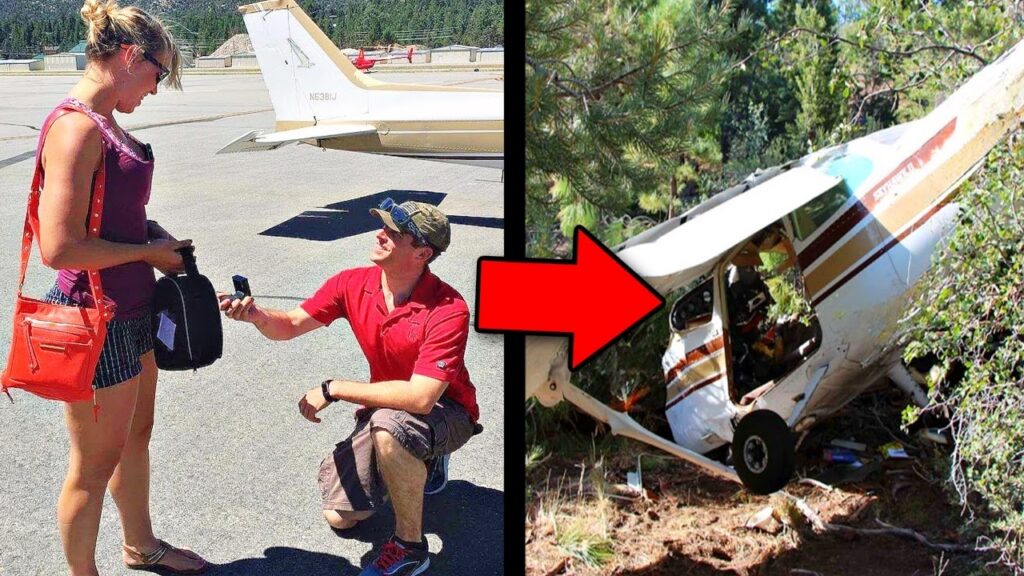
On July 29, 2017, Cessna 172N N5381J departed Big Bear City Airport, California, for Apple Valley. The pilot and his passenger had arrived the previous day, when he proposed to her on the airport ramp. Their return departure ended in a stall and impact with terrain, killing both occupants.
Big Bear’s airport elevation was 6,752 feet mean sea level. The density altitude around the accident exceeded 9,100 feet. The airplane therefore faced takeoff and climb conditions associated with air much less dense than the field elevation alone suggested.
Airport surveillance video showed a normal departure from runway 08 followed by a climb that became progressively slower. A witness near the departure end first saw the airplane at about 100 feet above the ground. It stopped gaining height while maintaining a nose-high attitude.
The witness described the airplane as hanging on the propeller. That phrase was an observation, not a measured aerodynamic condition, but it captured the high nose attitude without corresponding climb. He reported smooth, continuous engine sound.
Near a park beyond the runway, the airplane briefly turned onto crosswind and then about 90 degrees onto a tight downwind leg. The turns appeared coordinated to the witness, yet the nose stayed high. Coordination alone did not protect the wing from reaching its critical angle of attack.
The airplane began sinking. Its wings rocked back and forth before it disappeared behind trees. Another witness also described continuous engine sound before the airplane descended out of view.
The wreckage showed a nose-down impact and partial forward bending of the tail. Investigators considered the flightpath and damage consistent with an aerodynamic stall. The airplane was substantially damaged.
Investigation Findings
The NTSB compared the recorded climb with the airplane’s expected performance. The charts indicated a climb rate around 440 feet per minute in the relevant conditions, while the video indicated about 340 feet per minute. The airplane had some climb capability, but less than expected.
The Board concluded that the pilot likely responded to the reduced climb by increasing pitch in an effort to gain height. That response carried the airplane beyond its critical angle of attack and into a stall. Raising the nose did not create the engine power or airspeed needed to achieve the desired climb.
The environmental penalty was established, but the engine-mixture question remained uncertain. The mixture control was found full rich after the crash. Investigators could not determine its position before or during takeoff.
The report explained that taking off at that density altitude without appropriate leaning, or enriching the mixture while troubleshooting poor performance, would have reduced available power further. It did not establish that either action definitely occurred. A postimpact control position was not a reliable record of every setting during the flight.
The pilot’s primary experience was in turbine-powered helicopters, including military flying that was not included in his personal civilian logbook. That logbook showed 225 total hours and about 13 hours in the Cessna 172 across three flights. The record should therefore not be used to claim that 225 hours represented all of his aviation experience.
He had received a Cessna checkout that included high-density-altitude operations and mixture procedures. The instructor specifically reviewed mixture handling because the pilot had more experience with turbine engines than reciprocating engines. He had previously flown to Big Bear once in a Cessna 172.
Postaccident examination did not reveal a preimpact mechanical anomaly. Other customers who fueled at the airport that day did not report fuel contamination or engine problems. Those findings supported an explanation centered on performance management and the stall rather than a demonstrated engine failure.
The NTSB’s probable cause was the exceedance of critical angle of attack during takeoff in high density altitude. It did not identify the proposal itself as a cause or establish that excitement about the engagement dictated a cockpit decision. That detail explained the trip’s context; the aerodynamic sequence explained the crash.
The meaningful distinction was between a slow climb and a stalled airplane. A slow but controlled climb left some ability to assess the flightpath. Increasing pitch until the wing stalled eliminated that control margin close to the ground.
NTSB Probable Cause
The pilot’s exceedance of the airplane’s critical angle of attack during takeoff in high density altitude conditions, which resulted in an aerodynamic stall, loss of control, and subsequent impact with terrain.
Safety Lessons
The following takeaways apply the investigation to flight planning and training. They do not replace the aircraft flight manual or instruction in the airplane.
- Use density altitude before choosing the departure. Calculate takeoff and climb performance for the actual conditions, load, and engine configuration. Set a realistic expectation for the climb rather than comparing it only with lower-altitude experience.
- Protect airspeed when climb performance disappoints. Use the aircraft flight manual’s climb and engine procedures. An attempt to force more climb through pitch alone can trade away the margin needed to keep the wing flying.
- Translate experience across aircraft deliberately. A pilot moving from turbine helicopters to a piston airplane should practice its mixture management, performance limits, and stall recognition with an instructor. A checkout should establish usable habits for the intended environment.
Watch the Full Analysis
Frequently Asked Questions
Q: What caused the Big Bear Cessna crash?
A: The NTSB found that the pilot exceeded the wing’s critical angle of attack during takeoff at high density altitude, causing a stall and loss of control.
Q: Was the mixture definitely left full rich during takeoff?
A: That could not be determined. The control was full rich after the crash, but the NTSB did not establish its position before or during departure.
Q: How high was the density altitude?
A: The investigation calculated a density altitude above 9,100 feet, compared with the airport’s elevation of 6,752 feet mean sea level.
Sources and References