
The failure that was set in motion before anyone strapped in. Sometimes the airplane breaks, and no decision in the cockpit can fix it.
Most mechanical failures are survivable. An engine that quits at altitude, a system that fails with a checklist written for it, a gear that hangs up over a long runway: each of these hands the pilot something almost as valuable as the failure is dangerous, which is time. The deadly ones take the time away. They happen in the first hundred feet of climb, or they start a fire, or they break something in the flight control path. You can’t troubleshoot a problem that is already behind you.
From NTSB final reports, 2008–present*
- 2,609 mechanical-systems-failure accidents
- 13.0% involved at least one fatality
- 480 people killed
- 7.2% of aircraft destroyed on impact
These are the accidents where the part broke on its own (a hose, a clamp, a control cable, a magneto, etc)
- 743 maintenance-related accidents
- 15.2% involved at least one fatality
- 171 people killed
- 7.1% of aircraft destroyed on impact
These are the accidents where the part broke because someone in the shop missed something or did it wrong.
That 13 – 15.2% can look almost reassuring next to the other patterns we have covered. However, it’s the wrong number to take comfort in. Most mechanical failures are non-fatal because most of them happen with altitude and time to work the problem. The case I want to show you is the other kind: a failure on takeoff, an in-flight fire, an airplane destroyed before the pilot could do anything but turn back.
Now let me show you what one of these 3,352 tragedies looked like.
One real flight
May 16, 2016. Beech A36TC Bonanza. IFR personal flight, Tupelo, Mississippi to Charlottesville, Virginia.
There were four people on board. The pilot, in the left seat, held an airline transport pilot certificate and a flight instructor certificate, with single-engine, multi-engine, and instrument ratings, and reported 5,675 total flight hours at his last medical. By every measure on paper, he was exactly the pilot you would want flying your family. In the right seat was a pilot-rated passenger, a private pilot with about 180 hours. Two other passengers sat in the back.
The airplane’s most recent annual inspection had been signed off less than a month earlier, on April 19, 2016.
The takeoff was normal until it wasn’t. One witness on the ground saw something fall from the airplane as it departed. Moments later the pilot keyed the tower and reported smoke in the cockpit and the need to return. He turned left, westbound, climbing only to about 500 to 1,000 feet, and brought the airplane back toward the approach end of the runway, descending now instead of climbing.
He never got there.
Two witnesses reported seeing the airplane about fifty feet above them, with smoke and flames coming from the bottom left side, before it impacted terrain.
All four occupants were killed. The airplane was destroyed by fire.
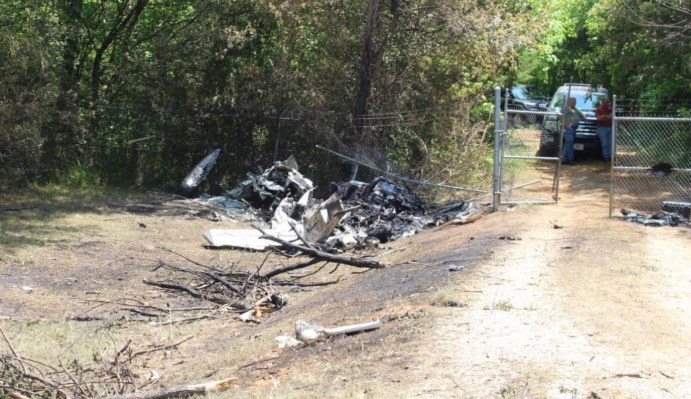
View of main wreckage
What fell from the airplane on takeoff was the exhaust tailpipe. Airport personnel later swept the runway and found it, along with a fractured v-band coupling, the band-style clamp that holds the tailpipe to the turbocharger.
Investigators sent the coupling to the NTSB Materials Laboratory. The fracture had started at the edge of a spot weld and run across about 60% of the width of the band before the clamp let go. It was a stress rupture. The NTSB discovered that the crack wasn’t new. It had been there, growing, through an unknown number of flights. A second spot weld on the same coupling was cracked too.
When the clamp failed, the tailpipe separated and hot exhaust gas poured into the engine compartment. That’s the fire the witnesses saw. From the first sign of trouble to impact, the pilot had a few hundred feet of altitude and less than a lap of the pattern. Nothing in any checklist, and nothing in 5,675 hours, recovers that.
Here is the part that should change how you think about your own airplane.
The v-band coupling isn’t exotic hardware. It’s standard on turbocharged piston engines, and it has been failing in service since the mid-1970s. The NTSB has issued at least seven safety recommendations about exhaust systems and v-band clamps. The FAA has issued twenty model-specific airworthiness directives covering v-band couplings on various airframes, six of them written specifically for v-band failures.
Twenty ADs, and this airplane was covered by none of them. One AD addressed the Beech A36 with a particular turbo conversion installed; this airplane didn’t have that conversion, so the AD didn’t apply. The exact failure mode was known, documented, and regulated for the airplane parked next to it on the ramp, and this one fell through the gap.
In 2013 the FAA issued a special airworthiness information bulletin, a SAIB, on precisely this hazard: in-flight fires from exhaust v-band failures on turbocharged engines. It urged owners to add the exhaust system to their preflight inspections and to replace the coupling every 400 hours. A SAIB carries no requirement. It is the FAA saying please, where an AD says you must.
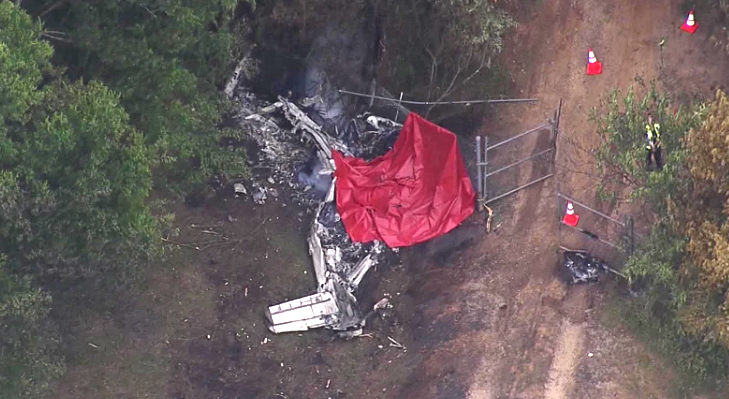
Aerial view of wreckage
The Continental engine maintenance manual did require something. It called for a visual inspection of the turbocharger and exhaust system, including the v-band clamp spot welds, at every 100-hour and annual inspection. This airplane’s logbooks never mention the exhaust system, the v-band coupling, or the tailpipe support clamp, not in the annual a month before the crash, not in the engine overhaul before it. There is no way to know when, or whether, that clamp was last inspected. And the airplane’s printed preflight checklist did not include the exhaust system at all.
In 2017, the year after this crash, the FAA proposed a new AD: a repetitive annual inspection and a 500-hour life limit on the exhaust tailpipe v-band coupling for this exact make and model. The rule that would have covered this airplane was written because of this airplane.
NTSB probable cause: “A preexisting stress rupture that initiated at a spot weld in the turbocharger v-band exhaust clamp, which resulted in the failure of the clamp and separation of the exhaust tailpipe, an in-flight fire, and subsequent impact with terrain.” (NTSB ERA16FA185)
The Decision Gates
There is nothing in this flight to second-guess. The pilot did not misjudge weather, press a bad approach, or run a tank dry. He answered a sudden fire about as fast as anyone could. So these gates are not decisions he got wrong. They are decisions you still get to make, on the ground, before your next flight, and the printed checklist will not prompt a single one of them.
Gate 1: The failure mode was documented for four decades before this flight.
V-band coupling failures have been causing in-flight fires since the mid-1970s. Seven NTSB safety recommendations, twenty airworthiness directives, an FAA working group that found three v-band failures in a sample of seventy fatal accidents. None of it is secret. It lives in service bulletins, accident reports, and type-club newsletters that most owners never open.
The check: Do you know the documented failure modes for your specific airframe and engine, the ones with a track record but not necessarily an AD? If you can’t name them, your type club and the NTSB database can. That is an evening of reading, not a rating.
Gate 2: A SAIB named this exact system, and because it was advisory, nothing made anyone act on it.
The 2013 SAIB named the hazard, named the system, and told owners to add the exhaust system to their preflight and replace the coupling every 400 hours. Because it was advisory and not an AD, nothing forced the issue. An AD generates a logbook entry and a compliance deadline. A SAIB generates nothing unless someone chooses to read it and act.
The check: Have you pulled the SAIBs for your make, model, and engine? They are free, they are public, and each one was written from an accident that already happened. Treating advisory guidance as optional is treating someone else’s crash as optional reading.
Gate 3: The checklist did not list the exhaust system, so the exhaust system did not get checked.
The manufacturer’s maintenance manual required a v-band inspection at every 100-hour and annual. The logbooks don’t show that it was ever done. The pilot’s printed preflight checklist did not mention the exhaust system at all. Between a maintenance requirement that left no paper trail and a preflight that never pointed at the part, the failing clamp had nobody assigned to find it.
The check: Your printed checklist is the floor of a preflight, not the ceiling. If you fly behind a turbocharger, walk to the exhaust, put a light on the v-band coupling where the tailpipe meets the turbo, and look for cracks and discoloration at the spot welds. What you check beyond the printed list is the only thing standing between you and a part that is failing in silence.
Before your next flight
Here are a few things I want you to think about.
- A SAIB is not an AD, but it exists because an accident already happened. Read the special airworthiness information bulletins for your make, model, and engine.
- If you fly a turbocharged piston single, add the exhaust system to your preflight walk. Put a light on the v-band exhaust clamp at the turbocharger and look for cracks and discoloration at the spot welds.
- The printed checklist is the floor of your preflight, not the ceiling. What you check beyond it is what decides whether you find the failing part before it finds you.
More patterns like this one
If you want to dig into another case involving mechanical failures and maintenance errors from the archive: