What Happened
On August 20, 2021, a North American SNJ-2, N52900, crashed near Wilkes-Barre, Pennsylvania, during departure for an airshow practice flight. The pilot was killed. The airplane lost at least part of its engine power during the initial climb, then stalled while maneuvering for a forced landing.
The departure followed an ignition problem the previous day. After arriving late because of weather, the pilot reported abnormal engine sounds while operating on the left magneto. Maintenance personnel investigated, replaced a component at the magneto’s grounding connection, and conducted checks that showed no remaining anomaly.
Before the accident departure, the pilot did not report any abnormality during the engine run-up. The airplane joined the other aircraft departing to practice their display. The pilot’s wingman then noticed a change in the normal sequence: the accident pilot did not look over to check the wingman’s landing-gear position as he ordinarily did.
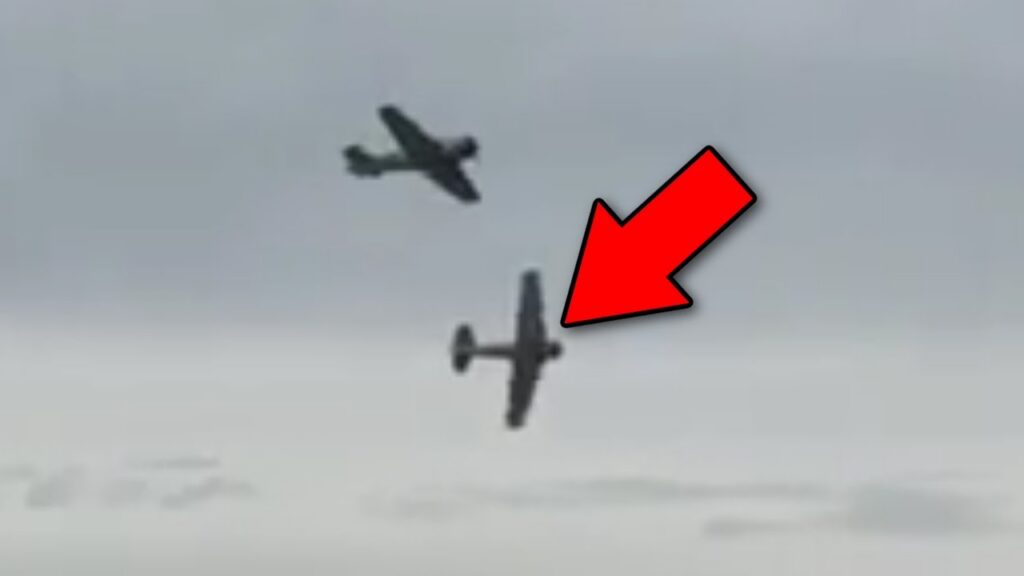
The SNJ-2’s own gear was retracting, and the airplane was slowing. The wingman heard the pilot announce an emergency. The airplane turned left, and once the bank passed about 20 degrees, the wingman saw further deceleration, increasing bank, and the beginning of a descent.
A ground video captured popping sounds consistent with engine backfiring before the airplane turned and pitched down. The smoke system came on during the sequence, but investigators did not observe black smoke before impact. The airplane struck the ground, and a postimpact fire followed.
The NTSB considered the left turn a possible attempt to reach a crosswind runway. That remained an interpretation of the maneuver, not a confirmed statement of the pilot’s intent. What the evidence established was a turn after an engine-power emergency, followed by an aerodynamic stall and loss of control.
Investigation Findings
The propeller carried signatures consistent with low power at impact. Combined with the emergency call and abnormal engine sounds on video, that evidence supported at least a partial power loss during the climb. Investigators did not find a definitive initiating mechanical failure that explained it.
The ignition work from the preceding day therefore received close attention. Running on the left magneto had produced popping and banging. During an idle-power grounding check, moving the switch through the left position made the engine appear to shut down as though the switch had reached off.
The director of maintenance found the left magneto’s P-lead spring compressed. That condition allowed an internal grounding spring to contact the magneto case. The P-lead is part of the circuit used to disable a magneto; an unintended ground can interrupt ignition. The spring was replaced, and the subsequent engine run-up, magneto check, and grounding check showed no anomaly.
Investigators also examined the magnetos after the accident. Impact damage prevented full rotation of the left unit, but the points appeared serviceable and testing found its coil and condenser serviceable within the limits described in the report. The right magneto rotated unusually easily, consistent with weak magnetism. It did not perform at low rpm and did not fire at all points until reaching 180 rpm.
Maintenance records did not establish when the right magneto had been installed or its service history. The NTSB considered it possible that an additional, undiagnosed ignition fault caused the power loss and that the right magneto’s poor performance compounded it. Fire damage prevented a complete examination of the wiring and components needed to test that explanation.
That left a firm finding about the loss of power but uncertainty about its source. The official probable cause retained “undetermined reasons.” A report of a repaired left-magneto defect the day before was not sufficient to prove that the same defect returned. Nor did the right magneto’s test performance alone establish the full accident sequence.
The aerodynamic part of the sequence was clearer. The pilot slowed while turning more steeply at low altitude. The NTSB concluded that the airplane exceeded its critical angle of attack during the maneuver. That is the point at which airflow can no longer remain attached sufficiently to sustain the commanded flightpath. The resulting stall removed the remaining opportunity for a controlled forced landing.
The investigation therefore identified two causal elements: reduced engine power and the subsequent stall. A pilot cannot always prevent a mechanical problem, but the airplane still needs an angle of attack and flightpath it can sustain after thrust decreases.
NTSB Probable Cause
A partial loss of engine power for undetermined reasons. Also causal was the pilot’s exceedance of the airplane’s critical angle of attack while maneuvering for a forced landing following the loss of engine power, which resulted in an aerodynamic stall and loss of control.
Safety Lessons
For pilots, the general forced-landing lesson is to preserve control while selecting a reachable landing area. A runway close to the airplane is not necessarily reachable through the turn needed to align with it. The actual bank, speed, altitude, and available power govern that decision, using the aircraft’s approved guidance and practiced procedures.
For maintenance teams, intermittent ignition symptoms merit system-level troubleshooting and a documented history. A successful run-up after a repair is useful evidence, but the investigation illustrates why the condition of the other magneto and the associated wiring also matter. The report did not establish that one specific additional check would have prevented this accident.
For formation operations, an emergency breakout must create separation while preserving aircraft control. The general planning task is to anticipate a loss of performance during departure and discuss what the other aircraft will do. A practice flight still carries the same low-altitude limitations as any other departure.
Watch the Full Analysis
Frequently Asked Questions
Q: What caused the SNJ-2 engine power loss?
A: The NTSB could not determine the reason. An ignition-system fault was possible, and the right magneto performed poorly during examination, but fire damage limited the investigation.
Q: Why did the SNJ-2 stall after turning left?
A: The NTSB found that the pilot exceeded the airplane’s critical angle of attack while maneuvering for a forced landing after the power loss.
Q: Was the previous day’s magneto problem repaired?
A: Maintenance personnel replaced the left magneto P-lead spring and completed checks without anomalies. The investigation did not prove that this same fault caused the accident flight’s power loss.
Sources and References