What Happened
On December 26, 2011, at 1352 eastern standard time, an Aero Commander 560-F, N560WM, lifted off from Venice Municipal Airport (VNC) in Venice, Florida, heading northeast toward Barwick Lafayette Airport in Lafayette, Georgia. The pilot, a 63-year-old private certificate holder with instrument and multi-engine ratings, had filed an IFR flight plan. He reported 6,000 total flight hours on his most recent medical application, including 700 hours in the Aero Commander make and model. The flight would never reach Georgia. Fourteen minutes after departure, N560WM was back on the ground at VNC, and the pilot was dead.
While the airplane was climbing through the assigned altitude block toward 6,000 feet MSL, the pilot came on frequency with Tampa Approach and reported a loss of power on the left engine. Tampa vectored him back toward VNC and began coordinating a return. The pilot acknowledged the vectors and worked the descent. At 1405:17, radar showed N560WM about 275 yards from the runway 22 threshold, at 200 feet. He had the runway made, or at least it looked that way from the ground. Then, 14 seconds later at 1405:31, the airplane was down to 100 feet and had drifted left of runway 22 centerline. The pilot reported the airport in sight at 12 o’clock and 4 miles just before that. There were no further radio transmissions.
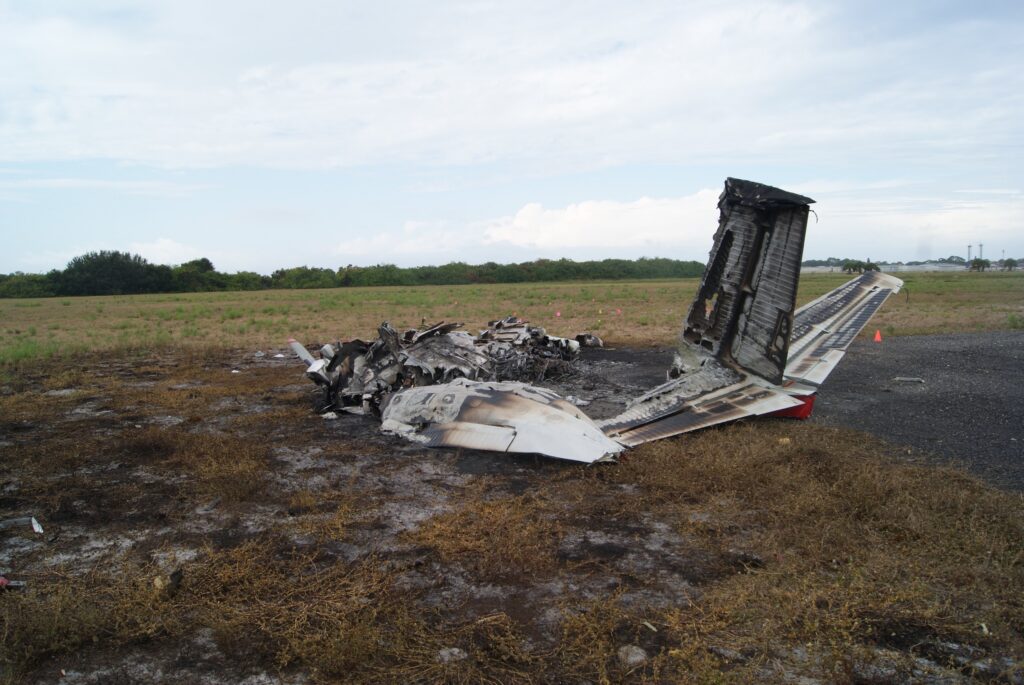
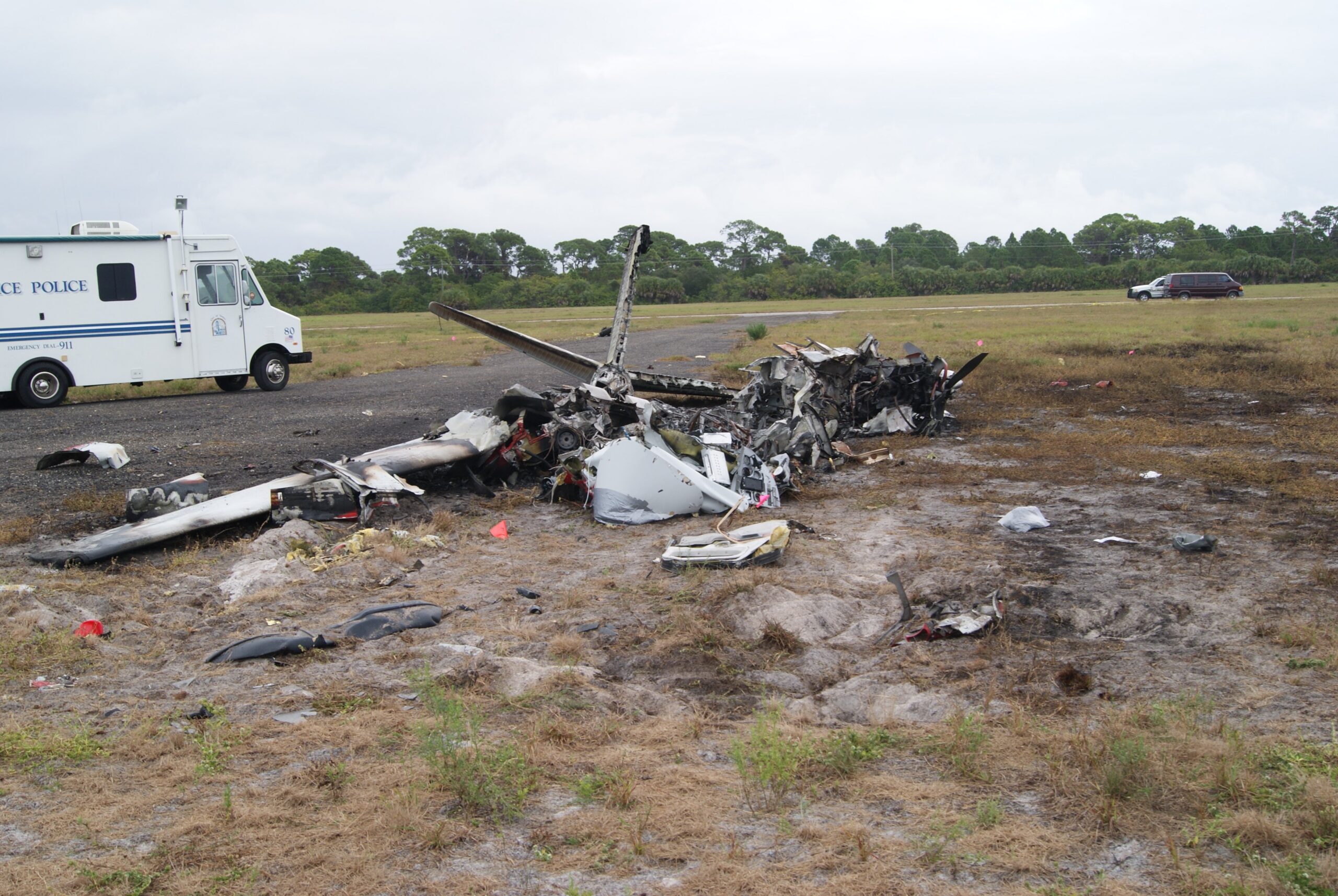
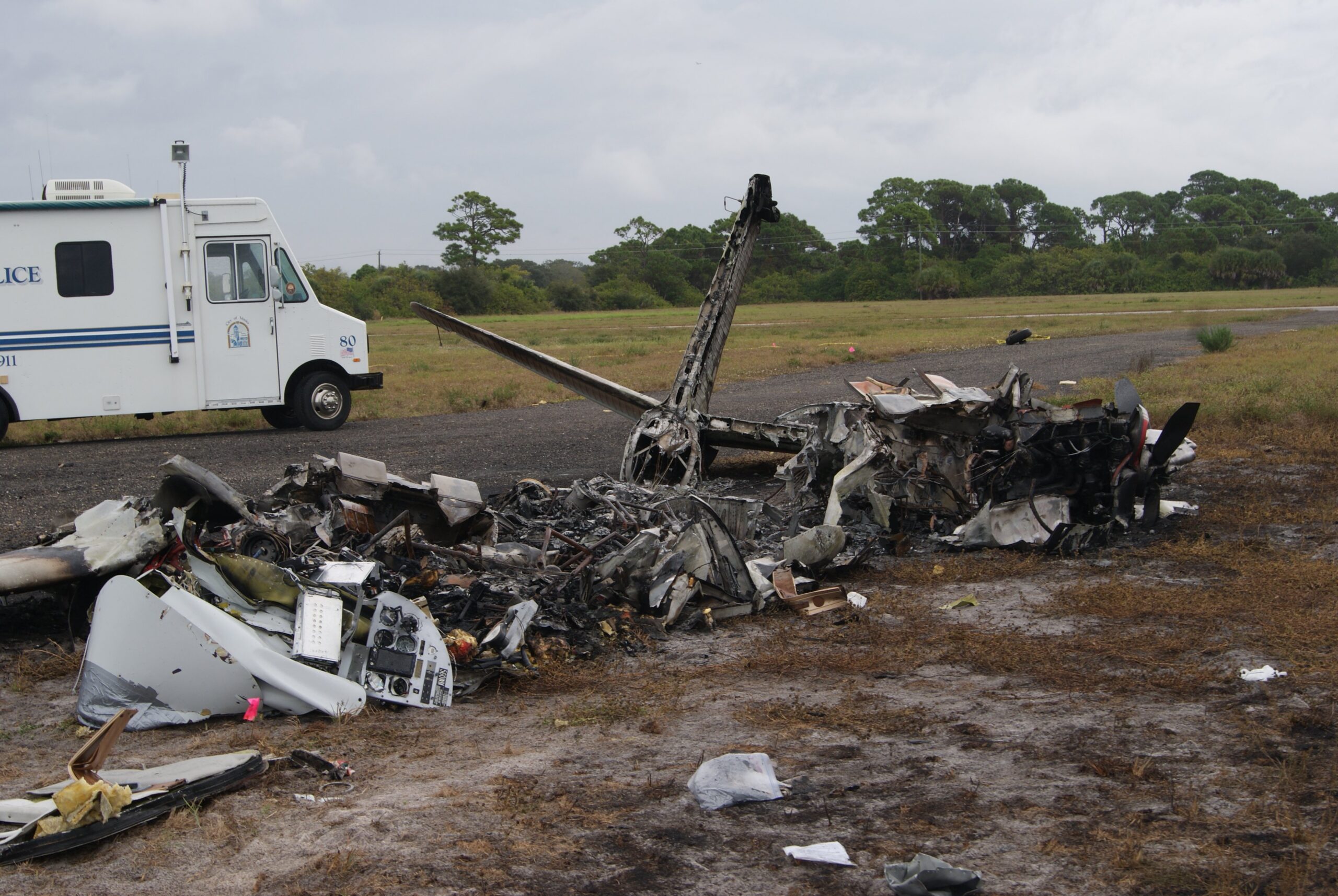
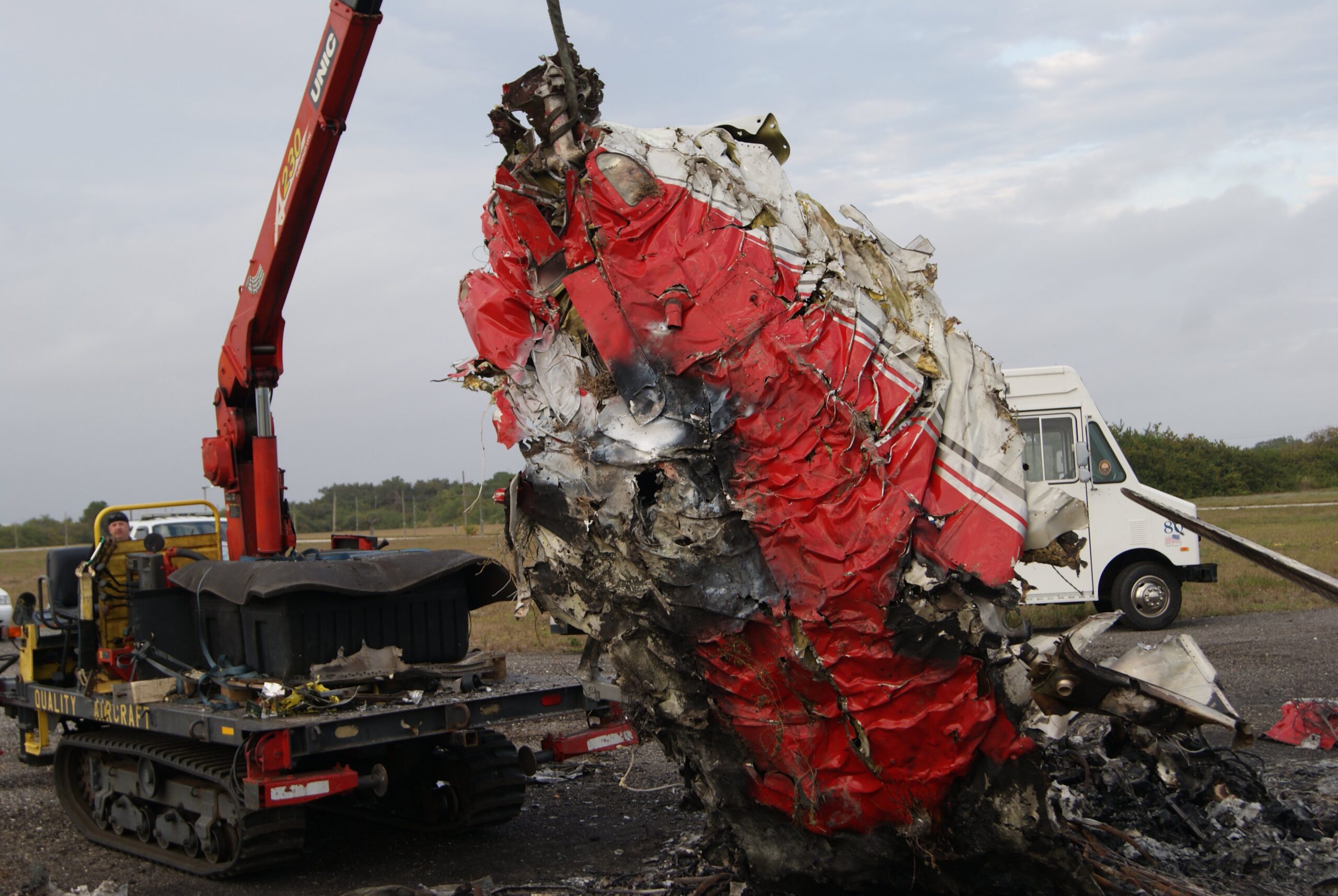
A witness on the field watched the sequence unfold. The airplane was in the vicinity of runway 22 when the nose pitched straight up. Then it stalled. Then it spun to the left, three full rotations, before it hit the ground. About 90 seconds after impact, the airplane was engulfed in flames. The main wreckage came to rest in an open field approximately 0.15 miles south-southwest of the closed runway 27 markings. The crash debris line was 12 feet long. The bottom of the fuselage was compressed upward with accordion-style crushing to the left, consistent with the left-wing-low, nearly vertical flat descent described by the witness.
The left throttle was found at idle. The left propeller lever was in the feathered position. The right throttle was at mid-range, the right propeller was full forward, the right mixture was full rich. So going into that final approach, the pilot had the dead engine configured correctly, feather set, throttle back. The right engine was still producing power, somewhere in the mid-range. What the wreckage and radar data together tell you is that at 200 feet above the ground, somewhere between 275 yards short of the threshold and the left side of the extended centerline, the pilot ran out of airspeed.
Investigation Findings
The NTSB pulled the left engine apart. All connecting rods were intact except for the No. 2 connecting rod. The No. 2 bearing was destroyed. Metallurgical examination of the components sent to the NTSB Materials Laboratory revealed the bearing failure was most likely due to progressive delamination. The crankshaft showed wear on the No. 2 journal. Metal contaminants were present in the oil suction screen, the oil filter, and the oil sump. The right engine, by contrast, showed no metal contamination in any of those locations. The left engine had been failing from the inside, and the oil system had been collecting the evidence for some time before the flight departed.
The propeller damage patterns told their own story. The left propeller blades were all in the feathered position, consistent with the cockpit lever position. Two blades were bent, one at the root and one at mid-span, but there was no rotational scoring or twisting. The left engine was not producing thrust at impact. The right propeller blades showed significant bending, one forward 90 degrees at quarter-radius, one aft 70 degrees, one aft 30 degrees, and none showed rotational marks either. The right engine was producing some power but not at a high thrust setting, which lines up with the mid-range throttle position found in the wreckage.
The investigation also turned up a significant pre-accident history. In October 2011, just over two months before the accident, the pilot had taxied N560WM into a parked Mooney at the Sarasota Avionics ramp after ground personnel had to use an external power cart just to get the right engine started. The taxi accident destroyed the nose radar dome. The airplane’s insurance adjuster told the pilot directly that the airplane could not be flown until a serviceable radar dome was installed and a ferry permit was obtained from the FAA. At the accident site, investigators found the fractured radar dome had duct tape around it. There was no record that the pilot had ever applied for a ferry permit, meaning N560WM was operating on an invalid standard airworthiness certificate the morning of December 26th. And there was more. The mechanic who performed the April 2011 annual inspection told investigators that the pilot had mentioned he could not start the left engine sometime after the taxi accident, and that he and an unidentified person were planning to move the right fuel pump over to the left engine and run a hose from the right boost pump to the right engine servo to make the left engine operable. The left engine’s total time since major overhaul at the last documented inspection was 1,029.9 hours.
The Aero Commander 560-F flight manual states the minimum control speed with one engine suddenly failed and takeoff power on the other is 90 calibrated miles per hour, or 78 knots. It also states that a minimum of 300 feet of altitude is required to recover from a power-off stall with a 7,500-pound gross weight at either center-of-gravity limit. At 1405:31, the airplane was at 100 feet. That was not a recoverable position.
NTSB Probable Cause
The pilot’s failure to maintain adequate airspeed during a single-engine approach, which resulted in an aerodynamic stall. Contributing to the accident was the total loss of power in the left engine due to a failed No. 2 connecting rod bearing.
Safety Lessons
Three things stand out in this accident chain, and each one is a point where the outcome could have changed.
- Airspeed discipline on a single-engine approach is non-negotiable. The Aero Commander 560-F flight manual calls out 78 knots as the minimum control speed with one engine out and takeoff power on the good engine. The stall speed with gear down and flaps down is 63 knots. On a single-engine approach, the margin between flying and stalling compresses fast, and the asymmetric thrust from the live engine makes the stall departure abrupt and directional. Fly the numbers. Whatever your aircraft’s single-engine approach speed is, that number is a floor, not a suggestion, and it becomes absolutely critical below 300 feet where there is no altitude to recover from anything.
- Know the recovery altitude requirements in your aircraft’s flight manual before you need them. The 560-F manual states explicitly that 300 feet is the minimum altitude required to recover from a power-off stall at gross weight. At 100 feet, a stall-spin entry is not survivable. A pilot flying a single-engine approach in a heavy twin, at 200 feet, left of centerline, with the nose pitching up, had no options remaining. Understanding that the book requires 300 feet of recovery altitude should change how you plan the entire approach, from pattern entry through final, with margin built in above that number.
- An airplane that cannot legally fly should not fly. N560WM was operating on an invalid airworthiness certificate. The insurance adjuster had told the pilot the airplane needed a ferry permit. The radar dome had duct tape on it. The logbooks were incomplete and largely unavailable. The pilot had been unable to start the left engine and may have performed undocumented fuel system modifications to get it running. None of that information was available to Tampa Approach when they were vectoring N560WM back to the field, and none of it helped the pilot when the left engine quit. The airworthiness certificate exists because unairworthy airplanes have failure modes that airworthy airplanes do not. This one did.
Frequently Asked Questions
Q: What is the minimum control speed for the Aero Commander 560-F with one engine out?
A: The Aero Commander 560-F flight manual states the minimum control speed with a sudden failure of one engine and takeoff power on the remaining engine is 90 calibrated miles per hour, or 78 knots. The stall speed with gear and flaps down is 73 mph or 63 knots.
Q: What caused the left engine to fail on N560WM?
A: Metallurgical examination of the disassembled left engine found the No. 2 connecting rod bearing had failed, most likely due to progressive delamination. The crankshaft showed wear on the No. 2 journal, and metal contaminants were found in the oil suction screen, oil filter, and oil sump, indicating the bearing had been deteriorating over time before the accident flight.
Q: Was the Aero Commander airworthy when it departed on December 26, 2011?
A: According to the FAA, the airplane’s standard airworthiness certificate was invalid at the time of the accident flight. The airplane had been involved in a ground collision in October 2011 that destroyed the nose radar dome, and the insurance adjuster had informed the pilot the airplane could not fly without a serviceable radar dome and an FAA ferry permit. No record of a ferry permit application was found. The dome found in the wreckage had duct tape around it.
Q: Why did the Aero Commander spin to the left when it stalled?
A: The left engine had failed and the left propeller was feathered, so all thrust was coming from the right engine. With asymmetric thrust pulling the right wing forward and the airplane already in a low-airspeed, high-pitch-attitude state, a stall departure to the left is consistent with the aerodynamic forces present. The witness described the nose pitching straight up before the stall, and the airplane completed three left rotations before ground impact.
Q: How much altitude does the Aero Commander 560-F need to recover from a power-off stall?
A: The aircraft flight manual states that a minimum of 300 feet of altitude is required to recover from a power-off stall at 7,500 pounds gross weight at both forward and aft center-of-gravity limits. Radar data showed the airplane was at 100 feet above ground level 5 seconds before the last radar return, well below any recoverable altitude.