
The Pattern: VFR into IMC
The most lethal decision trap in general aviation, and it doesn’t spare crews of two.
You launch legal and visual, but then the visibility ahead becomes worse than the visibility behind. You keep going toward it because turning around feels like admitting the trip was a mistake, and the terrain closes the margin before the weather does.
From NTSB final reports, 2008–present*:
161 accidents matched this pattern.
143 of them were fatal, a fatal rate of 88.8%.
247 lives were lost.
What 88.8% fatal means is simple: when this pattern completes, it almost never leaves a survivor to explain it. The reconstruction has to come from the wreckage, the radar, and the crew that made it out. Now let me show you what one of these 247 tragedies looked like.
One real flight
October 2, 2016. Cessna 208B Grand Caravan. Scheduled Part 135 commuter flight, Quinhagak to Togiak, Alaska.
The airplane departed Quinhagak about 1133 Alaska daylight time. Two commercial pilots up front, one passenger in back. A turbine Caravan, the workhorse of the Alaska bush, operated under visual flight rules by a Part 135 carrier out of Anchorage. Company flight-following procedures were in effect and this was a routine leg on a route the operator flew constantly.
The destination, Togiak Airport, had the closest weather observing station to what would become the accident site and they were reporting visual meteorological conditions. Unfortunately, they never made it to their destination.
A second company flight crew departed about two minutes behind the accident airplane and initially followed a similar path. That crew is the only reason we know anything. They reported unexpected fog, changing clouds, and the potential for rain along the accident route. They were flying the same route, same window, but two minutes apart, and the second crew saw a sky that didn’t match the destination observation.
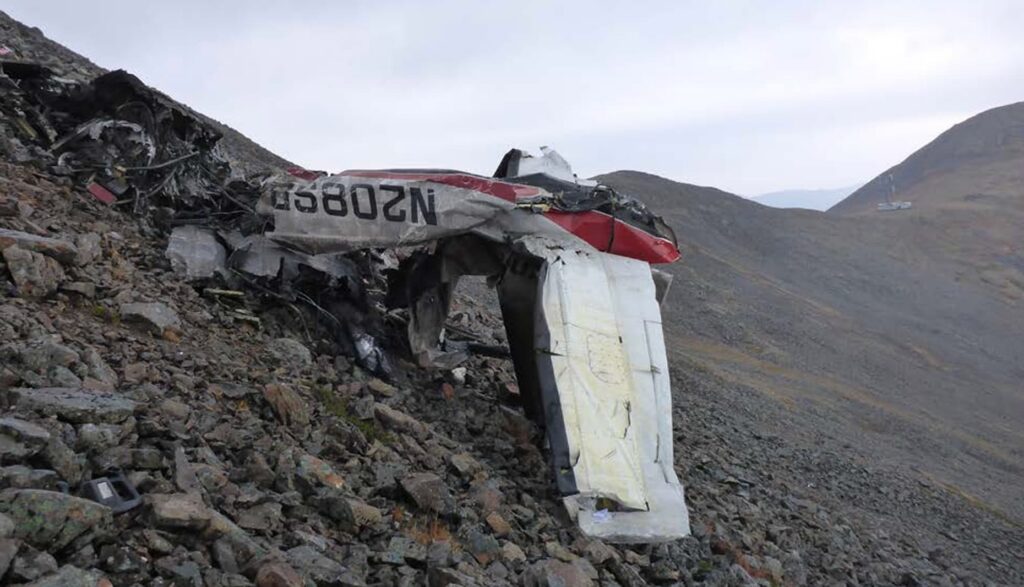
The accident crew flew into that deteriorating visibility and kept going. At about 1157, roughly twenty-four minutes after departure, the airplane collided with steep, mountainous terrain about ten nautical miles northwest of Togiak, still in the climb phase of the flight. The two commercial pilots and the passenger were killed. The airplane was destroyed.
Steep, mountainous terrain northwest of Togiak (NTSB)
The investigation surfaced something specific about how this operator flew. The airplane’s terrain awareness and warning system had a terrain inhibit switch, and the company allowed routine use of it to inhibit the alerts. The guidance for turning those alerts back on was inadequate. So the very system built to shout at a crew flying toward rising ground in bad visibility could be, and routinely was, told to stay quiet.
The NTSB determined the following.
The flight crew’s decision to continue the visual flight rules flight into deteriorating visibility and their failure to perform an immediate escape maneuver after entry into instrument meteorological conditions, which resulted in controlled flight into terrain (CFIT). Contributing to the accident were (1) Hageland’s allowance of routine use of the terrain inhibit switch for inhibiting the terrain awareness and warning system alerts and inadequate guidance for uninhibiting the alerts, which reduced the margin of safety, particularly in deteriorating visibility; (2) Hageland’s inadequate crew resource management (CRM) training; (3) the Federal Aviation Administration’s failure to ensure that Hageland’s approved CRM training contained all the required elements of Title 14 Code of Federal Regulations 135.330; and (4) Hageland’s CFIT avoidance ground training, which was not tailored to the company’s operations and did not address current CFIT-avoidance technologies.
NTSB probable cause: (NTSB ANC17MA001)
The Decision Gates
This is where the flight stops being about that crew because two pilots didn’t save this airplane. The gates are the same for one pilot as for two.
Gate 1: The flight launched into a route where the destination looked visual but the terrain in between did not.
The destination station was reporting VMC. That was comforting but dangerous, because the accident happened ten miles out over rising terrain, not at the airport. A destination observation tells you nothing about the notch you have to fly through to get there.
The check: When you read the destination weather, are you also reading the terrain and the weather along the leg, or just the numbers at the field?
Gate 2: The visibility ahead deteriorated, and the flight continued into it instead of turning back.
A crew two minutes behind on the same route saw the fog, the changing clouds, the rain potential clearly enough to report it. The information was in the air and available. Continuing toward worsening visibility rather than reversing course into the visibility you already know is good is the core of this pattern.
The check: When the visibility ahead of you is worse than the visibility behind you, what is your rule for turning around, and is it a number you set on the ground?
Gate 3: After entry into instrument conditions, no immediate escape maneuver was performed.
The NTSB named the failure to perform an immediate escape maneuver as causal. Entry into IMC in a VFR flight over mountainous terrain is not a moment to evaluate. It is a moment to execute a memorized climb and reversal, right now, before the terrain that you can no longer see decides the outcome.
The check: If you inadvertently entered IMC in the next hour, could you fly the escape maneuver from memory without looking anything up?
Here are a few things I want you to think about.
The destination weather is not the route weather. A field reporting VMC tells you nothing about the ridge or the fog bank ten miles out that you still have to fly through.
Set your turn-back number on the ground, before you launch, when it costs you nothing to be honest. In the air, when the visibility ahead is worse than the visibility behind, that number is the only thing that decides for you.
And know your inadvertent-IMC escape maneuver cold. If you have to think about it, you have already waited too long.
*Those 161 come from a corpus universe of 17,607 accidents. For scale, the NTSB’s own GA airplane-only count for VFR-into-IMC over 2008-2024 is 229; our narrower cohort of 161 lands at 70.3% of that, because we deliberately exclude one event-code category by design. This is not a gap in the counting. It is a tighter definition of the same killer.