
The airplane comes with a way out. Whether it saves you comes down to one number: how high you are when you decide to use it.
The Cirrus line of airplanes is built around a whole-airplane parachute, called CAPS. When something goes wrong that the pilot cannot fly out of, the idea is simple: stop trying to save the airplane, pull the handle, and let the canopy save the people. It has worked hundreds of times. But the canopy needs time and air beneath it to swing the airplane upright and slow the fall, and that time is spent in altitude. However, below a certain height, the ground arrives before the parachute can do its job.
Here’s the number that makes this issue different from the others. Across these airplanes, the share of accidents that killed someone fell from 38.2% in the years 2008 through 2013 to 23.3% in 2014 through 2024. That decline tracks the same years a “pull early, pull often” culture took hold among these pilots, pushed hard by the community and the factory. The parachute wasn’t the only thing responsible for the change, but the bottom line is it offers you a way out if you use it correctly.
From NTSB final reports, 2008–present*
- 337 Cirrus SR20, SR22, and SR22T accidents
- 28.2% involved at least one fatality
- 164 people killed
- 16.8% of aircraft destroyed on impact
That 28.2% is across the entire fleet, but what you need to know is that there has never been a fatality in which a CAPS pull was attempted within the normal operating envelope.
The case I want to show you though is one of the 95 that didn’t pull in the envelope and it turned fatal, because that’s what this whole issue is about.
One real flight
June 6, 2023. Cirrus SR22T. Instructional flight, Jamestown, New York.
There were two pilots on board. In the left seat was the airplane’s owner, a week out from his instrument rating practical exam. In the right seat was a flight instructor with about 9,650 hours, there to get him ready. This was a training flight involving a short hop to Jamestown and back, with some touch-and-go landings worked in.
The airplane had a recent quirk. The day before, a maintenance shop had adjusted its turbocharger because the manifold pressure had been running low, and a half-hour test flight afterward checked out fine.
On the accident flight the pressure went the other way. During a touch-and-go it spiked past its red-line limit, for reasons the investigation could not pin down, and set off a warning in the cockpit. The engine kept running and the fuel mixture held, but the warning landed at the worst possible moment: a hundred-some feet off the runway, climbing away, low and slow.
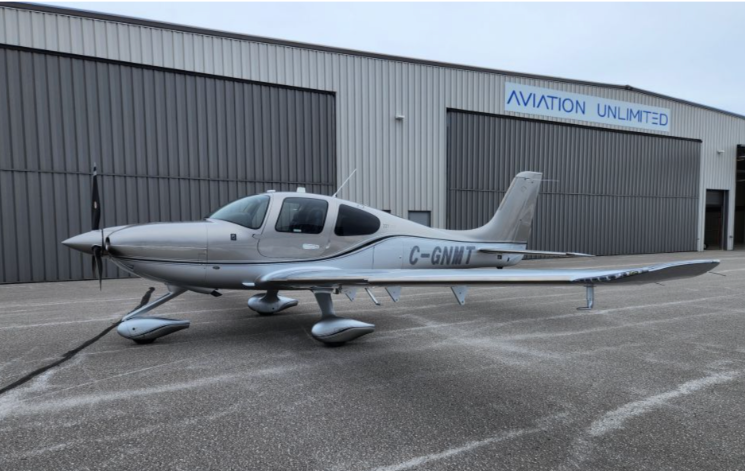
Accident Aircraft – Cirrus SR-22T, C-GNMT
What happened next took seconds. Climbing through 100 to 200 feet near midfield, the airplane banked steeply left, leveled, then rolled hard right. The airspeed bled to 76 knots, below the speed the wing needed to keep flying and the airplane departed controlled flight. That’s when the parachute came out at 293 feet above the ground.
The handbook for this airplane put the minimum demonstrated altitude loss after a pull at 400 feet, and that’s the number from straight-and-level flight, the easy case. It told pilots to keep 2,000 feet above the ground in mind as a cut-off decision altitude. The pull on this flight came at 293 feet, out of a steep bank and a stall, with the airplane already falling. The canopy never had the air it needed. The airplane came down in a wooded corner of the airport, and both pilot were killed upon impact.
This sequence wasn’t about a pilot that refused the parachute or didn’t trust it. It was about someone that pulled the handle instead of flying the plane to a forced landing.
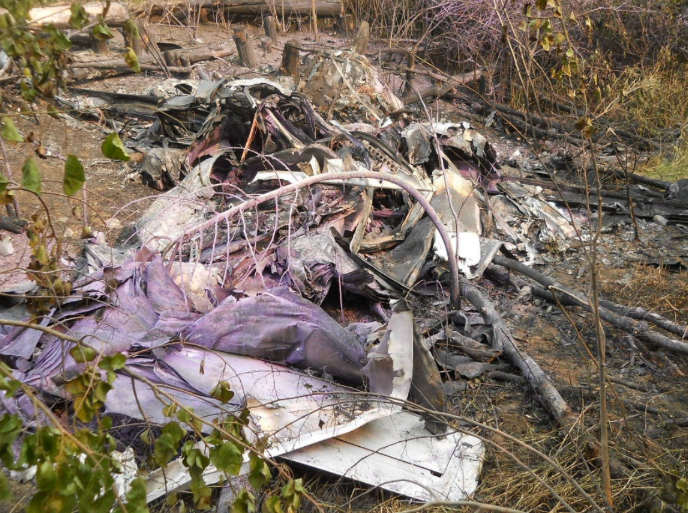
Aft view of the main wreckage
NTSB probable cause: “The pilots’ failure to maintain airplane control following an anomalous engine indication during the initial climb, which resulted in a loss of control and parachute deployment at an altitude too low for the system to operate effectively. Contributing to the accident was an exceedance of engine manifold air pressure for reasons that could not be determined based on the available evidence.” (NTSB ERA23FA258)
The Decision Gates
The mistake wasn’t pulling the CAPS, it was not flying the plane first. Pulling the handle was the right call based on the loss of control, there just wasn’t any altitude left to recover. Here are the decisions that were still open.
Gate 1: The anomaly arrived in the one place there was no altitude to spend on it.
A pressure spike and a warning light are a problem you solve with height and time. This crew got the warning at a hundred feet on the initial climb, where there is neither. The pull of attention to the panel, low and slow, is its own hazard, separate from whatever the panel is saying. The engine, it turned out, was still making power.
The check: When something anomalous lights up right after takeoff, your first job is the flight path, not the annunciator. Altitude is what buys you the time to read the warning. At 200 feet you don’t own any of it yet, so fly first.
Gate 2: The parachute has a floor, and the floor is higher than the number some pilots carry in their heads.
The number that matters is not “the airplane has a parachute.” It’s the altitude required for it to work.
The check: Do you know your airplane’s real minimum CAPS deployment altitude? If all you know is that there is a parachute back there, then you don’t know when it can actually save you.
Gate 3: The pull is a decision you make before you need it, not at the moment you do.
Because the floor exists, the parachute can’t be a last resort. By the time a pull feels like a last resort, you may already be under the altitude where it works. The “pull early, pull often” habit that tracks this fleet’s safer years is exactly this gate worked in advance: deciding on the ground which emergencies get an immediate pull, and at what height, while there is still air to spend.
The check: Decide now, parked, what scenarios get an immediate pull and at what altitude. A decision you have already made is one you can execute in the two seconds you will actually have.does not depend on what the other pilot says back.
Before your next flight
Here are a few things I want you to think about.
- If you fly behind an airframe parachute, learn its real floor, the from-an-upset number, not the level-flight one on the brochure. The handle helps only above a height most pilots underestimate.
- A warning light low after takeoff is a trap. Fly the airplane to a safe altitude first, then sort out what the light is telling you. Most of them can wait the thirty seconds it takes to get there.
- Decide your pull triggers and your pull altitudes on the ground. The fleet got safer as pilots started making that decision in advance instead of in the moment. The worst time to first think about the handle is the moment you need it.
More patterns like this one
If you want to dig into another loss of control during landing case from the archive: