
Wind that shifts faster than the wing can answer. On takeoff you meet it low, slow, and with nothing underneath you to trade.
Windshear is a change in wind speed or direction over a short distance. Up high it can lead to turbulence and a rough ride. Down low, in the first few hundred feet of a climb, it’s something else. A headwind that suddenly drops, or swings around to a tailwind, steals the airspeed you were counting on and the airplane sinks or stalls, sometimes before you can react.
From NTSB final reports, 2008–present*
- 457 turbulence and windshear accidents
- 21.2% involved at least one fatality
- 189 people killed
Most windshear and turbulence events don’t result in an event that leads to an NTSB report. These stats are just the ones that do, because the truth is most encounters with rough air end with a scare, a spilled coffee, and a note in the logbook. The ones that reach an NTSB final report are the ones I want us to focus on because one in five of those killed everyone the airplane was carrying. The case I want to show you is the deadliest version of it: not turbulence at altitude with room to recover, but shear on departure, where your margin for safety is often measured in seconds.
The case I’m sharing with you is one of the 97 that turned fatal.
One real flight
February 22, 2023. Beech B200 King Air. Part 91 business flight, Little Rock, Arkansas.
There were five people on board: the pilot, who held a commercial certificate, and four passengers. The airplane belonged to the company the four worked for, and the passengers were disaster-response workers headed several states away to an industrial plant explosion. This was a flight with a job waiting at the other end and a team counting on it to launch. The airplane itself was a twin-turboprop, about 300 pounds under its maximum takeoff weight, with no open maintenance issues.
Unfortunately, the weather was not routine. A cold front was moving through. A line of extreme-intensity precipitation was closing on the airport from the west, and a SIGMET was active for thunderstorms in the area. The automated observation a few minutes before takeoff had the wind at 210 degrees, 19 knots gusting to 27, with a recorded peak gust of 36. The wind had already shifted once, just eight minutes before the airplane started to taxi.

KLZK 0.549° Level-II base reflectivity product from a sweep initiated at 1153:14. The accident location is identified by the purple circle.
The pilot knew the headline. While still on the ground, he told the controller he had the current weather, which included a low-level windshear advisory. Over the next two minutes the tower transmitted a windshear alert twice more. The airport’s windshear alert system was posting gains of 15 and 20 knots on one approach and off the departure end of the runway the pilot was about to use. However, the pilot said he was ready to take off, and the tower cleared him.
What the wind did next is on the record in ten-second steps. A sensor northwest of the departure point read 18 knots at 11:55:53; thirty seconds later, 23 knots; thirty seconds after that, 37 knots, but the direction had swung more than 40 degrees. A second sensor along the airplane’s track went from 13 knots to 31 in about a minute. To make matters worse, the line of rain that had been off to the west was arriving, and it brought its own wind with it.

KLZK 0.549° Level-II base reflectivity product from a sweep initiated at 1200:05. The accident location is identified by the purple circle.
The takeoff itself looked normal. Surveillance video showed the airplane lift off in the first 2,500 feet of runway, gear coming up, climbing to the south. Then it stopped climbing. The recorded data has the airplane reaching 386 feet above the runway but never got higher than that, with its groundspeed bleeding off the entire 32 seconds it was airborne. Its total energy, the sum of the speed and height it had to work with, peaked five seconds before it reached that altitude and then fell away.
A performance study found that in the last 25 seconds the airplane was producing a small fraction of the climb power its earlier takeoffs from the same runway had managed. Not because the engines quit, they were making power all the way to the ground, but because the air it was flying through had turned against it.
A witness on the ramp described a smooth takeoff that simply stopped climbing, then went nose-low and descended straight at the ground. Another, a flight instructor watching from his office, saw the bank angle roll past 90 degrees into what he called a “classic stall and spin.” The airplane came down about a mile south of the departure end of the runway. Seconds after it dropped out of sight, the same wind reached the ramp where the cameras stood: blowing debris, heavy rain, a gust front arriving right behind the airplane it had just brought down. All five on board were killed.
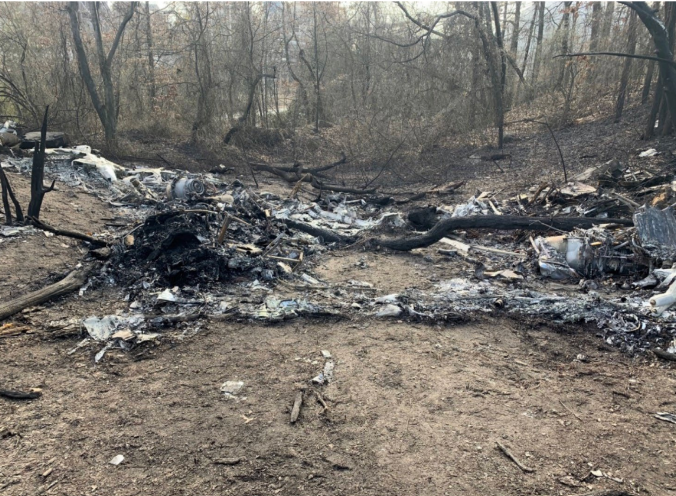
Main wreckage at accident site.
NTSB probable cause: “The loss of control during initial climb for undetermined reasons. Contributing to the accident were the sudden wind shifts during the initial climb.” (NTSB CEN23FA113)
The Decision Gates
There’s a temptation to read this as bad luck, a gust front that showed up a minute too early. But if you look closer, the timing was the only thing left to chance. Everything else was already on the table before they taxied. Here are the decisions that were still open.
Gate 1: The windshear alert was active, acknowledged, and overflown.
This was not a forecast or a hunch. The pilot had the advisory before he taxied, the tower repeated the alert twice, and the airport’s own sensors were posting 15 and 20 knot gains off the departure end. An advisory tells you shear is possible. An alert tells you it is happening, right now, on your runway. He had the second one, and took the runway anyway. Perhaps it was because he knew the team in the back needed to get to their destination, but that doesn’t change the fact that the alert existed.
The check: A windshear alert on your departure runway is not a caution to weigh against your schedule. It’s a stop signal. If the system is actively calling shear where you are about to fly, delay your takeoff.
Gate 2: The bigger picture was moving, and it was moving toward the runway.
The shear did not come out of clear air. A cold front was passing, a SIGMET was up for thunderstorms, a line of extreme-intensity rain was closing from the west, and the wind had already shifted once. Every piece of that evidence was available before the engine started. Together they said the air over the airport was about to change, and the only open question was whether the airplane would be on the ground or three hundred feet up when it did.
The check: Are you reading the snapshot or the trend? A current observation tells you what the wind is. The front, the approaching line of rain, the last hour of shifts tell you what it is about to be. On a departure, what it’s about to be is the number that matters.
Gate 3: On takeoff, the recovery is mostly made before the wheels leave the ground.
When the shear hit, the airplane was low, slow, and already giving up airspeed it couldn’t spare. The trained response to windshear is immediate and aggressive: full power, pitch for the escape, max perform without stalling, and climb away from the ground. But that response needs room, and at 386 feet with the energy already draining, there was almost none of it to use. This is why windshear on departure is so lethal. The airplane meets it in the one phase of flight where there is nothing underneath to trade.
The check: The real decision about windshear on takeoff gets made before brake release, not after. Once you are airborne and behind it, you are not so much recovering as hoping. Settle it on the ground: if the shear is active, don’t go.
Before your next flight
Here are a few things I want you to think about.
- A windshear advisory is a caution. A windshear alert on your runway is a stop signal. Treat the two differently, because the system does.
- Read the trend, not just the current observation. A front, an approaching line of rain, a wind that has already shifted once: those tell you what the air is about to do, and on a takeoff that is the only forecast that counts.
- Departure is the worst place to meet windshear, because you have no altitude to trade for the airspeed it takes. If the shear is active when you taxi, the cheapest thing you will ever do is wait for it to pass.
More patterns like this one
If you want to dig into more rough-air and windshear cases from the archive: