
The runway is in sight, the airplane is working, and the approach is the thing that beats you.
Loss-of-control-during-landing accidents are rarely about a pilot who can’t fly the airplane. They’re about a pilot who arrives at the runway with too much energy and too little plan, and keeps trying to make the landing work anyway. The airplane shows up fast, or high, or both.
Instead of throwing the approach away and trying again, the crew keeps reaching for the runway. The runway is right there. That’s what makes it so hard to give up.
Most pilots who end up here weren’t reckless. They were capable people doing something familiar, on a day with nothing obviously wrong, who fell a few seconds behind the airplane and never caught back up.
From NTSB final reports, 2008–present*
- 4,662 loss-of-control-during-landing accidents
- 2.9% involved at least one fatality
- 225 people killed
Think about that. Only about 3% of these kill someone, 97% don’t. That might sound like good odds until you remember that none of the 225 that died thought it would happen to them. It might have been a bad approach or something else, but the runway was right there and the aircraft was working. The landing was supposed to be the safe end of the trip. The difference between a survivable runway excursion and the one that kills you boils down to what you hit, how hard, and in Dale Jr’s case, whether the door opens or not.
Now let me show you what one of these 4,662 cases looked like.
One real flight
August 15, 2019. Cessna Citation Latitude. Cross-country personal flight, Statesville, North Carolina to Elizabethton, Tennessee.
The airplane belonged to Dale Earnhardt Jr. On board were two pilots and three passengers: Dale, his wife, and his infant daughter.
The crew was experienced. The pilot held an airline transport certificate with about 5,800 hours, 765 in this airplane. The copilot had around 11,000 hours, 1,165 in type. This wasn’t a new crew in an unfamiliar aircraft.
The flight was short. They left Statesville at 15:19, climbed to 12,500 feet, and eight minutes later started down toward Elizabethton. Takeoff to crash was about eighteen minutes. The weather was good: ten miles of visibility, calm wind, a cloud layer well above the field.
The cockpit voice recorder has no approach briefing. At no point did the two pilots agree on how the approach would be flown, what speeds they wanted, or what would send them around. The descent was spent reacting: clouds to dodge, traffic, ridgelines, and trouble picking the airport out of the terrain. They were looking out the window for the runway instead of flying the numbers.
The numbers were already slipping. At 1532, more than five minutes out, the pilot said it himself: “well it wouldn’t hurt to slow down.” Nothing changed. At 1535 the airplane crossed a ridgeline 710 feet up and the terrain warning went off. The copilot asked if he had the terrain. “Yeah, I got it,” the pilot said, and the approach continued.
The airplane was fast and staying fast. The pilot had been at idle for almost two minutes. Below 500 feet he partially extended the speedbrakes, which the flight manual prohibits that low. The terrain warning sounded again, and still the approach continued. Then, close to the runway, the copilot said what both of them already knew: “and I don’t need to tell ya, we’re really fast.”
“I’m at idle,” the pilot answered. There was nothing left to pull back. Six seconds later, he asked the question that should have ended the approach.
“Do I need to go around?”
“No.”
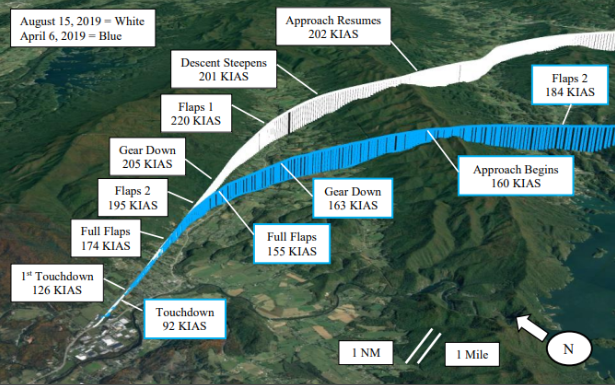
Accident flight in blue vs previous flight 9 month earlier
The airplane crossed the runway at 126 knots, 18 above its reference speed for landing, descending at more than 1,500 feet per minute against a limit of 600. Every measurement that defines a stable approach was outside its limit, and the crew flew it onto the runway anyway.
It did not stay there. The airplane touched down fast, bounced, and touched again, four times in all. The pilot called for the thrust reversers and once they unlocked the airplane went briefly back into the air with the reversers trailing open. He tried to go around. The engines wouldn’t give him the power because the airplane won’t let an engine spool up with the thrust reversers deployed. The decision to go around had finally been made, but it was too late.
The fourth touchdown was hard, 3.2 g, hard enough to trip the stall warning a half second before the wheels hit. The right main landing gear collapsed. The airplane left the pavement, crossed grass, an embankment, a creek, and a chain-link fence, and came to rest about 600 feet past the runway, near a four-lane highway. Then it caught fire.
This is the part of the story that makes the rest of it matter.
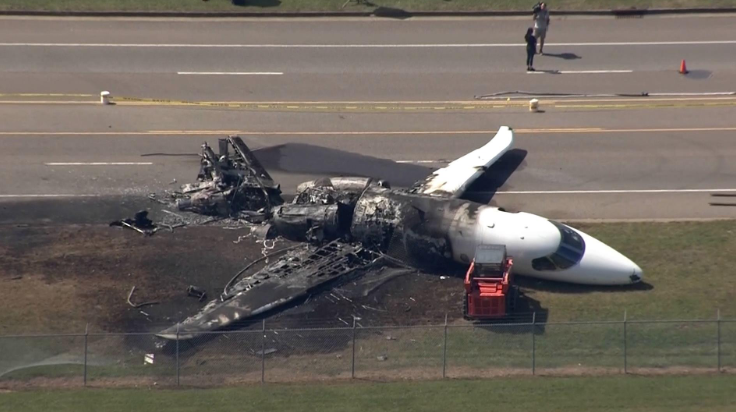
Wreckage on the side of the road next to the airport
The airplane had two ways out: a cabin door on the left side and an emergency hatch over the wing on the right. The pilots tried the cabin door. It would not open. A passenger tried the emergency hatch but it wouldn’t open. Both pilots came back to help, and the three of them together still could not move it. Heavy smoke began pouring from the lavatory, and then flames. The copilot went back to the cabin door, threw himself at it a second time, and forced it open just far enough for everyone to squeeze out.
They lived because of a gap a few inches wide. The cabin door handle had jammed against the ground when the airplane rolled to a stop. The emergency hatch had a chain-link fence post driven into it. When investigators later cleared the post, the hatch worked perfectly. The exits weren’t broken. They were blocked by where the airplane came to rest. Three minor injuries, two people not hurt at all, and a business jet burned down to the landing gear.
NTSB probable cause: “The pilot’s continuation of an unstabilized approach despite recognizing associated cues and the flight crew’s decision not to initiate a go-around before touchdown, which resulted in a bounced landing, a loss of airplane control, a landing gear collapse, and a runway excursion. Contributing to the accident was the pilot’s failure to deploy the speedbrakes during the initial touchdown, which may have prevented the runway excursion, and the pilot’s attempt to go around after deployment of the thrust reversers.” (NTSB ERA19FA248)
The Decision Gates
Nobody on that airplane was unqualified. The two pilots had more than 16,000 hours between them. This wasn’t a skill problem. It was a string of small decisions, each one reasonable enough on its own, that added up to an airplane nobody was flying anymore. Here are four of them.
Gate 1: The decision to start the approach without ever briefing it.
A short, familiar flight is exactly the kind that does not get briefed. Two minutes on the ground would have settled the speeds, the configuration, and what would send the crew around. The accident did not start on the approach. It started with the briefing that got skipped.
The check: Before the airplane moves, do you and the airplane agree on what the approach is and what would end it? If the briefing never happened, the approach is already behind you.
Gate 2: The decision to keep flying an approach the crew kept calling too fast.
Both pilots said the airplane was fast, more than once, out loud, to each other. Naming the problem is not the same as fixing it. An unstabilized approach you have noticed is still an unstabilized approach. The recognition was there. The action never came.
The check: When you hear yourself say the airplane is too fast, too high, or too hot, treat it as a decision point, not a status update. Fix it in the next few seconds, or go around.
Gate 3: The decision to land after thinking you should go around.
Fifteen seconds before touchdown, the pilot asked the copilot, “do I need to go around?” The copilot said no. By the time you are asking, the airplane has already answered, in the airspeed and the descent rate, not in the other seat. A go-around is not something you ask permission for. You announce it.
The check: If any part of you is asking whether to go around, you already have your answer, and it does not depend on what the other pilot says back.
Gate 4: The decision to go around after the airplane was already down.
The crew did finally try, after four touchdowns, after the thrust reversers had deployed, at the one moment the airplane was built to refuse them. A go-around has a window: open on the approach and in the flare, closed once the airplane is down and rolling out. The go-around here was not missing. It was thirty seconds too late.
The check: The time to go around is while you still can. Every second you wait spends part of the window, and the airplane, not you, decides when it is shut.
Before your next flight
Here are a few things I want you to think about.
- Brief the approach on the ground, before takeoff, while nothing is happening fast. The short, familiar flights talk you out of the briefing, and they are the ones where skipping it has nowhere to hide.
- Stabilized-approach numbers are a line, not a target. The answer to “do I need to go around” is yours, built from airspeed and descent rate, and you should have it before you think to ask the other seat.
- When the airplane is flying you instead of the other way around, take it back. Go around, climb, set up again. A go-around flown early is a non-event. One attempted too late is not available at all.
More patterns like this one
If you want to dig into another loss of control during landing case from the archive: