
CFIT: The pilot flying the airplane right into the rocks, the trees, or the ground, with nothing mechanically wrong with the airplane.
CFIT doesn’t usually happen because a pilot didn’t see the terrain. It happens because the pilot’s position and altitude got decoupled from where they actually were, and by the time the picture resolved, there wasn’t enough margin left to fix it. It’s a navigation and altitude-awareness failure at the tail end of a flight, not a weather-encounter failure at the front of one.
From NTSB final reports, 2008–present:
- 832 CFIT accidents
- 64.1% involved at least one fatality
- 1,326 people killed
- 33.9% of aircraft destroyed on impact
Two out of three CFIT accidents are fatal. The aircraft doesn’t have to be destroyed. Plenty of CFIT impacts happen at low energy into trees or soft terrain. But the fatality rate stays high because the impact is so often at the end of a descent, on a flight path the pilot thought was survivable right up until it wasn’t.
Now let me show you what one of these 832 tragedies looked like.
One real flight
November 1, 2020. Grumman GA-7 Cougar. Cross-country home.
A Grumman GA-7 twin, on a personal flight from Burlington, North Carolina back to Jamestown, New York. Three on board: the pilot and two passengers. Estimated time of arrival in Jamestown was a few minutes before 6 PM local. Sunset that day at the destination was at 4:55. By the time the airplane reached the approach, it had been dark for nearly an hour and snow was falling.
The pilot was instrument-rated and he had around 1,082 total hours, 37 hours of which were in actual IMC. We don’t know how much of that was recent because his logbook was never recovered.
The controller working the arrival asked the pilot for a pilot report. The PIREP that came back was honest: in and out of clouds, updrafts, downdrafts, snow, light to moderate turbulence. Shortly thereafter, the pilot requested and was cleared for the RNAV GPS approach to runway 25.
The approach minimums on that plate aren’t negotiable. With a local altimeter and no vertical guidance, the minimum descent altitude is 2,054 feet MSL, which is ~333 feet above the airport, and the minimum visibility required was half a mile. If he was using GPS vertical guidance, the decision altitude was 1,921 feet MSL which was ~200 feet above the airport. Either way, you’re required to see the runway before you descend below minimums.
The weather at the airport two minutes after the accident was three-quarters of a mile visibility in snow and mist, scattered at 500 AGL, broken at 1,000, overcast at 1,700, winds gusting to 30 knots. That meant he should have had sufficient opportunity to break out below the clouds and still be above minimums. Tragically, the weather wasn’t the problem.
The airplane’s last ADS-B target was recorded one mile from the runway threshold at 2,250 feet MSL, 527 feet above the airport elevation. At that point he was still above minimums and he was still descending. There is no recorded data between that target and the wreckage.
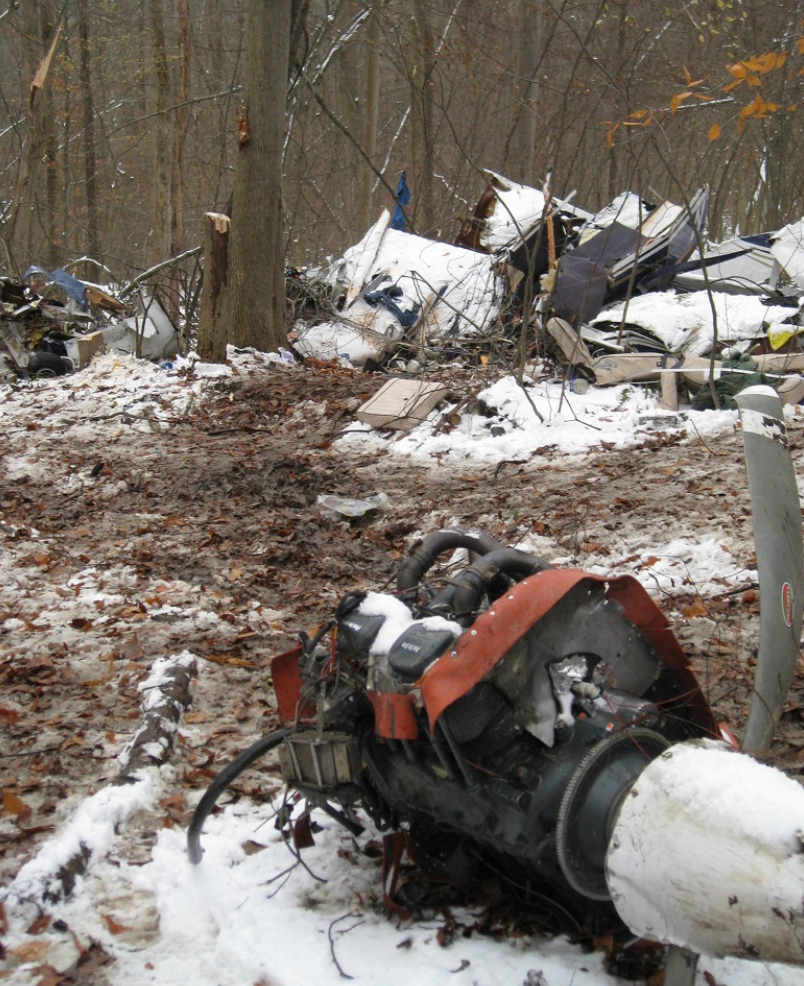
Wreckage in the woods (FAA)
The wreckage was located the next day, half a mile from the threshold, in a wooded area. The wreckage path demonstrated a gradual descent into trees where the airplane was destroyed. There were no preimpact mechanical issues with either engine, either propeller, or the airframe.
A hunter in a tree stand three-quarters of a mile from the wreck reported that he couldn’t see well because of the wind and snow. He heard loud engine noise for ten to fifteen seconds. Then silence.
NTSB probable cause: “The pilot’s continued descent below the minimum descent altitude while conducting an instrument approach in instrument meteorological conditions, which resulted in controlled flight into terrain.” (NTSB ERA21LA035)

Main wreckage recovered (FAA)
The Decision Gates
When a qualified pilot flies a published approach into the ground, the instinct is to look for a mechanical explanation or something unusual in the weather. There isn’t one here. The airplane worked and the weather was within legal approach minimums. However, in this case, the flight deteriorated across three gates where the correct action was clear and the pilot chose otherwise.
Gate 1: The decision to launch on a flight his instructor didn’t think he should make.
His instructor was experienced enough with him to know his ceiling. This was a mentor telling a friend what he was already worried about. The pilot heard it and took off anyway. That’s the decision that put him in position to make all the others.
The check: When somebody who knows your flying tells you no, that’s data. Pretending it isn’t data is the most expensive thing you can do in an airplane.
Gate 2: The weather check before the approach.
His own PIREP on the arrival described in and out of clouds, updrafts, downdrafts, snow, light to moderate turbulence. The same data should have driven a request for current weather at Jamestown and a real decision on whether to shoot the approach at all. If he got a weather update, the NTSB didn’t mention it in their report.
The check: Always get a weather update before you try to fly an approach in the weather. Additionally, if the PIREP you’re giving ATC describes conditions you wouldn’t want to land in, you should probably ask the controller for current destination weather before you accept the clearance. Flying an approach is a decision, not a default.
Gate 3: The continued descent past MDA without the runway environment in sight.
Broken at 1,000 AGL and scattered at 500 AGL means that he almost certainly broke out above minimums. However, on a snowy night over terrain with no ground lights, he likely struggled to see the runway. Looking outside on a dark approach is the most dangerous thing a pilot can do without an aggressive cross-check of the altimeter, because the eye keeps searching for lights that aren’t there yet and the airplane keeps going down until you hit the ground.
The check: At MDA, the decision is binary. Runway in sight, continue. Runway not in sight, go missed. If you have to think about it, the answer is go missed. Pilots fly into terrain on instrument approaches because they treat minimums as a number to descend through while they keep looking, instead of a floor they don’t cross without the picture.
Before your next flight
Here are a few things I want you to think about.
- Brief the miss before the approach, out loud, every time. If the words aren’t fresh when the runway doesn’t appear, you won’t invent them in the moment.
- If the PIREP you’d give right now describes conditions you wouldn’t want to land in, get a current weather report for the destination before you accept the approach clearance.
- The MDA is not a suggestion. Runway in sight, continue. Runway not in sight, go missed. The decision is binary and it’s supposed to be automatic.
- On a night approach in poor weather, your eyes will lie to you. Trust the altimeter, not the search for lights.
More patterns like this one
If you want to dig into more CFIT cases from the archive: