A Routine Flight That Never Reached Sealy
On May 28, 2019, a Cessna R172K, registration N2583V, departed Seminole, Texas (Gaines County Airport) just before dawn. The flight’s destination was Sealy, Texas, roughly a few hours away by air. The pilot, a 58-year-old private pilot who owned two irrigation businesses, was on a simple mission—transporting a piece of irrigation pipe to a job site. It wasn’t an unusual flight for him, but the circumstances surrounding this one made it anything but routine.
The flight took off at approximately 4:53 a.m., under dark, pre-sunrise skies. About an hour later, at 5:50 a.m., radar contact and communication were lost. The airplane had gone down in a remote, hilly area near Mertzon, Texas. There were no survivors.
The Pilot Behind the Yoke
The pilot held a private pilot certificate with a single-engine land rating. He was not instrument-rated and was flying under visual flight rules (VFR). According to FAA medical records from May 2016, he reported 780 total flight hours. His third-class medical certificate had expired a year before the accident, in May 2018.
A logbook recovered from the wreckage contained entries dating back to 1993, with the last recorded flight on August 15, 2015. His family mentioned that he hadn’t flown much recently—maybe not at all in the couple of months leading up to the crash. That’s important because night flying, especially in dark, featureless areas, demands proficiency that fades fast without regular practice.
Too Dark to Fly—The Warning the Night Before
The night before the accident, the pilot actually tried to make this same trip. But after taking off, he turned back, telling his family it was “too dark.” That statement says a lot. He was clearly aware of the challenge. His wife even suggested driving and meeting someone halfway instead. But he decided to fly early the next morning instead, believing that a pre-dawn flight would be easier. Unfortunately, the difference between “too dark” and “dark enough to fly” in an unlit area can be minimal.
Conditions Over West Texas
At the time of the accident, weather near Mertzon was reported as visual meteorological conditions (VMC)—clear with 8 miles visibility, overcast at 2,000 feet, and winds out of the south-southwest. So on paper, it looked fine for a VFR flight. But here’s the catch: the crash area was remote and completely devoid of cultural lighting—no towns, no roads, no farm lights. It was what pilots call “black hole conditions.” Even with clear skies, when there’s no visible horizon or ground reference, the world outside the cockpit can turn into a featureless void.
The moon that morning was just 32% illuminated and about 28 degrees above the horizon. That offered very little usable light. Sunrise was still almost an hour away. For a non-instrument-rated pilot flying over dark terrain, this was a textbook setup for spatial disorientation.
Impact in Remote Terrain
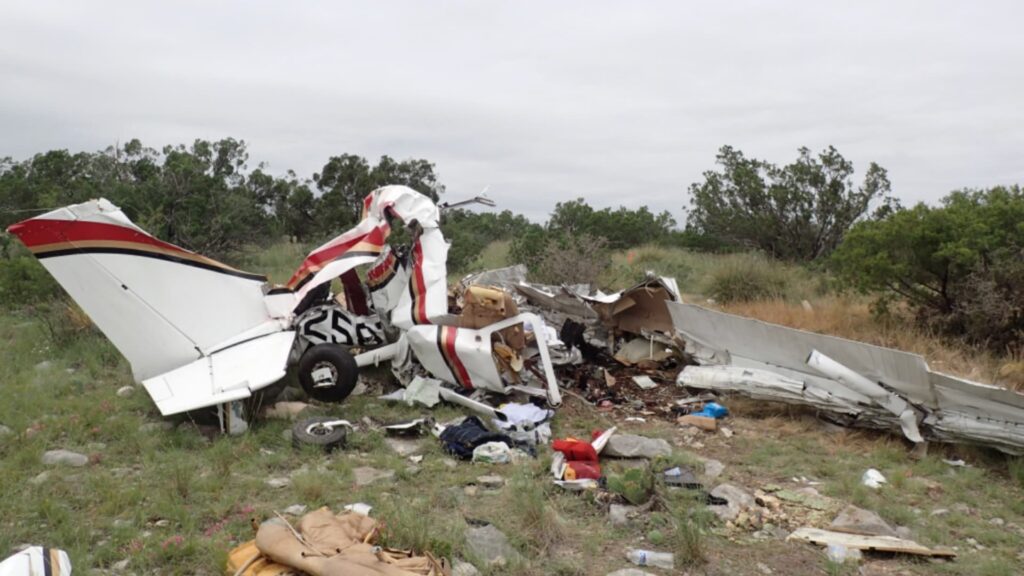
The wreckage was found at an elevation of about 2,330 feet MSL, resting nose-down in rocky terrain. The aircraft hit in a near-vertical attitude. Investigators found all major components of the airplane at the site, indicating it impacted intact. Both wings, tail, and engine were accounted for, and control continuity was verified.
The flaps were up, and there was no indication of any mechanical issues before impact. The engine and magnetos showed typical impact damage but no pre-crash failure. In short, this wasn’t a case of something breaking in flight—the airplane was mechanically sound right up to the moment it hit the ground.
Toxicology Findings
Toxicology tests showed the presence of ethanol in the pilot’s tissues—ranging from 0.032 to 0.085 grams per hectogram depending on the sample. However, due to tissue decomposition, it was unclear how much, if any, of that alcohol was from preflight consumption. Ethanol can develop in the body naturally after death, so the findings didn’t necessarily indicate impairment.
The Human Factor: Spatial Disorientation
Spatial disorientation is one of those insidious killers in aviation. The FAA defines it as a loss of proper bearings or confusion about position relative to the Earth. It often happens when flying without visual references—like in clouds, fog, or darkness over unlit terrain. The inner ear can’t reliably sense small changes in aircraft attitude, and without a visible horizon, the brain starts making incorrect assumptions about what “level” feels like.
The FAA’s Airplane Flying Handbook warns that pilots in these conditions may believe they’re level while actually descending or banking. Once that false sensation sets in, it can take just seconds to lose control—especially in a steep, descending turn.
In this case, the NTSB determined the pilot likely became spatially disoriented shortly after takeoff. The aircraft entered an uncontrolled descent, striking the ground nose-first. There was no sign of an in-flight breakup or attempted recovery.
The Bigger Picture: Training and Decision Making
The pilot’s lack of an instrument rating and his limited recent flight time likely played significant roles. Night VFR flight in a featureless environment can be deceptive, even for experienced aviators. Without an instrument rating—and the practice that goes with it—recognizing and correcting disorientation quickly is almost impossible.
What stands out here is that the pilot recognized the risk the night before and aborted the flight, yet attempted it again under nearly identical lighting conditions just hours later. It’s a reminder that self-awareness is good, but it only helps if it leads to a change in decision-making. The same hazards that made him turn around the first time were still there.
Lessons Learned
This accident is a classic case study in how night VFR over dark terrain can turn fatal, even for a competent private pilot. Spatial disorientation doesn’t require bad weather—it just needs darkness and the absence of visual cues. For pilots without an instrument rating, it’s a situation to avoid entirely.
The key takeaway is simple: if the flight feels “too dark,” it probably is. Pre-dawn flights over unlit terrain should be treated with the same respect as instrument conditions. If you’re not current on instruments—or don’t hold the rating—wait for daylight.
The airplane performed as expected. The weather was fine. The issue was visual perception—and human limits. As pilots, that’s the one system we can’t modify, only manage. Recognizing that limitation and planning accordingly is one of the most important parts of aeronautical decision-making.