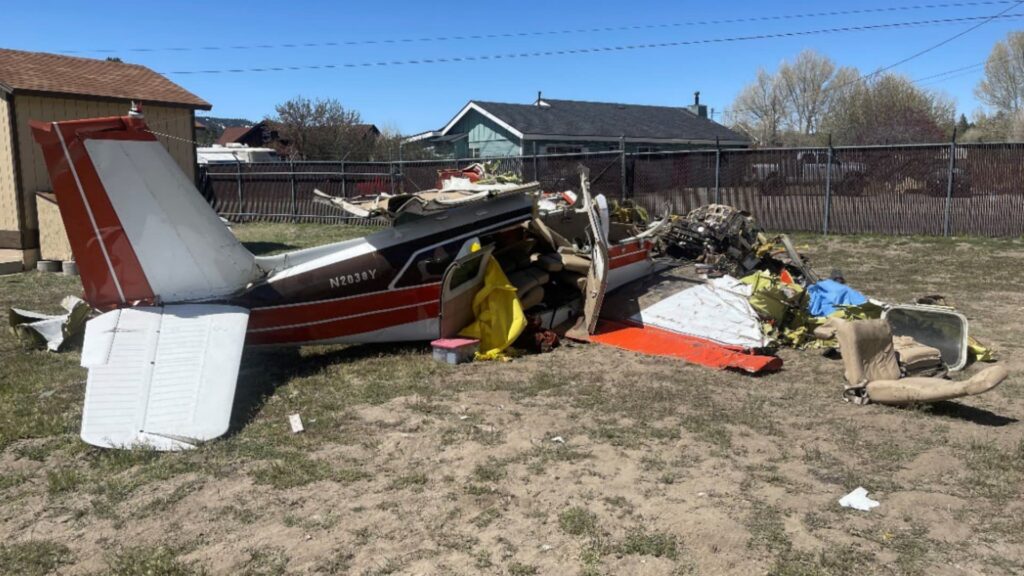
When flying into mountainous terrain, the skies can look deceptively calm. But as this tragic accident over Big Bear, California, reminds us, the real danger often lies in the invisible forces of wind, altitude, and judgment. Let’s take a detailed, human-centered look at the events of May 1, 2023, when a Beechcraft A36 Bonanza spiraled to the ground just short of the runway, claiming the lives of the pilot and two passengers.
A Routine Flight with a Purpose
The day began like many cross-country general aviation flights. The pilot, a 60-year-old man with a private pilot certificate, was taking two passengers to Big Bear City Airport (L35) for a pre-buy aircraft inspection. He wasn’t new to aviation: his logbook and FAA records estimated 2,000 total hours, including nearly 982 hours in the Beech A36, the very model they were flying. However, he did not hold an instrument rating, and his last documented flight review dated back to 2019—over three years earlier.
The flight started at French Valley Airport (F70), made a short stop at Corona Municipal Airport (AJO), and departed for Big Bear at 1:32 PM local time. Conditions at the time seemed benign at first glance: clear skies, good visibility, and daylight.
The Descent Into Big Bear
At around 1:59 PM, as the pilot began his approach into Big Bear, things started to unravel.
ADS-B data and surveillance video revealed that the airplane overshot the runway centerline while turning from base to final. A correction was made—a 20° left turn to realign with the runway. However, the airplane was now at a low airspeed of just 66 knots, descending through thin air at a density altitude of 8,200 feet.
Witnesses and surveillance footage caught the final moments: the right wing dropped abruptly, the airplane rolled right and descended rapidly. A moment of level flight was observed—perhaps a fleeting attempt at recovery—but then the wing dropped again. The Bonanza entered a sharp right roll and plunged nose-first into terrain.
The impact was fatal. All three occupants were killed instantly.
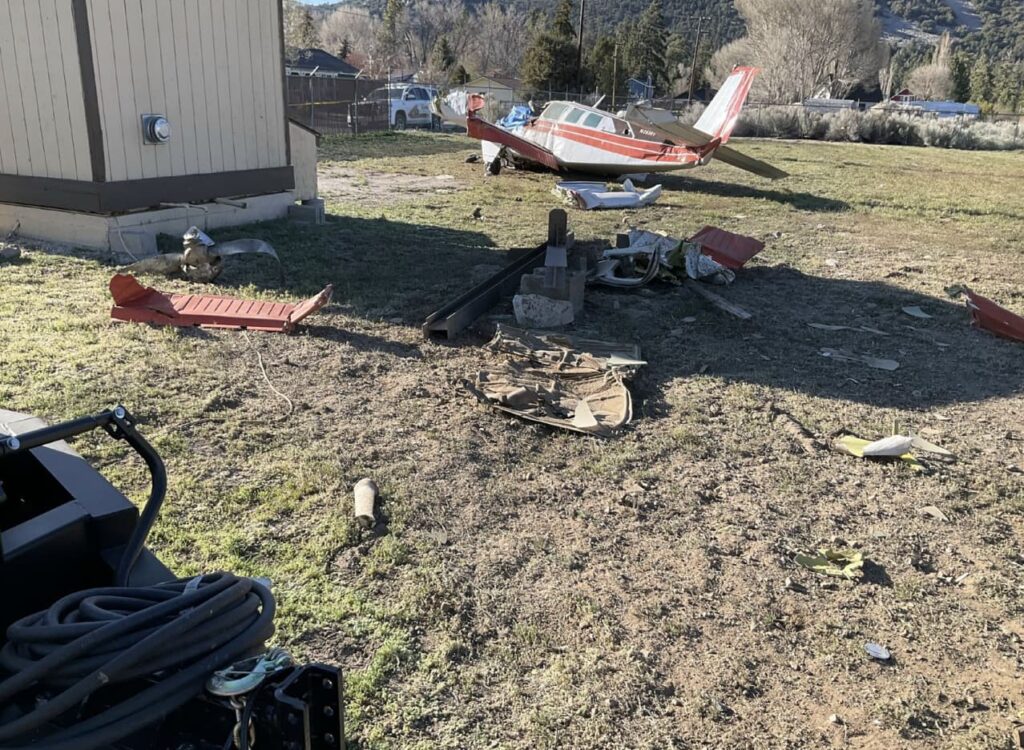
The Aftermath: Forensics in the Wreckage
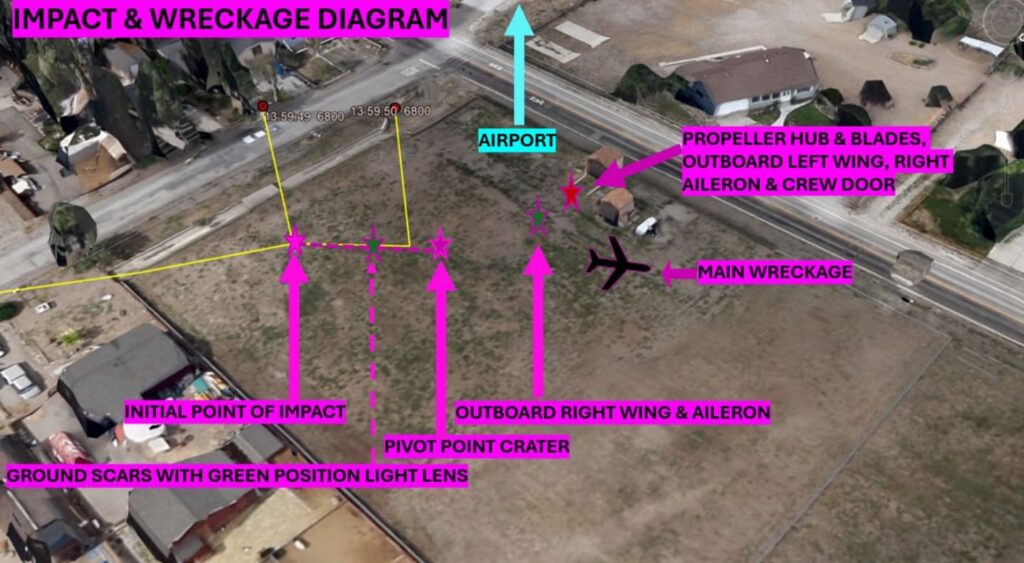
When investigators examined the wreckage, they found no signs of mechanical failure. The flaps and landing gear were consistent with an approach configuration. Fuel was present, the engine showed signs of power at impact, and no anomalies in the control systems were noted.
The aircraft hit the ground in a nose-down, right bank attitude, indicating a final, unrecoverable stall-spin scenario. The right wing struck first, followed by a cartwheeling motion that tore apart the fuselage and wings. The propeller was separated from the engine, and while the crash was severe, there was no fire.
Toxicology showed no drugs or impairing substances in the pilot’s system.
What Went Wrong?
The NTSB’s analysis points to a combination of aerodynamic and environmental factors:
- Stall in the Pattern
The airplane’s airspeed was too low for the high-density altitude conditions, and the attempt to rejoin the final approach with a left turn created increased load on the wings. The right wing likely exceeded its critical angle of attack, triggering an aerodynamic stall—the defining event of this crash. - Severe Wind Conditions
Mountain airports like Big Bear are notorious for treacherous wind patterns. On this day, weather models revealed strong southerly winds, gusting up to 60 mph, and a hydraulic jump—a violent vertical wind phenomenon. Turbulence, downdrafts, and abrupt airspeed fluctuations would have made precise control extremely difficult. - No Weather Briefing Taken
Critically, the pilot had not contacted any official weather services (like Leidos Flight Service), nor was there any evidence he used apps like ForeFlight for pre-flight planning. That means he likely flew blind to the turbulence warnings, including a G-AIRMET for moderate turbulence and a special urgent advisory issued just 30 minutes before takeoff. - Human Factors and Planning Gaps
The pilot had experience in the aircraft but lacked recent training. He also did not file a flight plan and flew into a challenging, high-altitude airport without an instrument rating or support from ATC. Combined with the pressure of a pre-buy inspection and carrying passengers, these human elements added layers of risk.
Lessons from the Mountain
This accident is a sobering example of how high-altitude flying can quickly become deadly—even under visual conditions. Here are key takeaways for pilots and aviation enthusiasts:
- Mountain Weather Is Notoriously Deceptive
Clear skies don’t mean calm winds. Always check for mountain wave activity, turbulence, and advisories—even for short flights. The NTSB referenced FAA Advisory Circular 00-57 for a reason: it clearly outlines how hydraulic jumps and downslope winds can create invisible threats. - Altitude Steals Performance
At 8,200 feet density altitude, the same indicated airspeed gives you less lift and less control authority. Stall margins shrink dramatically, especially when maneuvering. Add a tailwind and turbulence, and the envelope gets dangerously tight. - Preflight Weather Briefings Are Critical
Despite being optional under VFR, weather briefings are essential. The pilot never consulted official or third-party weather services, even though urgent wind advisories were active. In this case, what he didn’t know may have sealed his fate. - Stay Current, Stay Sharp
Though the pilot had experience, his last recorded flight review was in 20can19, and his instrument training was absent. Keeping current isn’t just about legality—it’s about maintaining skills for those unexpected moments that require precision and decision-making under stress.