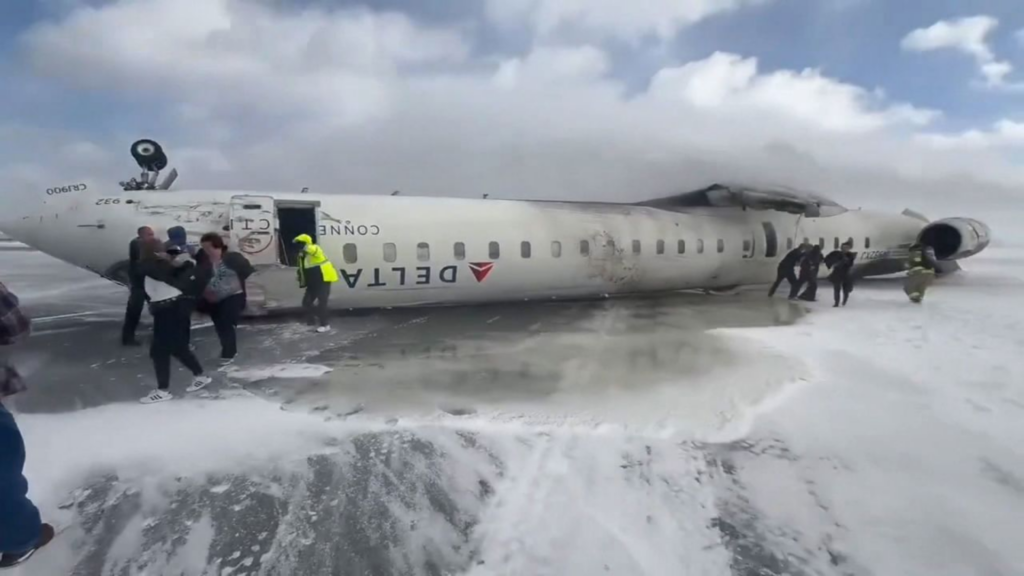
A dramatic landing accident at Toronto Pearson International Airport (YYZ) left a Delta Connection Bombardier CRJ-900 regional jet severely damaged but fortunately did not result in any fatalities. Delta Air Lines Flight 4819, which was being being operated by Endeavor Air, was attempting to land on Runway 23 when disaster struck, leaving passengers and crew shaken and emergency services scrambling into action.
Footage from a CCTV Camera at Toronto Pearson International Airport, appears to capture today’s crash and flip of a Delta Air Lines CRJ-900LR operated by Endeavor Air. It’s truly a Miracle that nobody was killed in the Crash. pic.twitter.com/1qrzYPrH2l
— OSINTdefender (@sentdefender) February 18, 2025
The Incident: A Close Call
On touchdown, the aircraft’s right main landing gear collapsed, causing the right wing to scrape against the runway. Within seconds, a fire erupted as the aircraft’s wing dragged along the pavement for approximately three seconds before the plane flipped over, coming to a rest in an inverted position. Emergency services responded swiftly, containing most of the post-crash fire before it could spread further.
Miraculously, all 76 passengers and four crew members survived, though 18 individuals sustained injuries, including three with serious conditions.
NEW: New video emerges showing Delta flight 4819 flipping on the runway as it landed at Toronto Pearson International Airport.
— Collin Rugg (@CollinRugg) February 18, 2025
One survivor said they were all “hanging like bats” after the plane flipped over as all they had holding them in was their seatbelts.
“It was just… pic.twitter.com/W3ckMzKn9A
Aftermath and Wreckage
Images from the scene paint a stark picture: the CRJ-900’s right wing had separated completely, while the aircraft remained belly-up on the runway. The main landing gear and tail control surfaces were also torn apart due to the impact. However, the left wing and nose gear remained attached to the airframe, providing some structural integrity amid the destruction.
NEW: New footage shows passengers walking on the ceiling to escape the Delta jet that crashed in Toronto, Canada.
— Collin Rugg (@CollinRugg) February 17, 2025
“Don’t take a video. Put that phone away,” a flight attendant could be heard saying.
Here is what we know so far:
– 15 people including a child were injured, at… pic.twitter.com/7FHt16WP2Q
Weather Conditions at the Time
Weather could have played a role in the challenges faced during the landing. Just 12 minutes before the accident, Toronto Pearson’s automated surface observing system recorded winds from 270° at 28 knots, gusting up to 35 knots. Visibility was reduced to six miles due to blowing snow, with cloud cover at 3,400 feet above ground level. The temperature stood at -9°C with a dew point of -14°C.
Twenty minutes after the accident, winds were still strong at 20 knots, gusting up to 32 knots, with similar visibility and cloud cover.
BREAKING: Delta Airlines plane crash lands at Toronto Pearson International Airport.
— Collin Rugg (@CollinRugg) February 17, 2025
“Toronto Pearson is aware of an incident upon landing involving a Delta Airlines plane arriving from Minneapolis. Emergency teams are responding,” the airport said.
All passengers and crew are… pic.twitter.com/GiEAnVtTaP
What’s Next?
Investigations are underway to determine the precise factors that led to the gear collapse and subsequent accident. While weather conditions were certainly demanding, further analysis will reveal if mechanical issues or other factors played a role in the incident.
For now, this serves as a stark reminder of the complexities and risks involved in aviation.