What Happened
On the evening of January 23, 2010, a 1974 Smith Aerostar 601P, registration N222AQ, departed Aurora Municipal Airport (KARR) in Aurora, Illinois, at 1850 central standard time. The flight was bound for Rocky Mountain Metropolitan Airport near Denver, Colorado. Both the pilot and his passenger were killed when the airplane struck trees and a residence approximately 2.3 miles north-northeast of the departure airport. Four people inside the residence escaped without injury. The airplane was destroyed by impact forces and a post-impact fire.
Earlier that day, a fixed base operator employee watched the pilot arrive at the airport around 15 minutes before departure. He used his own laptop to file an IFR flight plan. The FBO employee later told investigators he mentioned the fog and some icing along the route. A lineman pulled the airplane out of the hangar and helped load luggage. The pilot walked directly to the airplane and departed. The FBO employee stated he did not perform a preflight inspection. She noted they seemed to be in a hurry.
The weather at KARR at the time of departure was unambiguous. Wind from 140 degrees at 7 knots. Visibility one-half mile in fog. Vertical visibility 100 feet. Temperature and dew point both sat at 4 degrees Celsius, meaning the air was saturated. The altimeter read 29.63 inches. The airplane was not certified for flight into known icing conditions, and those were the conditions on the ground before the airplane ever left the runway.
The Aerostar rolled down runway 09 and lifted off into that soup. Departure control made contact. The pilot reported leaving 1,300 feet, climbing to 3,000. The controller cleared him to 4,000 feet. He acknowledged. That was the last transmission. No further radio contact was established, and no radar data was available for the flight.
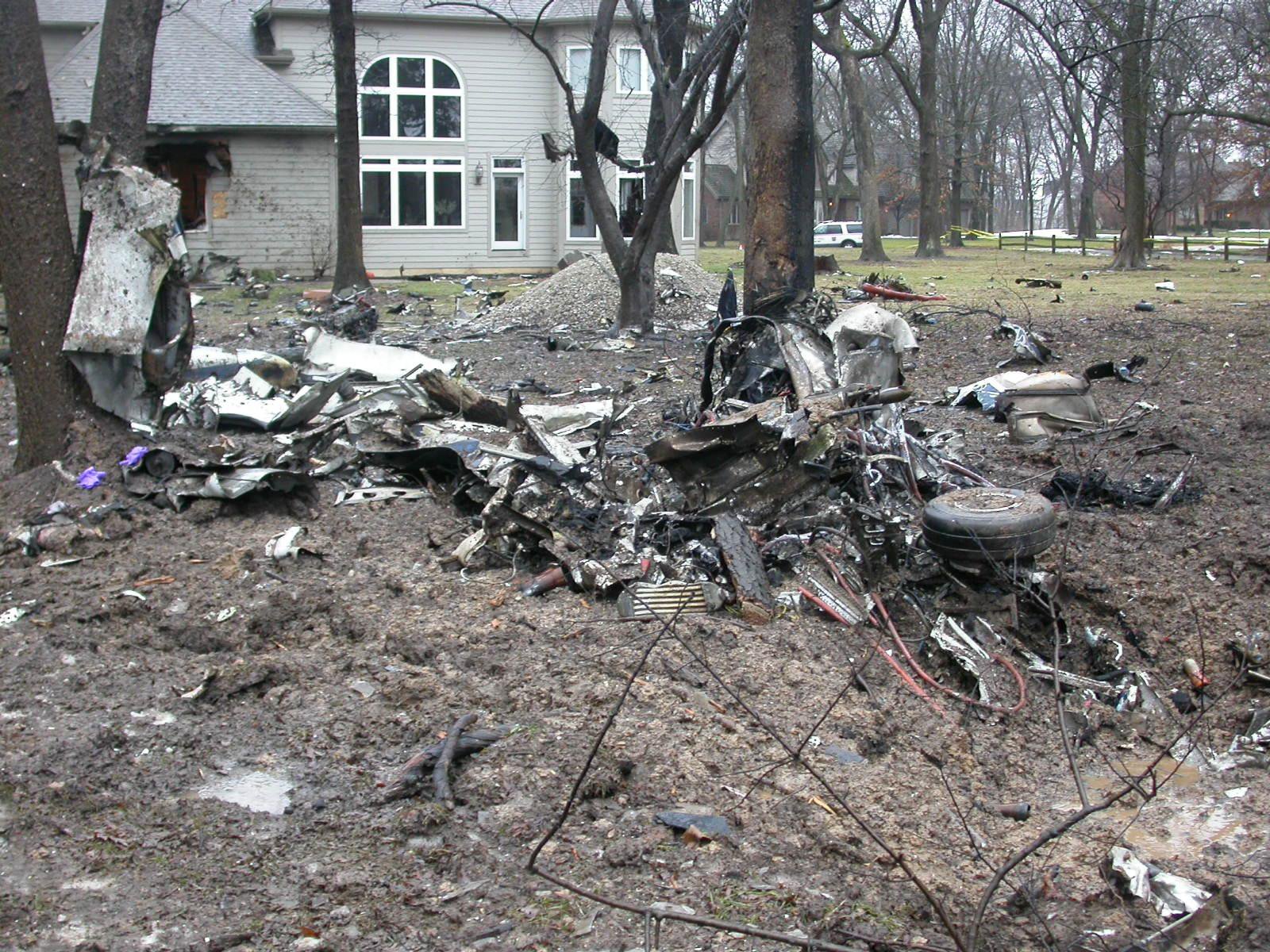
A witness standing outside about 1.5 miles northeast of KARR had to stop a phone conversation because the airplane was so loud as it passed overhead, just clearing the top of an oak tree on his property. Several other witnesses in the area heard the engines. A local fire chief who lived near the accident site heard the airplane fly directly over his house. He described it as very low, with the engines producing power.
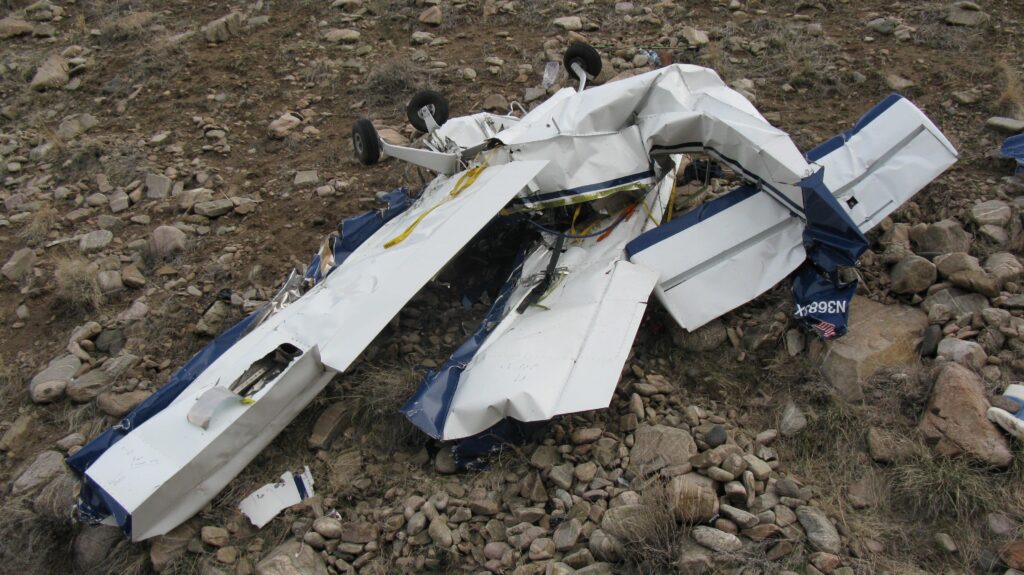
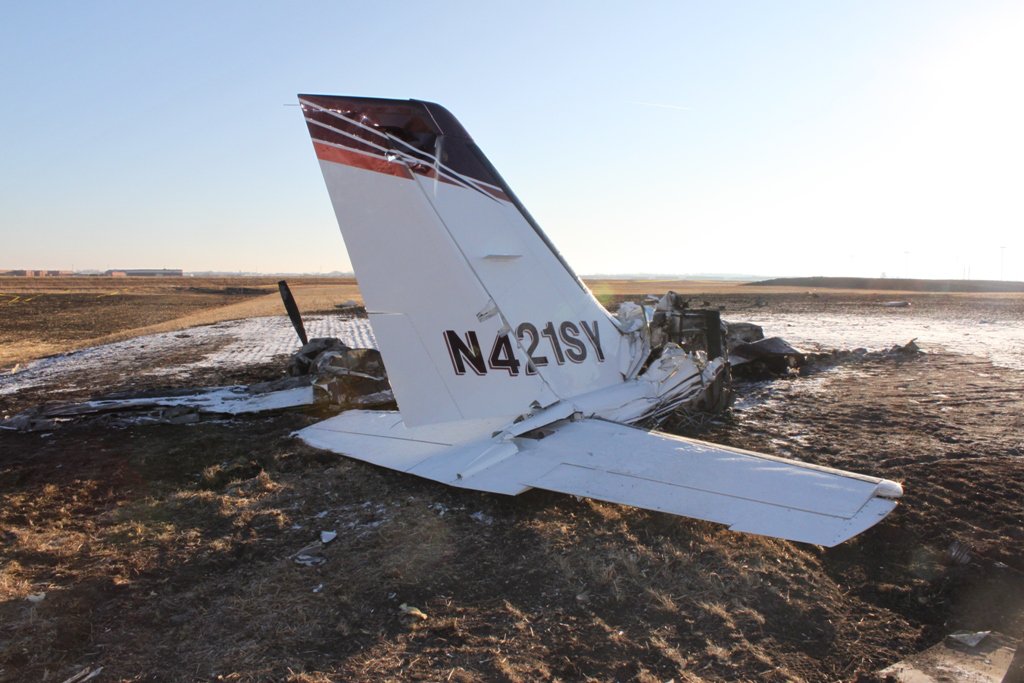
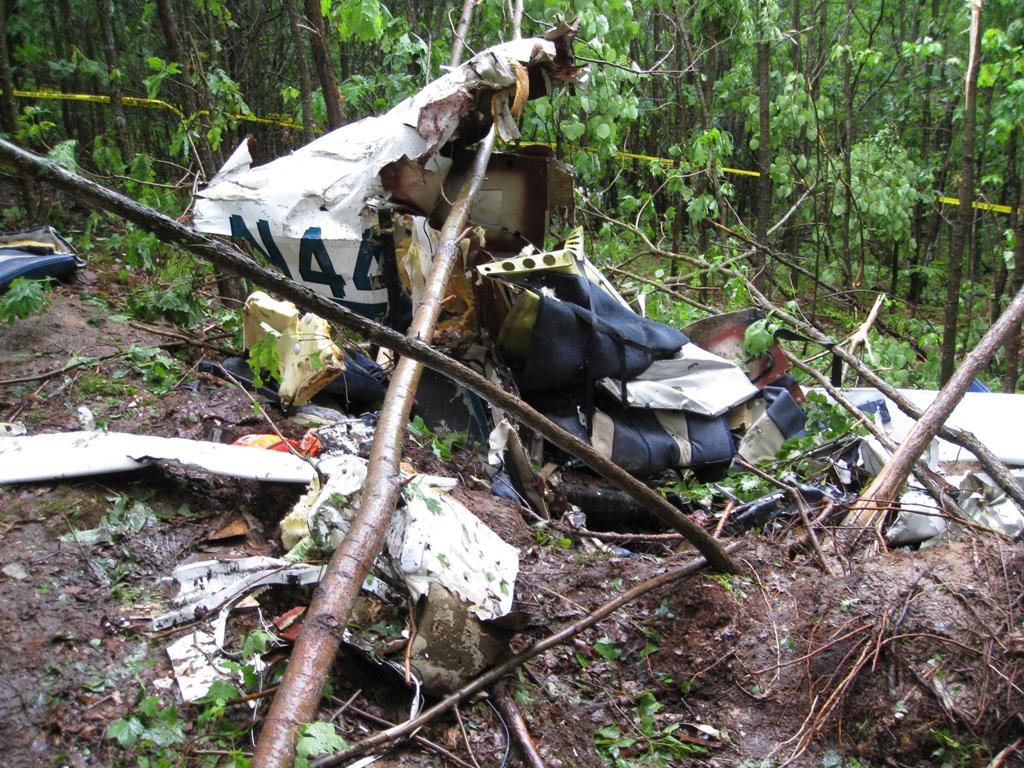
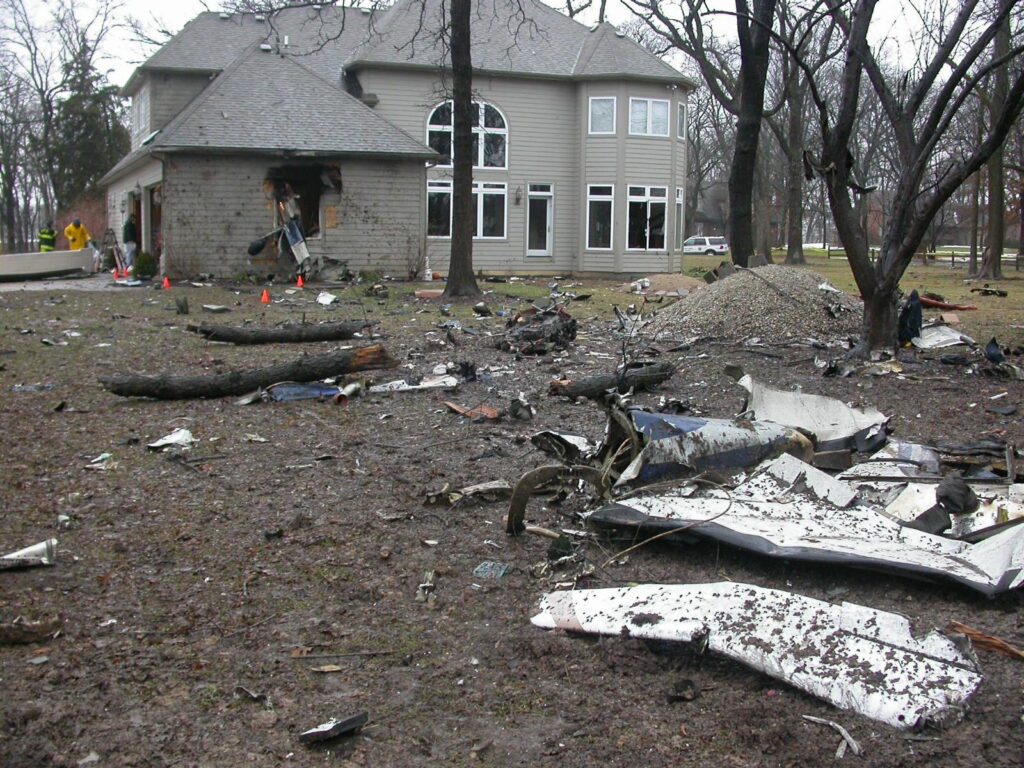
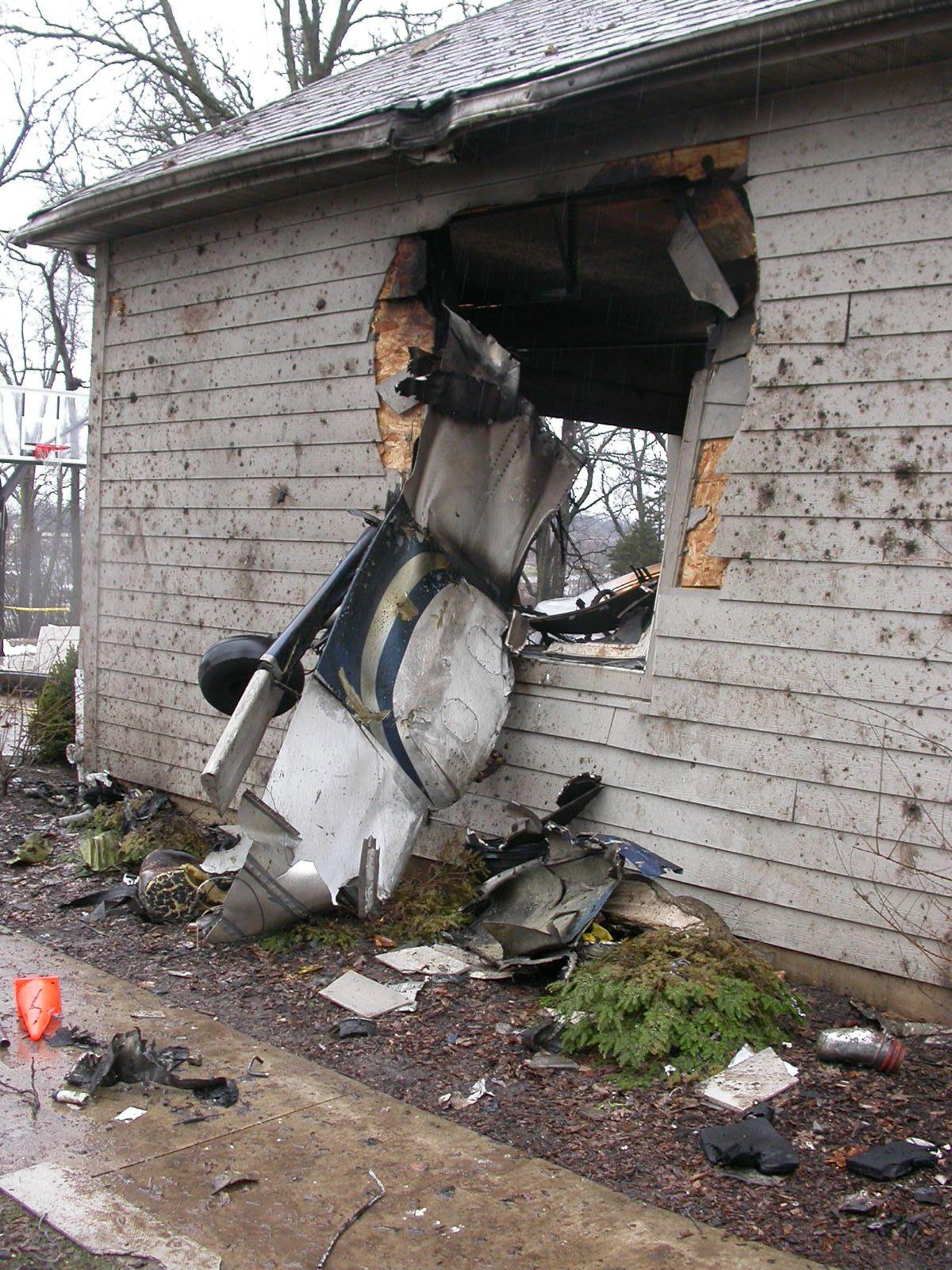
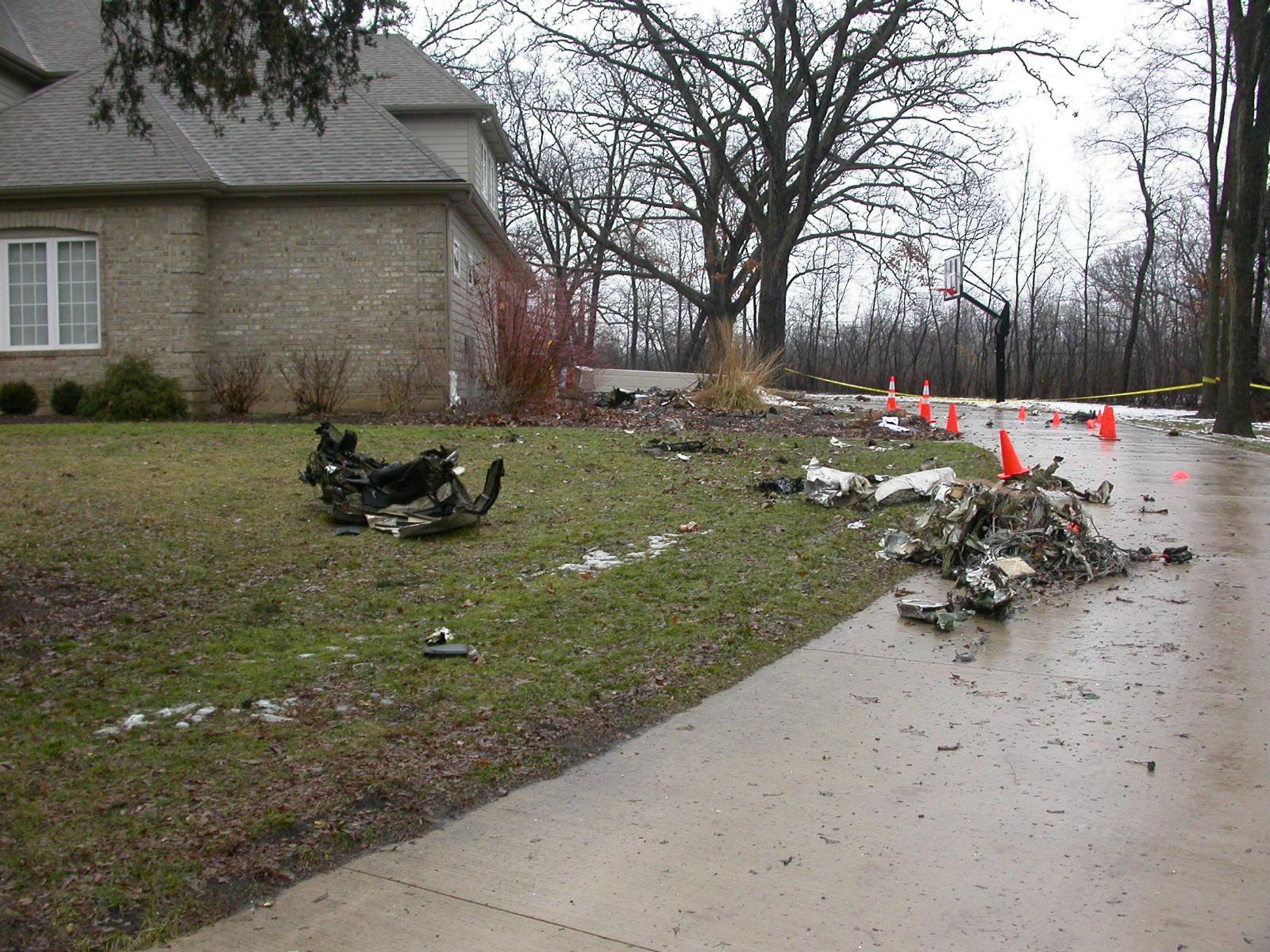
The wreckage path ran along a magnetic heading of 220 degrees and was approximately 120 feet in length from the first tree strike to the garage it partially embedded itself into. The airplane hit a 60-foot tree first, shedding the right wingtip strobe and an outboard section of the right wing. It then struck a second 60-foot tree, shearing off the top half. The right propeller drove itself 12 inches into the ground at the base of that second tree. The left engine, left propeller, wing sections, and most of the fuselage came to rest just beyond. A 9-foot section of the right wing and engine nacelle punched through the back wall of a residential garage. Three vehicles inside the garage sustained impact and fire damage. Small pieces of wreckage came through the kitchen windows of the home. A homeowner inside stated she had just stepped out of the kitchen when she heard the noise and felt the house shake. She and three family members walked out the front door, not yet knowing an airplane had hit them.
Investigation Findings
The pilot held a commercial certificate with single-engine land, multi-engine land, and instrument airplane ratings. He was 37 years old. His instrument rating had been issued on April 10, 2009, less than a year before the accident. His multi-engine rating came on June 15, 2009, after he failed the practical exam on his first attempt on June 12. His most recent FAA medical was a second-class certificate issued April 2, 2008, with no limitations. His logbooks were never located.
What investigators had was an insurance application dated October 27, 2009, roughly three months before the accident. On that application, the pilot self-reported 503.2 total hours, 437.9 as pilot-in-command, 72.6 hours of instrument time, and zero hours in the Aerostar 601. He had purchased N222AQ on November 10, 2009. A flight instructor who had worked with him on his commercial and instrument ratings told investigators he had tried to talk the pilot out of buying the Aerostar. He thought it was too much airplane. Another instructor who provided insurance-required transition training in the accident airplane said they flew 52 hours over 7 days in November 2009, conducting numerous instrument approaches around Florida. That instructor specifically told the pilot the Aerostar was unforgiving and had limited lateral stability. After those 7 days of instruction, no subsequent logbook entries were available to establish how much additional time the pilot had flown the airplane before the accident flight.
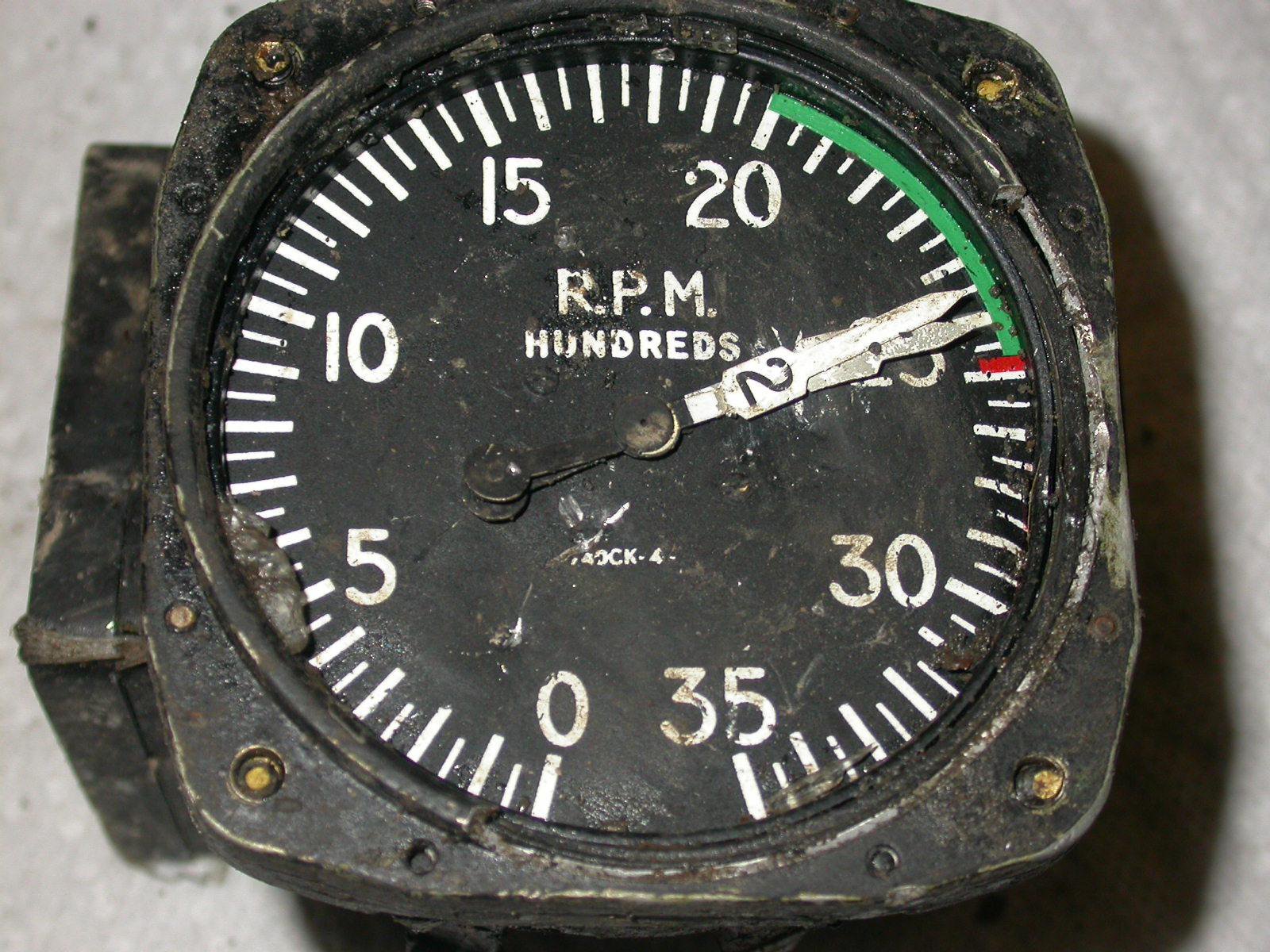
The post-accident engine examinations told a consistent story. Both engines showed spark plug coloring consistent with normal operation. Fuel was found in the injectors, flow dividers, and fuel pumps of both engines. Borescope inspections of the cylinders revealed no anomalies. The right engine crankshaft could be rotated by hand with thumb compression and suction on all cylinders and full valve train continuity. The left engine could not be rotated due to crankcase displacement from impact forces, not from any internal failure. Both vacuum pumps rotated freely and were found intact when opened. Propeller blade damage on both sides showed twisting, chordwise scratching, and sheared pitch stops, all consistent with the engines producing power at impact, which matched the tachometer reading. Both engine needles were bent at the mid-span position, the bend point corresponding to a mark on the face plate near 2,500 rpm. The investigation found no mechanical failure or malfunction that would have caused the accident. The airplane also had no record of weather or flight information being pulled through the DUAT service despite the flight plan being filed through that system.
Toxicological testing detected dextromethorphan in the pilot’s liver and kidney. Dextromethorphan is the active ingredient in most over-the-counter cough and cold medications. The NTSB noted the finding but did not cite impairment as a causative factor.
NTSB Probable Cause
The pilot’s spatial disorientation and subsequent failure to maintain airplane control.
Safety Lessons
This accident compresses several separate problems into a single departure that lasted under two minutes. Each problem was survivable on its own. Together, they were not.
- Vertical visibility of 100 feet is not an instrument departure condition, it is a no-go condition. An IFR flight plan does not obligate a departure. The weather at KARR that night placed the cloud base effectively at ground level. Standard instrument departure procedures require obstacle clearance that assumes the airplane can climb. With a vertical visibility of 100 feet and forward visibility of half a mile, there is no visual reference available to correct attitude until well above the ground. A pilot who has not fully internalized instrument scan discipline, especially in an airplane he had owned for 10 weeks, is dependent on the accuracy and speed of his cross-check from the first second off the runway. That scan has to work flawlessly before the wheels retract.
- Transition training intensity is not the same as proficiency. Fifty-two hours in 7 days produced a pilot who had the procedures but not the reflexes. High-performance multi-engine instrument flying in a pressurized twin builds real skill through repeated exposure over time, not volume compression. The Aerostar 601P has a clean-wing stall speed and roll rate that require constant attention at low altitude. The instructor said it directly: the airplane was unforgiving and lacked lateral stability. That assessment mattered most in the conditions present that night, and it deserved more weight than a departure into a 100-foot ceiling.
- Weather briefings are not optional on IFR flights, even when you already know the conditions are bad. The DUAT record showed a filed flight plan with no associated weather request. The FBO employee heard the pilot mention fog and icing. Knowing a condition exists and formally briefing it are different things. A formal briefing creates a paper record, forces a structured review of PIREPs, AIRMETs, SIGMETs, and freezing levels, and sometimes surfaces a detail that changes a decision. The pilot knew it was foggy. What he may not have fully processed was that the fog was sitting on the ground at the airport he was departing from, with no ceiling above it and a destination that was more than 800 nautical miles away.
Frequently Asked Questions
Q: What is the Aerostar 601P and why is it considered a demanding airplane?
A: The Smith Aerostar 601P is a pressurized twin-engine piston airplane originally designed by Ted Smith and produced in the 1970s. It is known for high cruise speeds, a clean aerodynamic profile, and limited lateral stability compared to other light twins of the era. Instructors frequently describe it as unforgiving at low altitude because its roll response and energy management require a well-developed instrument scan and precise control inputs. The 601P variant adds pressurization, which increases system complexity further.
Q: How does spatial disorientation develop so quickly after takeoff in IMC?
A: Spatial disorientation can begin within seconds of entering instrument conditions, particularly when the transition from visual to instrument flight is abrupt. The vestibular system, specifically the semicircular canals in the inner ear, detects angular acceleration but not constant rate turns. A gradual roll into a bank in low visibility may produce no sensation of turning at all. If the pilot then attempts to level the wings based on feel rather than instruments, he often applies opposite inputs that steepens the bank. Departure is the highest-risk phase because the airplane is accelerating, climbing, and often turning simultaneously, all while the pilot is managing communications and initial climb tasks.
Q: Was the Aerostar N222AQ legal to depart in those conditions?
A: An IFR flight plan was filed and the pilot held an instrument rating, so the departure was not explicitly prohibited under instrument meteorological conditions. However, the Aerostar 601P was not certified for flight into known icing conditions, and the pilot had acknowledged icing along the route. The decision to depart into a 100-foot vertical visibility environment with a half-mile of forward visibility, in an airplane he had owned for roughly 10 weeks, with 72.6 total instrument hours, fell within the legal bounds of IFR operations but well outside any reasonable personal minimums for a pilot with that experience level in that aircraft.
Q: What did the propeller and engine evidence tell investigators about the flight?
A: The propeller blade damage, specifically the twisting, chordwise scratching, and sheared pitch stops, along with tachometer needle positions bent near 2,500 rpm at impact, indicated both engines were producing power when the airplane hit the ground. This ruled out engine failure as a contributing factor and confirmed the airplane was airborne and under power until the moment it struck the first tree. The absence of any mechanical anomaly on post-accident inspection was consistent with a controlled aircraft that was simply not being controlled.
Q: What does the wreckage path direction tell us about the final moments of the flight?
A: The wreckage path ran along a magnetic heading of 220 degrees, meaning the airplane was tracking roughly southwest when it struck the trees. It departed runway 09 heading east, was issued a left turn to 270 degrees heading west, and impacted terrain approximately 2.3 miles north-northeast of the airport tracking southwest. That ground track, combined with the witness account of the airplane at treetop height 1.5 miles northeast of the airport, suggests the airplane completed at least a partial left turn before losing altitude. The NTSB described the turning ground track combined with the low visibility conditions as conducive to spatial disorientation onset.