
When the engine quits, the next minute belongs to the plan you hopefully already had.
Engine failure accidents aren’t decision traps the way most patterns are. The pilot didn’t scud-run into a cloud or press a bad approach. A part inside the engine let go, and the airplane became a glider somewhere it wasn’t planned to be. What happens next isn’t about catching a mistake before it compounds. It’s about whether the pilot had already rehearsed the glide, the field, and the hazards, long before the propeller went quiet.
Most pilots who die this way were not careless. They were handed a short, unforgiving window and had not practiced for it.
From NTSB final reports, 2008–present*
- 3,401 engine-failure accidents in cruise or approach
- 11.3% involved at least one fatality
- 426 people killed
- 5.4% of aircraft destroyed on impact
Look at that fatality number. 11.3% is the lowest of any pattern in this series. An engine failure is not a death sentence. Most pilots who lose an engine in cruise or on approach put the airplane down and walk away, because they have altitude, time, and a place to glide to. The fatal cases are the ones where one of those three ran out first. That’s the good news and the warning in the same sentence: this pattern is survivable, and it is survivable because of work you do before it ever happens.
Now let me show you what one of these 3,401 tragedies looked like.
One real flight
October 18, 2022. Piper PA-32-300 Cherokee Six. A short personal flight to drop the airplane off for avionics work.
The pilot was 62 years old. He held a private certificate with a single-engine land and an instrument rating. He had about 505 total flight hours, 105 of them in the PA-32.
The airplane was a 1969 Cherokee Six with a 300-horsepower Lycoming IO-540. Its most recent annual inspection had been signed off on October 4, 2022, two weeks before the flight. The engine had been overhauled ten years earlier and had run only about 101 hours since. By every record a pilot can see, this was a sound, well-kept airplane.
The morning was the kind you plan a flight around. Clear, ten miles of visibility, a few clouds at 5,000 feet, wind almost calm. The airplane lifted off from Springfield, Tennessee at 07:17 for a short hop to Fayetteville, where it was being dropped off for avionics work.
At 07:33:40 the airplane was in cruise at 5,400 feet, making 139 knots over the ground. Then the engine lost power. Not all of it, not yet. The pilot declared an emergency right away for a partial loss of engine power.
The controller went to work with him, offering the three nearest airports. The pilot picked one; the controller pointed out that Nashville International was two miles closer, so he redirected him there. As the pilot turned toward the airport he was advised to check his mixture.
At 07:35:50 the airplane was at 4,800 feet and 109 knots, and the pilot reported he could still maintain altitude. A minute later, at 4,500 feet, the controller told him the airport was eleven miles ahead, at his eleven o’clock, and cleared him to runway 2L. The controller tried his best to reassure the pilot:
“Just keep flying that airplane all the way through, you’ll be just fine.”
At 07:38:25 the airplane was at 3,500 feet and 94 knots. The pilot announced that the engine was “stopped,” and that the airplane was “heading down.” The partial loss had become total and the airport was still several miles away.
The airplane glided northeast for about forty-five seconds, then entered a left descending turn from around 2,700 feet. The last ADS-B return put it at 800 feet. A witness driving below described an airplane maneuvering about 75 feet above the ground, with no engine noise, making only a “whistling” sound. It struck power lines roughly 50 feet up, crossed the road, and came to rest in the trees on the far side. A post-impact fire followed.
The airplane was destroyed. The pilot, the only person on board, was killed.
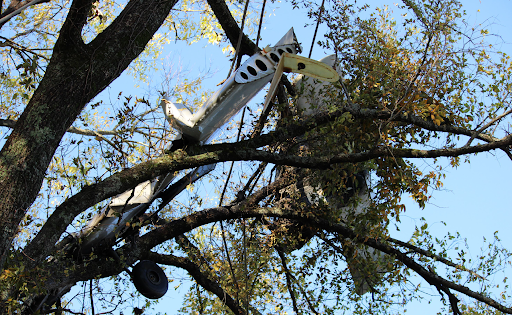
View of left wing and tail section
The reason the engine quit wasn’t anything that happened that morning. When investigators took the engine apart, the crankshaft was fractured by a fatigue crack. The crankshaft itself was the wrong part for this engine model. It had been installed during a field overhaul ten years earlier, along with connecting rod bearings that were also not approved for this engine. The mismatch put stress on the crankshaft every hour it ran, and after about 101 hours the metal gave up. Nothing on the outside of that engine showed it. The annual two weeks earlier couldn’t have found it. The failure was built into the airplane a decade before the pilot ever strapped in.
NTSB probable cause: “A total loss of engine power due to the catastrophic failure of the crankshaft resulting from the improper installation of the crankshaft for this application.” (NTSB ERA23FA025)
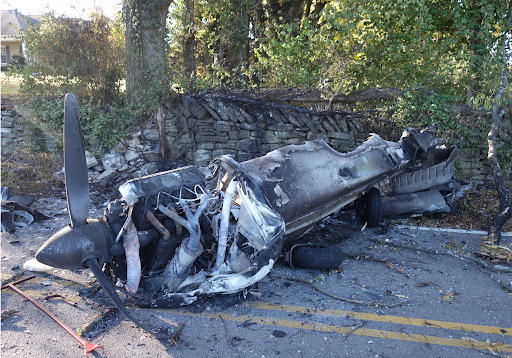
Main wreckage
The Decision Gates
To be perfectly clear, this pilot didn’t make the mistake. He declared early, he worked the problem with the controller, and he flew the airplane. The decision gates below aren’t things he got wrong. They are the three places where an engine failure squeezes any pilot, and the checks are for you, on the flight you have not taken yet.
Gate 1: When the engine first lost power, it didn’t quit all the way.
For about three minutes the airplane held altitude on partial power. The pilot reported he could maintain altitude, and at that moment it was true. But a crankshaft with a fatigue crack in it does not stabilize. The reduced power was not a new, lower normal. It was borrowed time, and the loan came due at 3,500 feet.
The check: Treat a partial power loss the same as a total power loss that hasn’t finished yet. From the first rough second, pick your field and plan your glide as if the engine is already gone. If it keeps running, you’ve lost nothing. If it quits, you are already set up.
Gate 2: The airport was eleven miles away.
With partial power and altitude in hand, a runway eleven miles off was a reasonable place to aim, and the controller helped him get there. But when the engine fully quit at 3,500 feet, that runway was no longer feasible.
The check: Know your airplane’s glide ratio as a real number, not a vague idea. From a few thousand feet, a typical single engine aircraft might give you four or five miles in still air, and less into wind. Leapfrog your options as you fly: always have the best reachable spot already picked, and trade up only when a better one comes into range. The airport you can see isn’t always the airport you can reach.
Gate 3: The field below wasn’t as open as it looked.
When the propeller stopped, the pilot glided toward the ground he had. He came down in an area crossed by power lines strung along a road. From a thousand feet and up, wires are nearly invisible, and the strip of grass beside a road reads as a clear landing area. The airplane struck the lines about 50 feet above the ground.
The check: Assume wires. They run along almost every road, field edge, and property line in the country, and you will not see them from pattern altitude. A construction site looks like an open field from above. A road has traffic on it. When you choose an emergency landing spot, pick the middle of the biggest space you have, plan to touch down away from every edge, and treat every margin as if it is strung with cable.
Before your next flight
Here are a few things I want you to think about.
- If your engine ever runs rough, treat it as a countdown, not a new normal. Reduced power can feel survivable enough to keep flying on, but plan from the first rough second as though the rest of it is about to leave. It can go with no more warning than this pilot got.
- Have a real landing site picked right now, and keep trading up. Not a direction, an actual spot. When a better option slides into glide range, switch to it, so an engine failure never finds you without an answer already chosen.
- Distrust the field that looks easy. Power lines, traffic, and fresh construction all hide inside terrain that reads as landable from altitude. Pick the largest open space you can reach, and aim for the middle of it.
More patterns like this one
If you want to dig into more engine-failure cases from the archive: