Configuration error: the airplane set wrong for the phase of flight, by the hand that was supposed to be flying it.
This is what happens when the flaps, gear, trim, or a control is set for one phase of flight while the airplane is in another. Most of these errors cost a pilot some pride and a prop strike. The lethal ones share one thing in common: low and slow, on a takeoff or go-around, where the wing is already near the edge of what it can do and there isn’t any altitude to trade for recovery. The airplane doesn’t care how busy you are. Below a certain speed, with the flaps coming up, the wing simply stops flying.
From NTSB final reports, 2008–present*
- 657 configuration-error accidents
- 589 of them, roughly 9 in 10, were non-fatal
- 68 were fatal, 10.4%
- 137 people killed
When we look at those stats, most often it’s a story about a pilot that forgot to put the gear down or missed a flap setting on a normal landing. Those routine events turn fatal about 0.6% of the time.
The errors in this pattern kill at 10.4%, roughly seventeen times as often. The difference isn’t the mistake, it’s where it happens. Low and slow, the same error has no altitude underneath it, and the stall that follows has nowhere to go but down.
Now let me show you one of the 68 that turned fatal.
One real flight
June 9, 2016. Cirrus SR20. Personal cross-country, Norman, Oklahoma to Houston.
The pilot’s name was Dana. She held a private pilot certificate earned a little under two years earlier, and her logbook showed no flight review in the preceding 24 months. She was flying her SR20 from Norman to Houston with two passengers on board. All three would be fatally injured within sight of the runway.
Houston Hobby is a busy Class B airport, airline jets and one light Cirrus in the same pattern. From the moment Dana checked in, the instructions almost never stopped: land on runway 4, follow the 737, keep your speed up, go around, right base for 35, no, back to 35.
Over the course of about 16 minutes she was re-sequenced repeatedly, told to go around twice: once for a jet overtaking her, once because she was too high to land. She flew three approaches and completed none.
Minutes before the end, the tower changed controllers and a new voice took the position. Dana was on her third approach, again struggling to get down, and she elected to go around one more time.
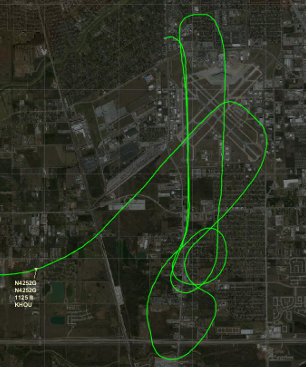
Overview of N4252G’s ground track in the vicinity of HOU
What happened next is in the airplane’s own data, second by second.
As she began the go-around, the airplane was at 63 knots, about a hundred feet over the runway, full flaps, pitching up to climb. The published balked-landing procedure for that airplane is specific: pitch for the best climb speed, 81 to 83 knots, before you touch the flaps.
She never saw that speed. The airplane peaked at 74 knots about five seconds into the climb, then started losing airspeed.
While that happened, the new controller was still transmitting a long instruction to her about the downwind, sequencing behind traffic, which runway it might be, non-stop instruction through the most critical seconds of the go-around until the controller said “straighten up.”
The airplane had entered a left turn. The power, which should have been full, came back from 94% to about 81%. And the flaps came up anyway, exactly when the airspeed couldn’t afford it: from full to half at 62 knots, then from half to none at 58 knots. Published flap-retraction speed was 81 to 83. She raised them at 58, in a bank, with the power reduced and the nose high.
She exceeded the critical angle of attack, rolled hard left, and spun into the ground. The last recorded data point showed a 71-degree left bank, the nose dropping through level with no altitude left to recover.
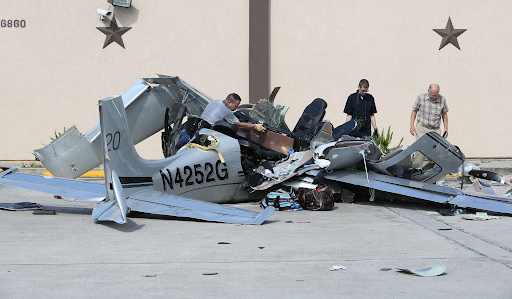
Wreckage
NTSB probable cause: “The pilot’s improper go-around procedure that did not ensure that the airplane was at a safe airspeed before raising the flaps, which resulted in exceedance of the critical angle of attack and resulted in an accelerated aerodynamic stall and spin into terrain. Contributing to the accident were the initial local controller’s decision to keep the pilot in the traffic pattern, the second local controller’s issuance of an unnecessarily complex clearance during a critical phase of flight. Also contributing was the pilot’s lack of assertiveness.” (NTSB CEN16FA211)
The NTSB didn’t stop at Dana’s hand on the flaps. The controllers’ choices are named as contributing too: keeping a light single in a jet pattern, and stacking a complex clearance onto the most critical seconds of the flight. And they also said this:
“Compliance with ATC instructions greatly increased the pilot’s workload as it led to an extended period of close-in maneuvering at a Class B airport.”
That’s the trap. Not one bad decision, but a slow accumulation of inputs that filled every channel she had, until the one that mattered most, airspeed in a go-around, got dropped.
The brutal truth though per the NTSB is that Dana:
“did not assert the responsibilities that accompany being a pilot-in-command… requesting to be re-sequenced, telling the controller to standby, or stating ‘unable.'”
Three phrases. Any one of them, would have handed the workload back and bought Dana the seconds she needed. None of them got said. That isn’t a character flaw. It’s the hardest skill in a saturated cockpit, and the one we practice least.
The Decision Gates
Dana was complying the whole way down. That’s what makes this hard: the pattern isn’t recklessness, it’s compliance carried past the point where it served her. Here are the decisions where the exits were still open.
Gate 1: The workload kept climbing and nobody handed any of it back.
Every instruction got accepted, for 16 minutes straight. The pilot-in-command holds a release valve a controller does not: the authority to say not now. “Unable.” “Standby.” “Re-sequence me, I need a few miles.” Saying any of those is necessary if you’re going to fly the airplane.
The check: When the inputs arrive faster than you can act on them, what are you doing to shed load? If the answer is nothing, you’re falling behind. The word that buys you room is always yours to say.
Gate 2: A go-around is a maneuver with a procedure, not just a decision to climb.
Going around was the right call. But a go-around has an order of operations: power, pitch, airspeed, and only then a staged flap retraction. Under the workload it came apart: power came back instead of going up and the flaps came up before the speed was there.
The check: Do you know the balked-landing procedure for your airplane cold, without reading it off the panel? A go-around is the worst moment to be assembling the steps under pressure.
Gate 3: The flaps came up below the speed that made them safe to move.
This is the mechanism at the center of the whole issue. Full flaps to half at 62 knots, half to none at 58, against a published retraction speed of 81 to 83. The airplane stalled because it was configured for a speed it never had.
The check: In any low, slow phase, a hand reaching for the flap or gear lever should trip one question first. What is my airspeed, and does this configuration match it?
Before your next flight
Here are a few things I want you to think about.
- In any low, slow phase, treat the flap and gear levers as airspeed-gated. Before your hand moves one, name your airspeed and confirm the configuration matches it.
- Know your balked-landing procedure cold, the climb speed and the sequence, so a go-around is something you execute, not something you improvise.
- When the radio hands you more than you can act on, you’re allowed to give some of it back. “Standby.” “Unable.” “Re-sequence me.” Practice the words out loud now, so they are there when the cockpit fills up.
- You are the only one flying your airplane, and the only one who can decide it has run out of capacity.
More patterns like this one
If you want to dig into more configuration-error cases from the archive: