What Happened
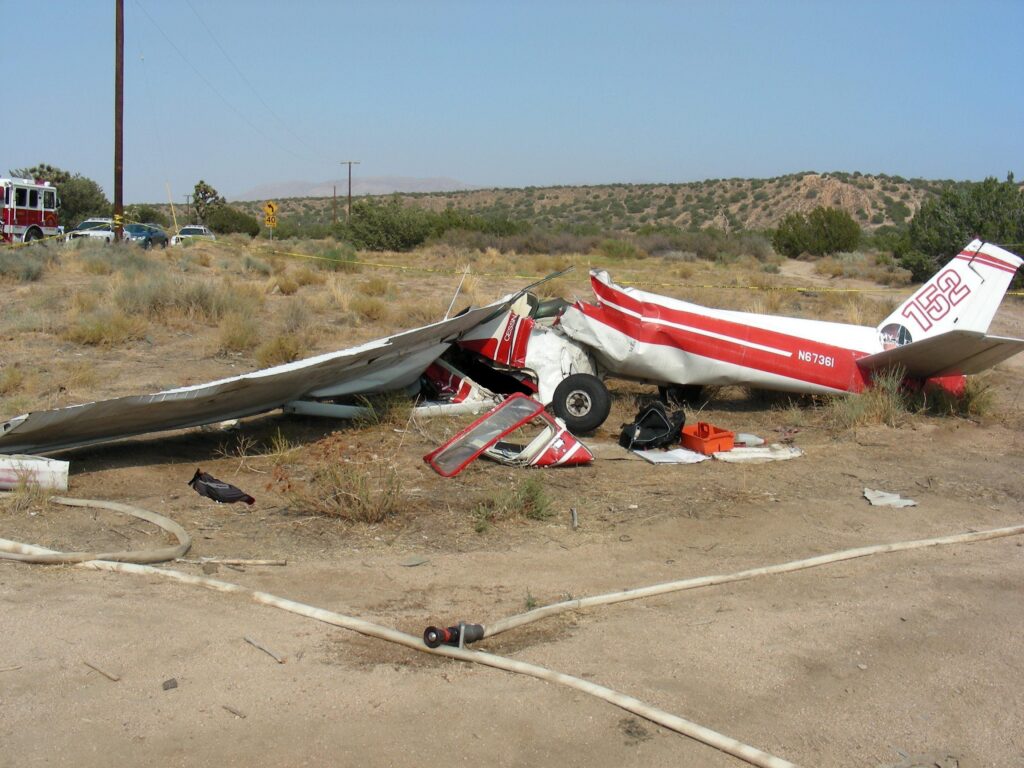
On August 16, 2009, at approximately 1121 Pacific daylight time, a Cessna 152, registration N67361, descended nearly straight down into sandy terrain about a quarter mile southeast of the Hesperia Airport in Hesperia, California. The airplane was operated by M.Y. AIR, a flight school based in Redlands, California. Both the 41-year-old private pilot and his passenger were killed on impact. The airplane was substantially damaged. Visual meteorological conditions prevailed throughout the flight.
The pilot had rented N67361 many times before. His logbook showed 193.3 total hours, 51.0 of which were dual instruction hours. Almost all of his flying had been done in southern California, in Cessna 150, 152, and 172 models, starting with his first lesson in September 1992. He had earned his private certificate in November of that year with roughly 59 hours of total time. What followed over the next 17 years was a pattern of flying almost exclusively in bursts, typically in August, typically at M.Y. AIR. He had received a flight review on August 13, 2007, another on August 11, 2008, and another on August 13, 2009, just three days before the accident. That most recent review, performed in N67361 by the flight school’s manager and CFI, lasted 1.1 hours. He then flew the airplane on August 14 for 1.3 hours, August 15 for 1.0 hour, and departed again on the morning of August 16. He had blocked the airplane from 0900 to 1200. He took on fuel, loaded his passenger, and departed Redlands around 1040.
The direct routing from Redlands to Hesperia is roughly 30 minutes. His exact route could not be determined, but the airplane appeared on a security camera at Hesperia Airport at approximately 1119, overflying the approach end of runway 21 from northeast to southwest at an altitude too high to be captured fully by the camera’s angle. A witness, a former FAA controller and rated pilot, was driving near the airport and watched the approach. He described it as high and fast. The airplane could not land and the pilot executed a go-around. The airplane came back for a second attempt at runway 21. Again high, again fast. Another go-around. Then the witness saw something that stopped him. As the airplane climbed away from the runway 21 departure end and turned left to enter the crosswind leg of the traffic pattern, the pitch attitude was approximately 45 degrees nose up and the bank was approximately 60 degrees left. The airplane had turned back toward the pattern very quickly after crossing the departure end, before it had established any meaningful altitude or airspeed margin. The witness lost sight of the airplane seconds later as he drove behind a row of ground obstacles. A few minutes after that, he came upon the wreckage beside the road.
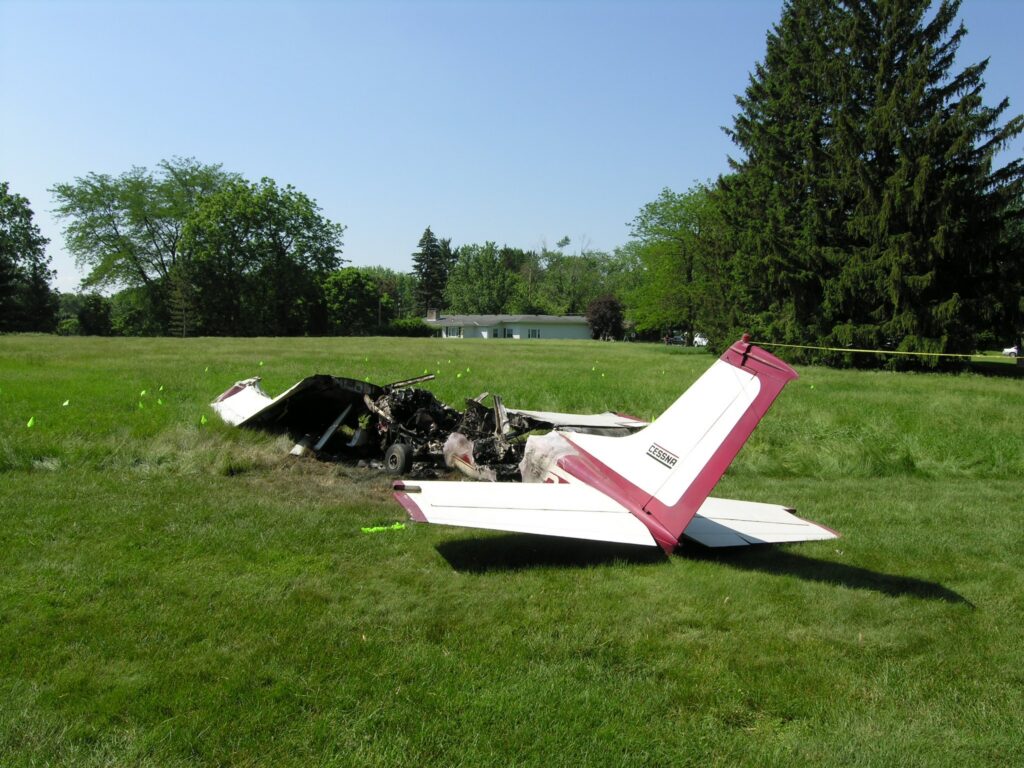
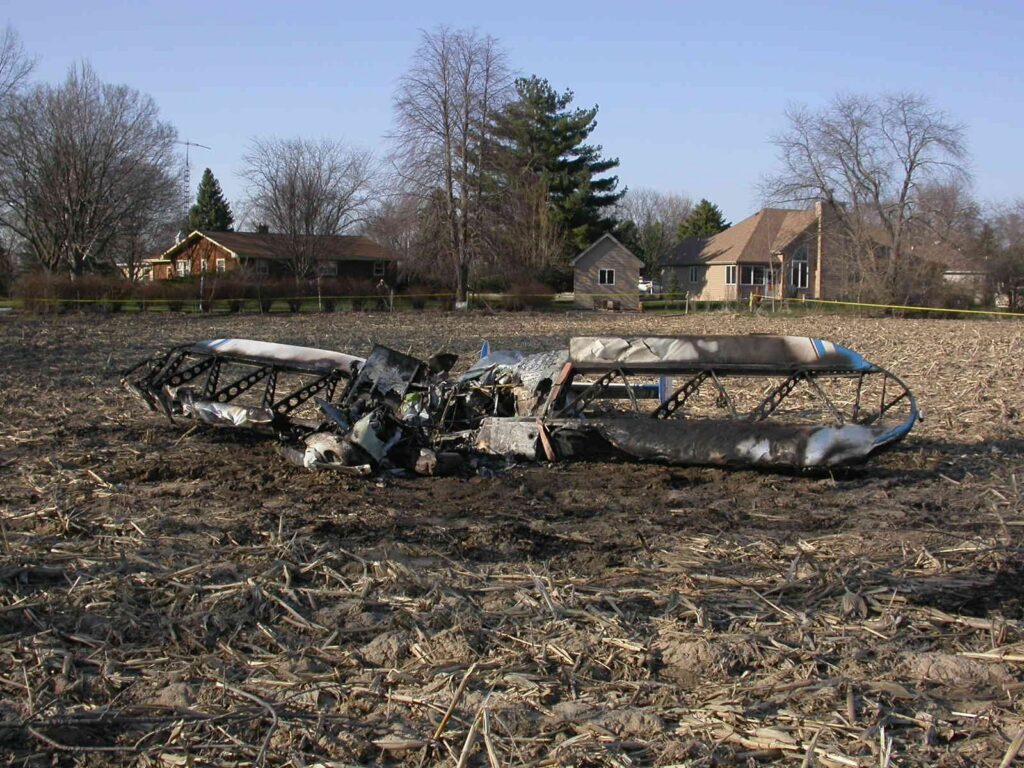
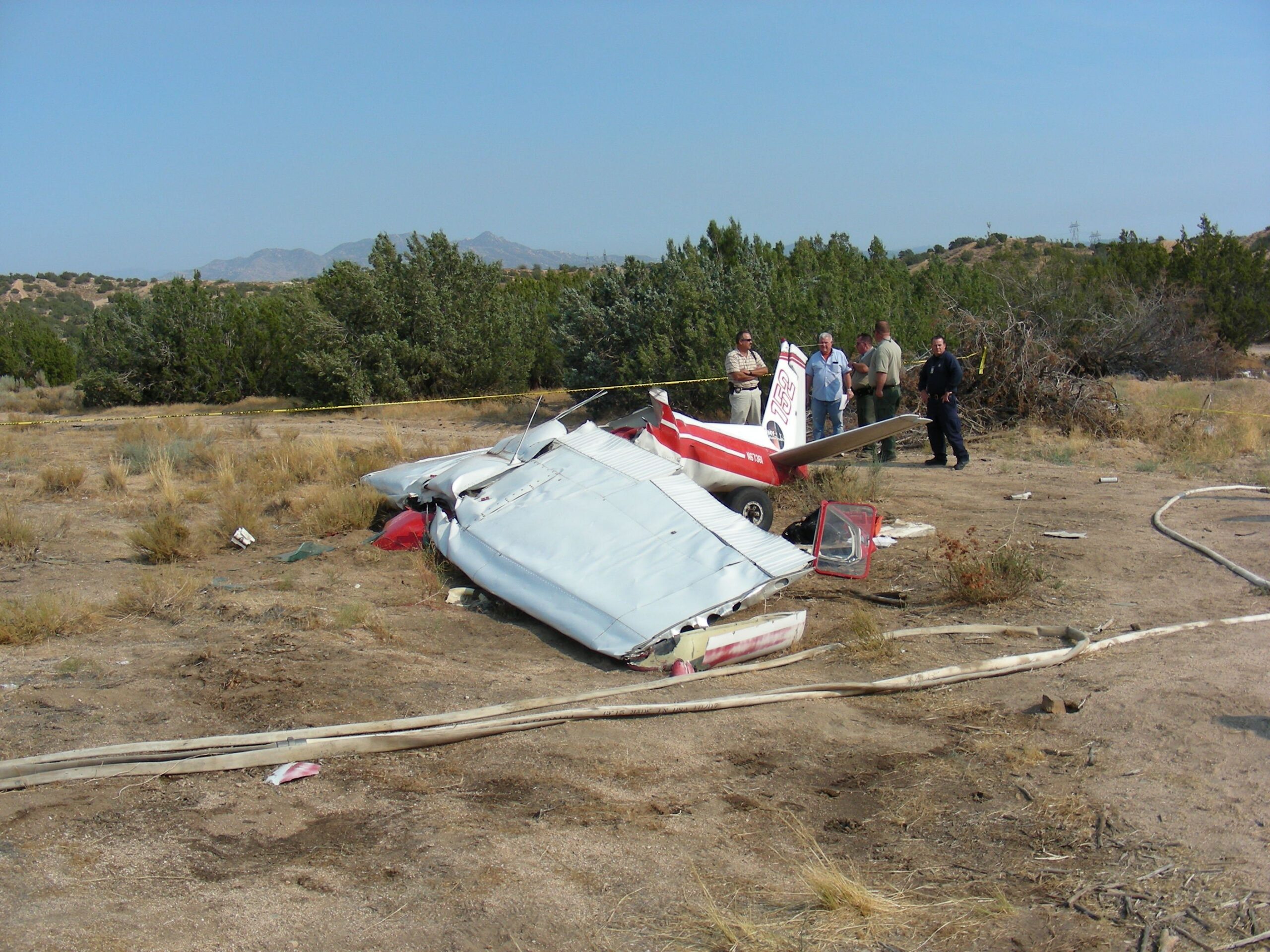
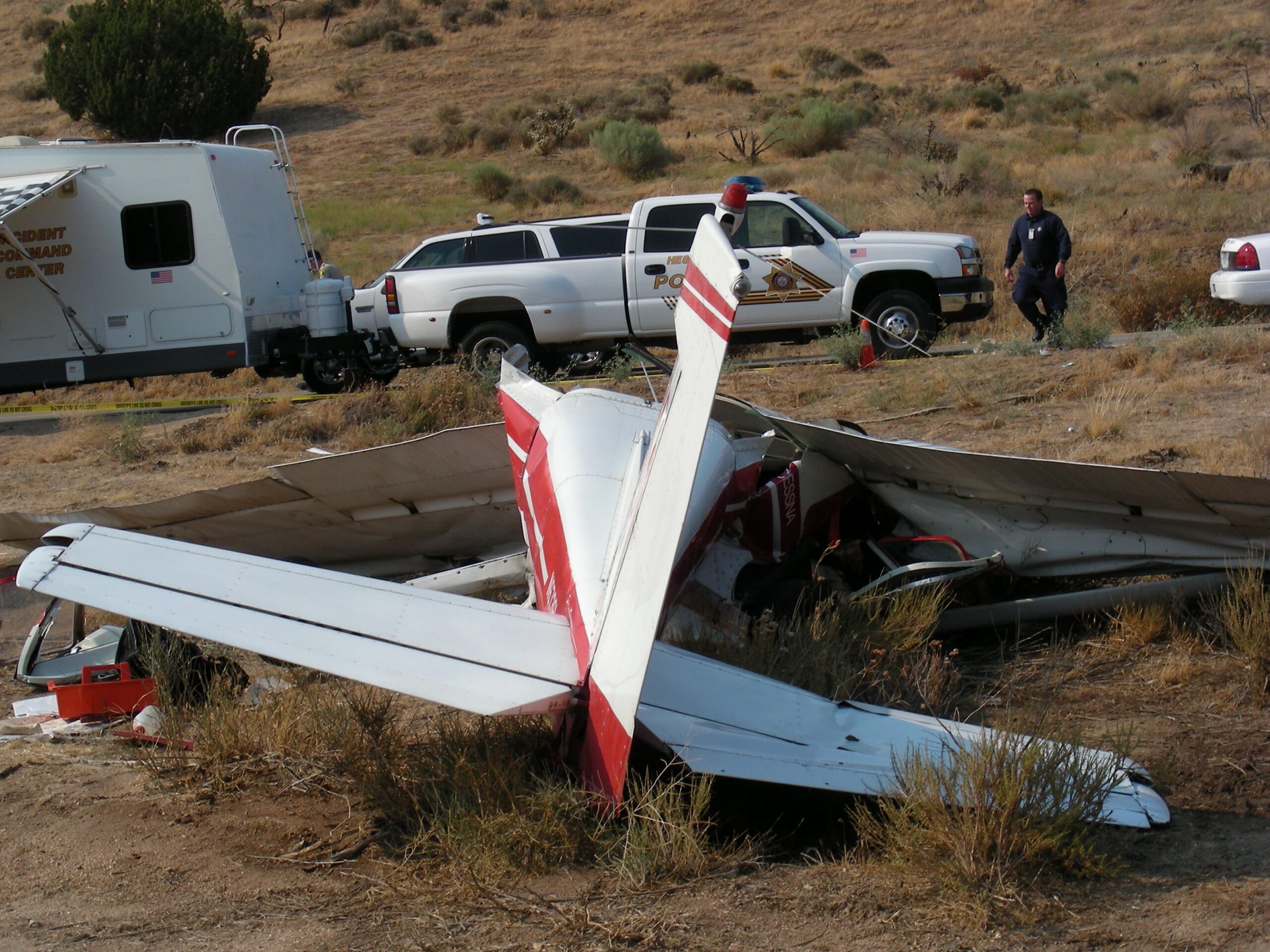
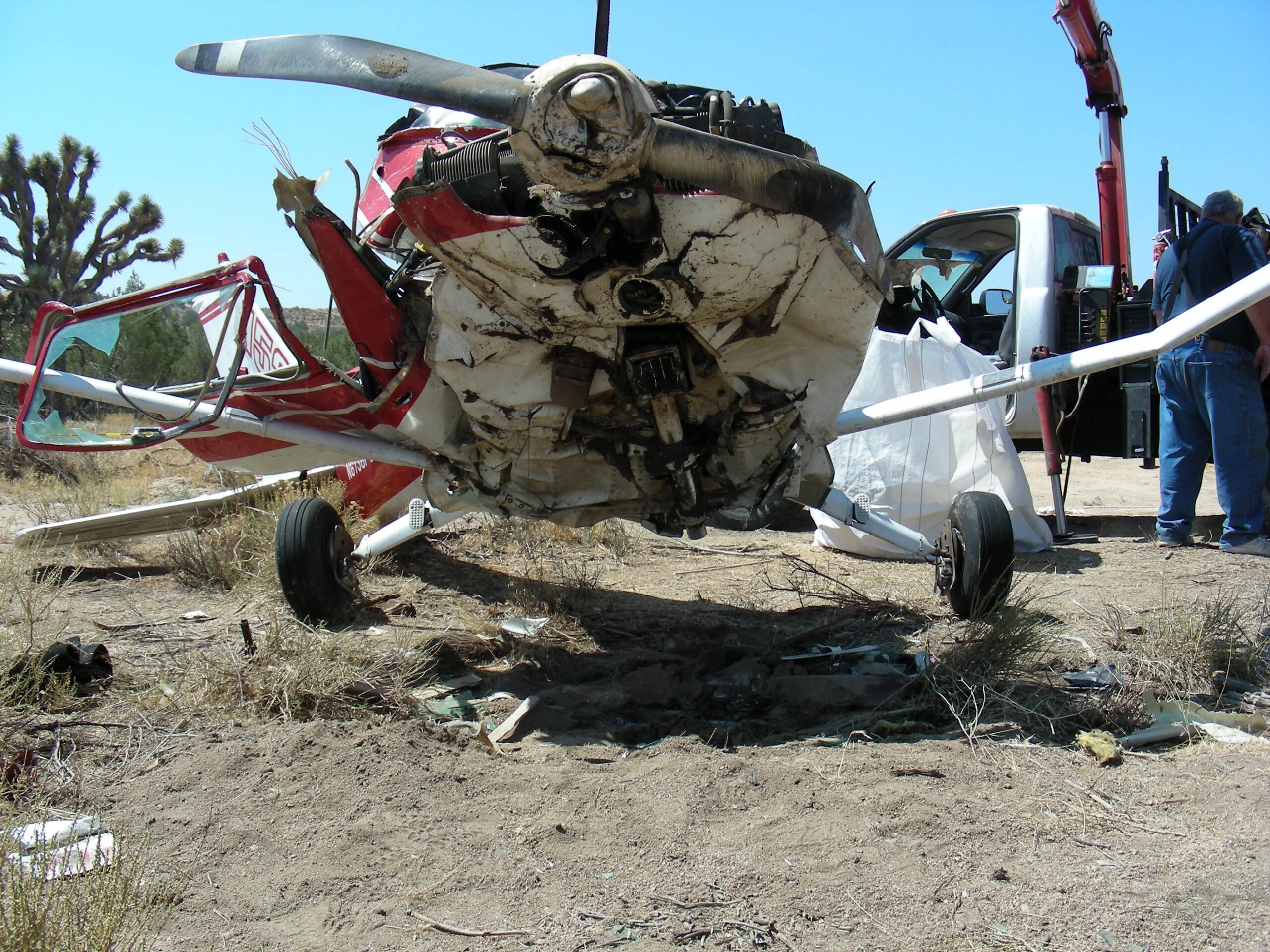
The airplane was oriented roughly northward, nose buried approximately one foot into the sandy soil at about a 45-degree angle. No ground scar surrounded the crater. No skid marks, no debris field consistent with a controlled forced landing. The leading edges of both wings were accordioned straight back. The engine compartment and instrument panel had been driven aft, collapsing the cockpit. The fuselage and tail remained attached and were upright and nearly wings-level. The propeller showed chordwise score marks across the full cambered span and across the outboard foot of the face side, with both blade tips bent aft. Several gallons of fuel remained in the left tank. There was no fire. The evidence at the accident site was consistent with a vertical, nose-down, near-zero-airspeed impact, which is exactly what you would expect at the bottom of a spin.
Investigation Findings
When investigators examined the engine at Aircraft Recovery Service in Chino on August 24, 2009, they found the airframe and core engine in remarkably intact condition. The crankshaft rotated freely. Thumb compression was present on all four cylinders in proper firing order. The valve train operated correctly. All four cylinders showed combustion signatures consistent with normal operation, except for one detail: the bottom spark plugs exhibited excessive lead deposits. The cylinders, pistons, rings, camshaft, and connecting rods all showed no pre-impact mechanical failure. The engine was capable of making power. But then investigators got to the magnetos.
Both magnetos had been displaced from their mounting pads on impact. When the left magneto was removed, the castellated nut, washer, and cotter pin that are supposed to secure the magneto drive gear to the magneto shaft were missing. The nut and washer were found later inside the oil sump. The cotter pin was never located. The threads on the shaft were undamaged, meaning the nut had not been torn off by force. It had backed off gradually during engine operation. The bore of the drive gear showed no witness marks, which is significant: if the cotter pin had ever been installed and had worked loose over time, it would have left marks. The absence of marks indicated the cotter pin was likely never installed in the first place. The rear face of the engine case in the accessory section, right where the drive gear sits, showed a rotational burnishing pattern consistent with the gear spinning loose and rubbing the case for an extended period. The oil filter contained metallic particles. This was not a failure that happened on the accident flight. The engine had been running with an improperly assembled left magneto for a sustained period of time before August 16, 2009. The left magneto sustained impact damage that prevented functional testing, but based on the physical evidence, once the nut backed off far enough to free the drive gear from the shaft, the left magneto would have stopped producing any spark at all.
The right magneto fared no better. Its internal timing, the E-gap, was measured at 34 degrees, plus or minus 1.5 degrees. The manufacturer’s allowable tolerance is plus or minus 5 degrees. The magneto could still produce a spark during bench testing by hand rotation of the drive, but the spark was weak. Not absent, but weak enough to meaningfully degrade combustion and reduce power output. The maintenance history told a longer story. Over the two-year period between the engine’s overhaul in August 2007 and the accident, records documented multiple instances of magneto removal, replacement, and timing adjustments, particularly to the left magneto, at roughly 50-hour intervals. That recurring timing drift is a symptom of internal magneto problems that were never resolved at the root. The maintenance personnel had been re-timing the magneto to the engine repeatedly instead of addressing the internal timing issue. And on August 8, 2009, eight days before the accident, a renting pilot had written up an rpm drop of 225 on the left magneto during run-up. The Cessna 152 POH specifies a maximum allowable drop of 125 rpm on either magneto. The maintenance shop’s response was to clean and gap the spark plugs and confirm the external timing. No entry was made in the aircraft logs documenting that any work had been performed in response to the write-up.
NTSB Probable Cause
The pilot’s failure to maintain adequate airspeed while maneuvering in the traffic pattern, which resulted in an aerodynamic stall/spin. Also causal was the failure of the left magneto due to improper assembly of the drive gear during installation on the engine, and the improper internal timing of the right magneto due to inadequate maintenance that reduced the ability of the magneto to produce an adequate spark, resulting in a partial loss of engine power.
Safety Lessons
Two people died in this accident and the chain of events that led there began long before the airplane ever departed Redlands that morning. There are at least three places in that chain where a different decision stops the outcome.
- A magneto write-up is a grounding event until it is properly resolved. The August 8 run-up produced a 225 rpm drop on the left magneto. The POH limit is 125. That is not a borderline anomaly. That is nearly double the maximum allowable drop. The appropriate response is a documented maintenance action that identifies and corrects the root cause, not a plug cleaning with no logbook entry. When a pilot write-up disappears without a corresponding maintenance record, the next pilot to fly that airplane has no way to know the problem was ever reported. The airplane flew multiple flights between August 8 and August 16 with a left magneto that had already been flagged as operating far outside limits.
- Recurring magneto timing drift at 50-hour intervals is not a tuning problem, it is a mechanical problem. External timing is the position of the magneto relative to the engine. Internal timing is the relationship of the breaker points to the rotor inside the magneto itself. If a magneto needs its external timing corrected every 50 hours, the external timing is chasing an internal problem. The fix is internal inspection and overhaul per the manufacturer’s service bulletin, not another trip around the timing procedure. Slick’s SB2-80C specifies external inspection every 100 hours and internal inspection every 500 hours. Both magnetos in N67361 were well past those thresholds without documented internal inspections.
- A go-around from a high and fast approach on a high-density-altitude day requires a complete energy management reset before the next turn. The density altitude at Hesperia that morning was calculated at 5,754 feet. The Cessna 152 is a 118-horsepower trainer, and at that density altitude with any degradation in ignition, it was producing meaningfully less than that. After two go-arounds from already unstabilized approaches, the pilot was likely task-saturated and behind the airplane. A 45-degree nose-up pitch with a 60-degree bank at low altitude in the crosswind turn is not a recoverable energy state in any normally operating 152. With partially failed ignition reducing available climb power, the margin was even thinner. Airspeed is the one thing that cannot be negotiated in the traffic pattern. When the approach is not stabilized, the go-around has to be flown all the way back to a stabilized energy state before the next turn is initiated.
Frequently Asked Questions
Q: What causes a magneto to fail in flight?
A: Magneto failures in flight can result from several causes, including internal timing drift, worn or cracked distributor blocks, failed breaker points, or, as in this accident, a missing castellated nut and cotter pin that allows the drive gear to come free from the magneto shaft. Once the drive gear separates from the shaft, the magneto stops turning entirely and produces no spark. The Cessna 152 engine runs on two independent magneto systems for redundancy, but if one magneto is already producing weak spark due to internal timing issues, losing the second magneto results in a significant and immediate loss of power.
Q: What is a stall/spin in the traffic pattern and why is it so dangerous?
A: A stall/spin in the traffic pattern occurs when a pilot allows the airspeed to decay below the stall speed while the airplane is banked, typically during the base-to-final or crosswind-to-downwind turn. The low wing in a banked turn stalls before the high wing, which rolls the airplane further into the bank and introduces a yawing motion that can develop into a spin. The danger is altitude: at traffic pattern altitudes, there is rarely enough height to recover from a developed spin before ground impact. In this accident, the witness observed a pitch attitude of approximately 45 degrees nose up with a 60-degree bank angle at low altitude, which is a classic precursor to an accelerated stall entry.
Q: How does density altitude affect Cessna 152 performance?
A: Density altitude is the pressure altitude corrected for non-standard temperature. At higher density altitudes, the air is less dense, which reduces the lift generated by the wings and reduces the power output of the engine because there is less air mass moving through it. The Hesperia Airport sits at 3,390 feet MSL, and on the morning of the accident the calculated density altitude was 5,754 feet. That means the Cessna 152 was performing aerodynamically as if it were at 5,754 feet even though the airport was physically at 3,390 feet. Climb rate, cruise speed, and stall margins are all degraded at high density altitude. With additionally degraded ignition from both magnetos, the available power was reduced further still.
Q: What is the required maintenance interval for Slick magnetos on a Lycoming engine?
A: Unison Industries Slick Service Bulletin SB2-80C, which is incorporated by reference into Lycoming Service Letter L173C, requires external inspection of the 4300-series magnetos every 100 hours and internal inspection and overhaul every 500 hours. The internal inspection includes verifying the E-gap (the breaker point opening timing relative to the rotor position), inspecting the distributor block, and checking the integrity of the impulse coupler components. In the accident airplane, maintenance records documented recurring external timing adjustments at roughly 50-hour intervals but no documented internal inspections, even though both magnetos were past their 500-hour internal inspection threshold.
Q: What should a pilot do if a magneto check shows an excessive RPM drop during run-up?
A: An excessive magneto RPM drop during run-up is a no-go item. The Cessna 152 POH specifies a maximum allowable drop of 125 RPM on either magneto. If the drop exceeds that limit, the flight should not depart until the cause is identified and corrected by a certificated aircraft mechanic, with a corresponding logbook entry. Common causes include fouled spark plugs, improper ignition timing, internal magneto timing issues, or failing breaker points. Cleaning the plugs may address fouling-related drops, but the fix must be documented and the system retested before return to service. A write-up with no logbook response entry, as occurred eight days before this accident, leaves subsequent pilots unaware that a discrepancy was ever reported.