The only thing keeping you apart from other traffic at a non-towered airport is that everyone sees everyone. It is a system with no backup, and close to the ground it fails all at once.
Midair collisions are not common. You can fly a whole career and never come close to one. But that rarity hides what actually matters about them: how little you can do once one begins. A collision in the traffic pattern happens low, slow, and with the airplanes pointed at the runway, not at altitude with room to recover. There is no checklist for it and no time to run one. By the time two airplanes touch, the event is essentially over. So this isn’t a pattern you manage your way out of. It’s one you have to keep from starting, and the only tool you have for that is your eyes and the discipline behind them.
From NTSB final reports, 2008–present*
Midair collisions are rare. If you count only general aviation airplanes at small fields like this one, the NTSB’s final reports since 2008 include roughly 18 over the last 17 years, well under two a year… Those few collisions still killed about 21 people.
Let me show you what it looks like when that tool runs out of room, in a case where both pilots were talking and at least one of them was looking.
One real flight
August 18, 2022. A Cessna 152 and a Cessna 340. Non-towered airport, Watsonville, California.
It was a clear afternoon on the California coast. Two airplanes were converging on the same runway, and neither one was doing anything illegal.
The first was a Cessna 152, a small two-seat trainer, flying laps in the traffic pattern. Its pilot had been on the radio the whole time, calling each leg the way you are taught to: crosswind, downwind, base. Over his previous four trips around the pattern, he had announced his position again and again.
The second was a Cessna 340, a fast, pressurized twin, inbound from another airport about ten miles to the east. Descending through 4,500 feet, its pilot announced on the common frequency that he would be coming straight in to the same runway. He wasn’t going to fly the pattern. He was going to fly a long, fast final and land.
A straight-in approach is legal at a non-towered field. It’s also the thing the pattern isn’t built around. The pattern is a conveyor belt of slow airplanes spaced by eye; a straight-in drops a faster airplane onto the end of it from a direction the pattern pilots aren’t used to looking at. The published guidance asks the straight-in pilot not to disrupt the flow, and asks the pattern pilots to stay alert for him. Everyone is supposed to see everyone.
For about a minute, it seemed to be working. The 152 called downwind, then base. The 340 called three miles, then one mile, and added that he was looking for the traffic on left base. The 152 pilot answered that he had the 340 in sight, and that it was behind him. Both pilots knew the other was up there. One of them had eyes on the other.
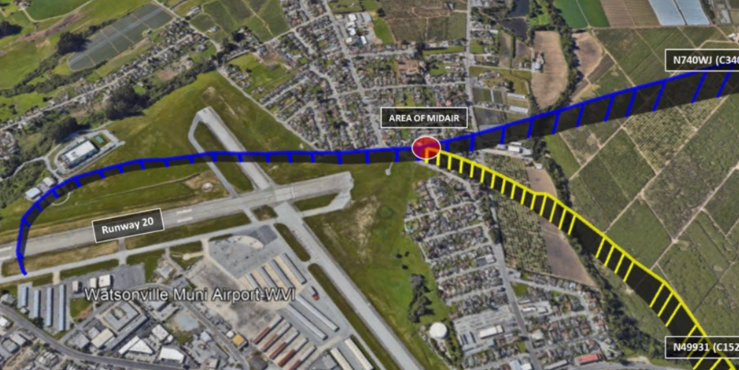
ADS-B plots of flight paths – NTSB
What neither of them had was time. The 340 was carrying about 180 knots of ground speed toward a runway where the other airplane was flying at less than half that. On the radio it sounded like spacing. In the air it was a closure rate that ate the gap between them in seconds.
The 152 pilot, realizing the faster airplane was coming up on him much quicker than he had judged, called a go-around. A few seconds later the two airplanes met about 150 feet above the ground, just short of the runway. The 340 broke hard to the right at the last instant, and its wing struck the wing of the 152. Both airplanes fell to the airport below. The pilot of the 152, and the pilot and passenger in the 340, were all killed.
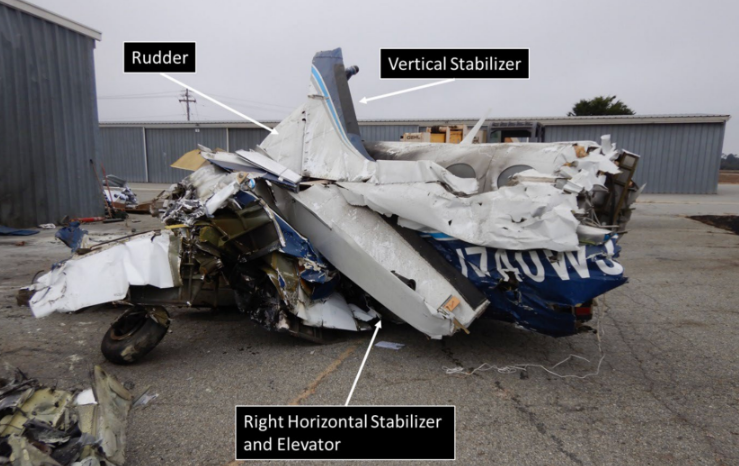
Cessna 340 wreckage – NTSB
NTSB probable cause: “The failure of the pilot of the multi-engine airplane to see and avoid the single-engine airplane while performing a straight-in approach for landing.” (NTSB WPR22FA309)
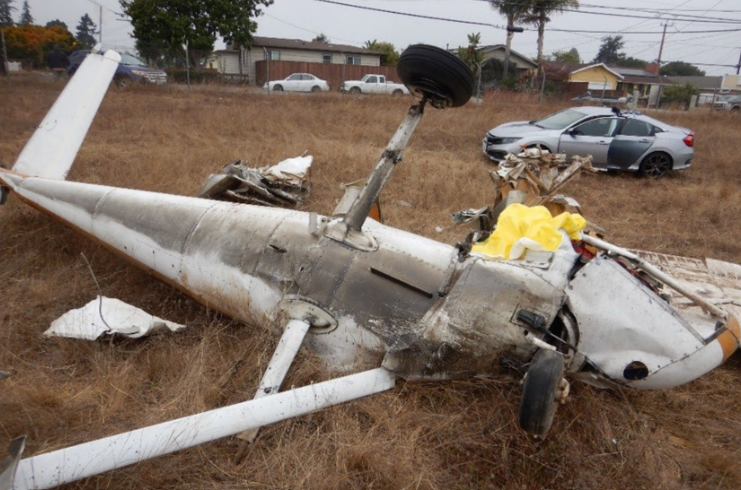
Cessna 152 wreckage – NTSB
There is one more fact in this report, that I didn’t mention yet. The pilot of the 152 had drugs in his system: active THC, the residue of cocaine, and ketamine. The pilot of the 340 had a trace of THC and some ordinary, non-impairing medications. It would be easy to stop there and file this under impaired pilot, a story about someone who did something you would never do. But, I think the NTSB made the right call by not including impairment in the probable cause. It put see-and-avoid there, and the straight-in. The faster airplane came up from behind at about a hundred knots of closure, and that sight picture would have fooled a rested, sober, sharp pilot too. The impairment is real and it’s ugly, but I don’t think it’s the lesson. The lesson is geometry.
The Decision Gates
So set the toxicology aside, the way the investigation did, and look at the geometry, because that’s the part you can carry into your own flying. Two airplanes converged on one runway, each arriving from a direction the rules allow, and the system that was supposed to keep them apart let them down together. Here’s where it broke, and where you still get a say.
Gate 1: A straight-in drops a fast airplane into a pattern built for slow ones.
The pattern works most of the time because everyone in it is going about the same speed, in the same direction, looking in the same places. A straight-in approach breaks all three of those at once, and a straight-in flown fast breaks them hard. The faster airplane came at the runway from where the pattern traffic was not looking, at twice their speed, and the geometry did the rest.
The check: If you fly a straight-in at a non-towered field, you are the variable the pattern didn’t plan for. Slow down to pattern speed, blend into the flow, and fly it as though no one has you in sight, because they may not.
Gate 2: “I see him” is not the same as “I am clear of him.”
The pilot in the pattern had the other airplane in sight and didn’t think it was a threat because it was behind him. However, seeing traffic is only the first half of see-and-avoid. The second half is judging where it is going, and a fast airplane on a collision course barely moves on your windscreen, which is exactly what makes it so easy to dismiss. Fighter pilots call it zero line of sight, and the physics is unforgiving: any airplane that is actually going to hit you holds the same spot on your windscreen the whole way in. Your eye is built to catch movement and a collision course is the one geometry that gives it nothing to catch.
The check: When you spot traffic, the question is not whether you see it. It’s whether it is drifting across your windscreen or sitting still and growing. A target that holds its position and gets bigger is coming to you.
Gate 3: Radio calls build a picture, but the picture is not separation.
Both pilots were talking. Both had a rough idea where the other was. That shared picture is worth a great deal, and it is also exactly the thing that can lull you, because it feels like coordination when it’s really just two people narrating.
The check: Use the radio, make your calls, build the model. Then remember the model can be wrong, and go find the traffic with your eyes before you need it to be where you think it is.
Before your next flight
Here are a few things I want you to think about.
- If you are flying a straight-in to a non-towered airport, assume the pattern doesn’t see you, and fly it at a speed that gives everyone time. Fast and straight-in is the combination that keeps showing up in these.
- When you call traffic in sight, finish the thought. Where is it going, and is it moving on your windscreen or holding steady and growing? Holding steady and growing is the one that hits you.
- The radio is not a separation service. It builds a picture in your head, and the picture is only as good as the next look out the window. Make the call, then go find the airplane.