The airplane is still flying. The pilot has stopped flying it.
Loss-of-control-in-flight accidents are rarely about a broken airplane. The airframe works, the engine runs. What fails is the loop between what the airplane is doing and what the pilot believes it’s doing. They diverge, the pilot corrects, the correction makes it worse. By the time the pilot sees what’s happening, the airplane is in a regime they’ve never trained for and can’t recover from.
Most pilots who die this way had every legal qualification to be in the seat. What they didn’t have was the proficiency the airplane was quietly demanding.
From NTSB final reports, 2008–present*
- 4,088 loss-of-control-in-flight accidents
- 51.1% involved at least one fatality
- 2,514 people killed
- 26.0% of aircraft destroyed on impact
That second number says one in two of these accidents kills someone. Loss-of-control isn’t the most common general-aviation accident category, but it kills more often than not.
Now let me show you what one of these 4,088 tragedies looked like.
One real flight
December 7, 2023. Beech 35-C33 Debonair. Cross-country personal flight, Knoxville to Benton, Arkansas.
The pilot was Jenny Blalock, known online as TNFlyGirl. She was 44, a private pilot with about 390 hours total, around 200 in the Debonair, no instrument rating. Her passenger was her 78-year-old father.
She had earned her private certificate 18 months earlier with 193 hours in her logbook, almost all in a Piper PA-28-140 she had bought to learn in. A PA-28-140 is a fixed-gear, fixed-pitch, 160-horsepower trainer that cruises around 110 knots. Two months after her checkride she sold it and bought a Beech 35-C33 Debonair, the airplane she would ultimately die in.
The Debonair is not the same as a Piper PA-28. It has a 260-horsepower engine, retractable landing gear, and is a complex, high-performance aircraft with a max cruise of 161 knots and a never-exceed of 195. Jenny’s flight school’s general manager told the NTSB her instrument-phase check, a few weeks before the crash, had gone poorly “on almost all aspects of aircraft control, situational awareness, and risk management.” He told Jenny that she was behind the Debonair and had bought more aircraft than she was ready for. “She and her father,” he said, “did not disagree when I repeated this assessment.”
One of her flight instructors told the NTSB she “leaned on technology too much and did not have solid stick and rudder flying skills.” The same instructor described two cockpit habits: when she trimmed manually, she moved the trim wheel the wrong direction; and on the autopilot, she pressed the Down or Up button “repeatedly” instead of holding it down. The autopilot was a Century 2000, a prompting autopilot. It does not trim the airplane. It flashes TRIM UP or TRIM DOWN, telling the pilot exactly what to do. If the pilot doesn’t, the autopilot fights the trim mismatch until it can’t anymore.
She took off from Knoxville Downtown Island Airport at 09:48 on a clear, calm December morning. Ten miles of visibility, surface wind 9 knots. She climbed to 2,500 feet, then to 6,500, tracking 255 toward Arkansas. The heading was stable. Transmissions with departure control were normal.
At 10:33, the airplane stopped holding altitude.
ADS-B data shows the next 25 minutes as a slow, building oscillation. The airplane gained airspeed while descending and slowed while climbing, repeatedly. Airspeed swung between 100 and 160 knots. Altitude swung 1,000 to 1,500 feet up and down. Vertical speed alternated between negative 1,200 feet per minute on the descents and positive 500 on the climbs.
The NTSB’s analysis: she had been using the autopilot. However, because the Century 2000 doesn’t trim for you, and because Jenny had a documented history of mishandling both the trim wheel and the autopilot’s pitch buttons, the airplane was probably trimmed against her.
When the pitch servo tried to hold altitude with mis-set trim, she likely fought it on the yoke. That is pilot-induced oscillation: the pilot’s inputs and the airplane’s response out of phase, with each correction making the next swing worse.
At 10:36 the airplane bottomed out at 5,300 feet at 133 knots, climbed back to 7,000, and started the next cycle. Memphis picked her up on handoff and told her she was “well left of course.” She acknowledged and said she was correcting. The correction was small.
After 10:59 the controller tried twice more to reach her. She did not respond.
At about 11:03, the radio came alive with a faint transmission.
“…this is Debonair, [unintelligible…] Emergency.”
The airplane was in a left turn, descending at 2,000 feet per minute and through 170 knots. About 60 seconds later, a faint second transmission in a male voice.
“[unintelligible], oh…. help us.”
The controller’s attempts went unanswered. The Debonair’s final track was 262 degrees, descending at over 10,000 feet per minute. It struck wooded terrain at 230 knots. The fire spread to the trees; the cockpit was destroyed beyond reading.
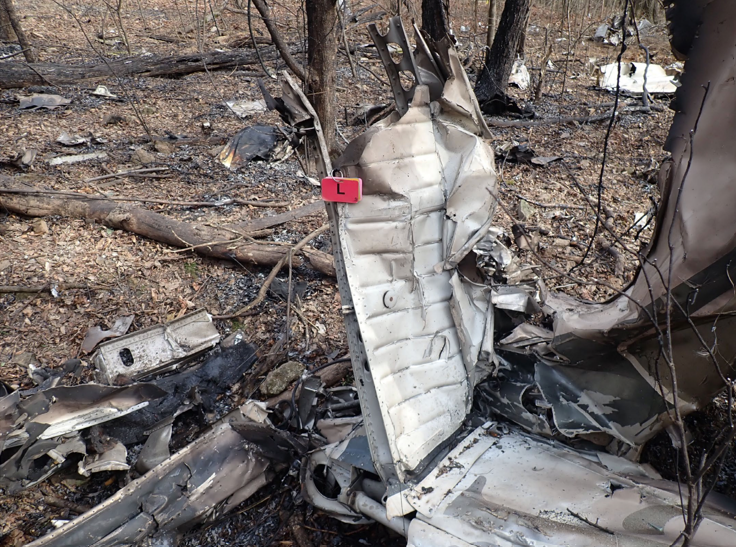
View of left elevator and vertical stabilizer
Wreckage at the impact site (NTSB)
Investigators recovered two onboard video recorders. One memory card was destroyed by impact and fire. The other was intact but contained no recording from the accident flight.
Toxicology found three medications in the pilot’s tissue that the FAA classifies as Do Not Fly: alprazolam, trazodone, and buspirone. None of those medications had been reported on her January 2023 medical. Because measurement was limited to tissue specimens, the report concluded that the available evidence was insufficient to establish whether medication effects contributed to the accident. The probable cause does not cite medications but I’m including the finding here because it’s in the file, not because it explains anything the airplane was doing.
NTSB probable cause: “The pilot’s failure to maintain airplane control, which resulted in pilot-induced oscillations and a subsequent loss of control and impact with terrain.” (NTSB ERA24FA058)

Jenny and her father on a previous flight
The Decision Gates
A pilot reading this can find a way to think this could never happen to me. But the pattern itself is one that most of us have run into at one time or another: an airplane we haven’t grown into, an automation system we don’t quite understand, and a feedback loop we’re trying to fix with the wrong control input. Here are three decisions the pilot reading this can map onto their own next flight.
Gate 1: The decision to launch despite a documented proficiency gap.
Jenny’s flight school general manager had told her, in plain words, that she was behind the airplane and had bought more aircraft than she was ready for. Her instrument-phase check had gone poorly on aircraft control, situational awareness, and risk management. She filed no flight plan, took her father, and launched a 430-nautical-mile cross-country in the Debonair anyway.
The check: When someone whose job is to evaluate your proficiency tells you you’re behind the airplane, what does it take for you to hear it?
Gate 2: The decision to engage automation she didn’t understand.
The Century 2000 is a prompting autopilot. It doesn’t trim the airplane. It flashes TRIM UP or TRIM DOWN and waits for the pilot to adjust the trim. Her instructors had documented two problems: she moved the trim wheel the wrong direction when she trimmed, and on the autopilot she pressed the Down or Up button repeatedly instead of holding it down. Coupling that autopilot in an airplane she was already behind on depends on a pilot who can keep up with what it’s asking.
The check: Do you know what your autopilot is asking for in cruise, and what happens if you ignore the question for ninety seconds?
Gate 3: The decision to fight the airplane for 25 minutes instead of taking it back.
From 10:33 to 11:02 the airplane was not holding altitude. It oscillated in 1,000-to-1,500-foot swings with airspeed swinging 60 knots. That is a long time, in a working airplane in clear weather, to recognize something is wrong and unwind it. Disengage the autopilot. Pitch for level flight and manually trim the aircraft to neutral hands. Slow down. Ask for vectors or ask for help. Any one of those would have stopped the cycle.
The check: When the airplane is doing something you didn’t ask for, do you take it back to hand-flying and stabilize, or do you keep adjusting the thing that’s already not working?
Before your next flight
Here are a few things I want you to think about.
- When your airplane is newer in your life than your training is, treat every flight as a check ride against the airplane. If someone qualified to assess your proficiency says you’re behind it, that data is the whole point.
- A prompting autopilot is not an autopilot. It’s an instruction set. If you don’t know the instructions, hand-fly.
- If the airplane is doing something you didn’t ask for, take it back and stabilize before you adjust anything else. The cure for out-of-phase corrections is to stop correcting.
More patterns like this one
If you want to dig into another loss-of-control-in-flight case from the archive: