
The runway behind you seems closer than the field ahead. Don’t make that decision in the air.
The impossible turn is the decision a pilot makes in the seconds after a power loss on initial climb to attempt to return to the departure runway. It is rehearsable on paper: minimum altitude, minimum airspeed, the direction to turn, how much bank angle the wing can carry. It’s also a maneuver the pilot has rarely flown under the conditions that would force them to. The pattern is the gap between the rehearsal and the reality.
The difference between the pilots who live and the ones who die after a loss of thrust on takeoff is usually the brief.
From NTSB final reports, 2008–present*
- 1,206 loss of thrust on takeoff (LOTOT) accidents
- 316 people killed
- 16.7% of those accidents had at least one fatality
- 21.8% of impossible turn attempts were fatal
- 4.6% of straight ahead landings were fatal
164 of these 1,206 accidents fell into a third category: the narratives don’t tell us what the pilot did. Half of those — 82 accidents — were fatal. Most of those fatal cases share a pattern: no surviving pilot, no witness with a clear view, no radio call. The data we can analyze is the data the surviving pilots and witnesses gave us. The deadliest accidents often leave the least narrative behind.
The findings are clear. The pilots who tried to turn back to the runway died 4.73 times more often than the pilots who landed straight ahead.
Now let me show you what one of these tragedies looked like.
One real flight
October 1st, 2023. Cessna 177RG Cardinal RG. Lake Placid, New York.
Russ Francis and Richard McSpadden showed up at Lake Placid Airport that afternoon to fly an air-to-air photo shoot for a magazine article. The lead Beech A36 was rigged with a photographer in the open right rear and would take off first. Russ was sitting left seat in the Cardinal as PIC. Richard was right seat. The plan was for Russ to fly the takeoff and join-up, then hand the controls to Richard for the photography.
Both pilots were experienced. Russ had a commercial certificate with single and multi-engine ratings, about 9,000 hours total time, and a DC-3 type rating, but only about 10 hours in the make and model of the Cardinal. Richard had a commercial and CFI certificate with about 5,800 hours total time and a long career as a Thunderbirds commander and aviation safety leader.
Field elevation at Lake Placid was 1,747 ft, the temperature was 23°C, and density altitude was about 2,758 ft. Per the POH, those conditions stretched the takeoff distance about 37% longer than normal and reduced the rate of climb by about 28%. A weight and balance calculation for the flight was not found in the airplane’s records. Estimating from fuel and occupants, the center of gravity was about an inch forward of the published forward CG limit.
About 30 seconds after engine start, witnesses saw the Cardinal’s engine stop and the propeller stop turning. About five seconds later the engine restarted on its own. There was no explanation for why it had stopped. They taxied to runway 32, did their run-ups, and Richard gave a thumbs up indicating they were ready for takeoff.
A witness heard the engine surge during the takeoff roll. On initial climb the engine “did not sound as if it were running at full power.” Another witness saw a brief puff of white smoke from the exhaust and the airplane “barely going up” as it climbed away.
At about 300 to 400 ft above the ground, the airplane made a gentle left turn to join up with the Beech. It then suddenly rolled into a hard right turn back toward the airport. The pilot of the Beech heard a transmission on the common traffic advisory frequency: “we have a problem and we’re returning to the airport.”
The options around the airport were thin. A golf course about a mile away to the right. A 30-foot-wide road to the left, with powerlines crossing and running alongside. Russ chose to turn back to runway 14, the reciprocal of the runway they had departed.
Recorded GPS data captured what happened next. Past the runway threshold, the airplane’s energy peaked and dropped as engine power decreased. The airplane rolled from a left bank into the right turnback. Nine seconds later the lift coefficient exceeded the airplane’s calculated maximum, the bank reached 39°, the airspeed reached 52 KCAS, and the vertical speed dropped to negative 1,300 ft per minute.
The airplane struck an embankment in a right-wing-low, nose-low attitude about 440 ft from the approach end of runway 14, 250 ft left of centerline. Both Russ and Richard were killed. The airplane was substantially damaged.
The teardown of the engine, propeller, magneto, fuel system, and governor found two minor maintenance discrepancies. The hydraulic lifters had not been replaced during a recent overhaul as required, and a portion of the fuel reservoir drain control was improperly installed. Neither was found to be causal. The probable cause for the partial power loss stayed at “undetermined.”
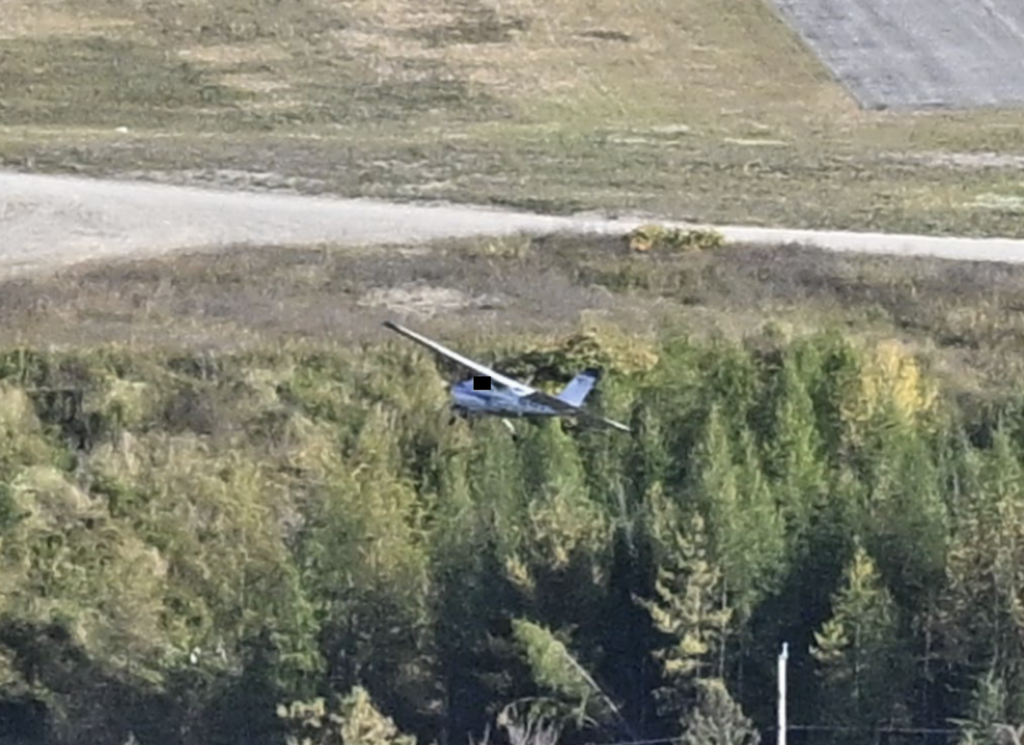
Just Prior to Impact (Courtesy of David Tulis / АОРА / NTSB)
Two weeks before the accident, Russ took off from this same runway with a flight instructor in the right seat to prepare for the photo shoot. About 200 ft above the ground, they heard a noise and felt a draft. The cargo door had come open.
According to GPS data, when they were about 430 ft above the ground and doing 73 knots, Russ began a 40° left bank turn. His turn rate was about 9.6 degrees per second, more than three times the rate of a standard turn. He reversed course with a 27° right bank to line up with runway 14 and landed. Full engine power throughout. The flight instructor described the maneuver: “It was upsetting to say the least.”
The accident-flight turnback was similar in shape but not in conditions. The practice was at full power; the accident was at partial. The practice was an annoyance; the accident was an emergency. Russ had a recipe in his head, but the recipe was built under conditions that didn’t apply.
NTSB probable cause: “A partial loss of engine power for undetermined reasons. Contributing to the accident was the pilot’s inadequate preflight weight and balance planning and his aggressive low altitude maneuvering, which resulted in an aerodynamic stall and loss of control.” (NTSB ERA24FA001)
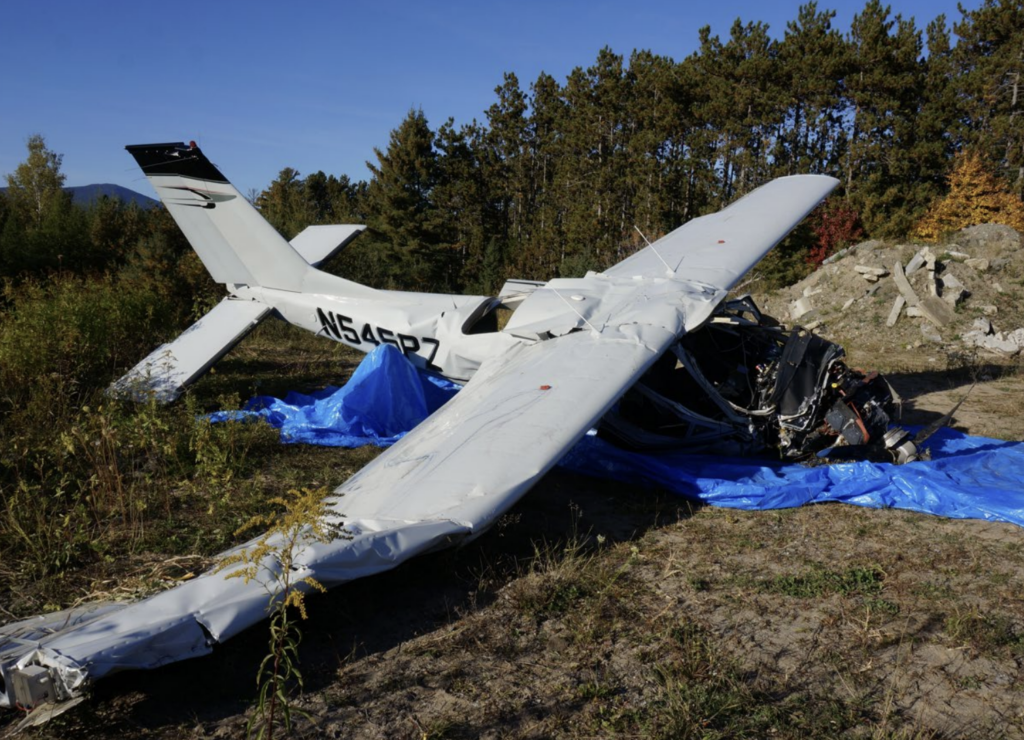
Wreckage (NTSB Image)
The Decision Gates
Russ Francis was experienced. Thousands of hours, a commercial certificate, a DC-3 type rating, and two weeks earlier he had executed an aggressive low-altitude turnback at this same airport in this same airplane and walked away. He was not flying out of his depth on paper. He was flying a maneuver he believed he had already passed. Three decisions on the day of the accident closed exits the wing was not going to give back.
Gate 1: The decision to take off after the engine stopped during start.
The Cardinal’s engine stopped about 30 seconds after start, with the propeller coming to a stop, and restarted on its own five seconds later with no explanation. They taxied, ran up, and took off.
The check: Anything an engine does on the ground that you can’t account for is a takeoff cancellation. Don’t put the runway behind you while the question is still open.
Gate 2: The decision to turn back instead of land ahead at 300 to 400 ft AGL.
The engine was producing partial power. The airplane had cleared the runway and was about a thousand feet past the threshold at peak energy. The choice was between turning back and a controlled crash into the trees. There was no friendly option ahead. But Russ had a recipe in his head: two weeks earlier in this same airplane at this same airport, so he turned back. That recipe was built under conditions that did not apply. The practice turnback was at full power; this one was at partial. A maneuver that worked once under benign conditions doesn’t transfer to the moment that demands it again under different inputs.
The check: A successful maneuver under benign conditions is not a procedure. The turnback decision belongs in the pre-takeoff brief, said out loud: the minimum altitude below which you commit one way or the other, the airspeed below which you commit to land ahead, and the wind-corrected turn direction if you decide to turn. None of those decisions belong at 300 ft with an engine that’s not making full power. If the answer ahead is ugly, you brief that too. A controlled crash into trees with airspeed and wings level is survivable; a stall in a banked turn is not.
Gate 3: The decision to bank past what the airspeed and CG could carry.
The airplane was an inch forward of its forward CG limit. The published stall speed at 10° flaps, wings level, max gross weight, most-forward CG was 57 KCAS. Russ rolled into a 39° right bank, where the stall speed rises to roughly 65 KCAS. The recorded airspeed at the moment of stall was 52 KCAS. The wing was being asked to hold the airplane at an angle of attack it could not produce.
The check: The wing has one number that does not negotiate, the critical angle of attack. Bank angle multiplies the airspeed required to stay below it. Forward CG raises the stall speed further. If the airspeed isn’t there, the wing isn’t either, and 300 ft above the ground is not where you find that out.
Before your next flight
Here are a few things I want you to think about.
- Know what’s around your airport for emergency landing options before you take off. The golf course, the road, the field, the trees. If there aren’t good ones, that’s a planning input, not a discovery you make at 300 ft.
- Set personal minimums for the turnback. The altitude below which you don’t try, the airspeed below which you don’t try, the bank angle you won’t exceed if you do. Brief them out loud before brakes off. If you didn’t say it before you released the brakes, you are improvising at 300 ft.
- If you have a partial loss of engine power below your personal minimums, treat it as a total loss. Level the wings, point the airplane at the best option ahead, and fly the airspeed the wing wants. The runway behind you is not coming back.
→ Watch: Full Breakdown of this Accident
More patterns like this one
If you want to dig into more impossible turn cases from the archive: