
The wing doesn’t care how close you are to the runway. It cares about angle of attack.
Pattern stall-spin accidents are almost never about not knowing how to fly. They’re about banking the airplane past the angle of attack the wing can carry, at low altitude, where the airplane has nowhere to recover to. The pilot is usually trying to fix something by tightening the turn such as an overshoot or a misaligned final, sometimes caused by a downwind or base flown too tightly. The wing answers by stalling, and what was a fixable approach becomes an unrecoverable spin two hundred feet above the ground.
Most pilots who die this way were not new to the airplane. They were doing something familiar in a place they knew, with a sight picture that wasn’t quite right.
From NTSB final reports, 2008–present*
- 907 traffic pattern stall-spin accidents
- 39.7% involved at least one fatality
- 550 people killed
- 13.7% of aircraft destroyed on impact
That 39.7% fatality number looks low next to the other patterns we’ve covered. However, it isn’t and that’s because the truth is that stall-spin mishaps include a lot of training-altitude departures and benign-looking practice stalls where the pilot recovers and walks away with substantial damage. The ones that are fatal are often the ones in the traffic pattern at 200 feet, without any room to recover. When stall-spin happens in the pattern, it almost always kills.
Now let me show you what one of these 907 tragedies looked like.
One real flight
June 28, 2022. Beechcraft V35B Bonanza. Personal flight, departing Pearson Municipal in Vancouver, Washington.
The pilot held a private certificate and a Class 3 medical with waivers. His logbooks were not recovered after the accident, so his total time, time in the airplane, and recent flying are unknown. A friend who had flown at least 30 hours with him in the accident airplane reported giving the pilot his most recent flight review. He also said the two of them had a pattern they normally flew at this airport: the turn to final was made over a large white building about half a mile from the runway threshold. The pilot was familiar with this airport.
He took off from runway 26 at Pearson Municipal at 0723 local time on an easterly heading. The METAR at the field, recorded a few minutes after the accident, read 1 3/4 statute miles in haze, with visibility variable between a quarter mile and 5 miles, few clouds at 200 feet, wind variable at 6 knots. Visual conditions on paper. Not the conditions a pilot wants to be in when he needs to find a runway.
About 3 minutes after takeoff, with clouds lower than he’d expected, he told air traffic control he was going to “circle back” to lose altitude and see if the weather cleared. For the next several minutes he flew northwest over Vancouver Lake while he and the controller worked through a transponder issue and discussed the weather. At 0734 the controller told him radar services were terminated and to switch to the airport CTAF. He acknowledged he had the airport in sight.
At 0735 he announced entering the downwind for runway 26. About a minute later he announced he was on downwind. That was his final radio transmission.
ADS-B data shows what happened next. He turned to the base leg early, well before the white building landmark his friend taught him to use, and he started descending at about 1,000 feet per minute at 80 KCAS, in a very shallow bank averaging about 7 degrees. He was set up to overshoot the runway centerline.
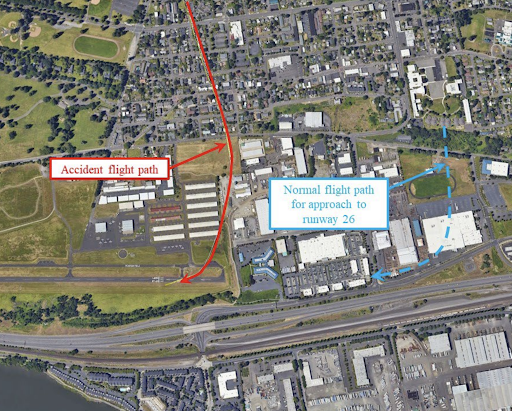
Accident flight path versus the pilot’s usual flight path to runway 26 (NTSB)
Surveillance video at the field captured the last seconds. The airplane appeared in a slight right-wing-low attitude. Over the next two seconds the right bank steepened. The right wing struck the ground first in a bank near 90 degrees, and the airplane burst into flames at the displaced threshold. It slid inverted along the runway.
A post-accident performance analysis used the published stall chart for the V35B. At maximum bank, the airplane’s stall speed at his weight would have exceeded 80 knots. ADS-B put his airspeed at the turn to final at about 73 knots. The wing was being asked to do something it could not.
The airplane was destroyed. The pilot was the only person aboard, and he was killed.
NTSB probable cause: “The pilot’s decision to execute a steep turn to final approach, which resulted in an exceedance of the airplane’s critical angle of attack and an accelerated stall. Contributing to the accident was the improper positioning on base leg and the pilot’s subsequent decision to continue the approach.” (NTSB WPR22FA235)
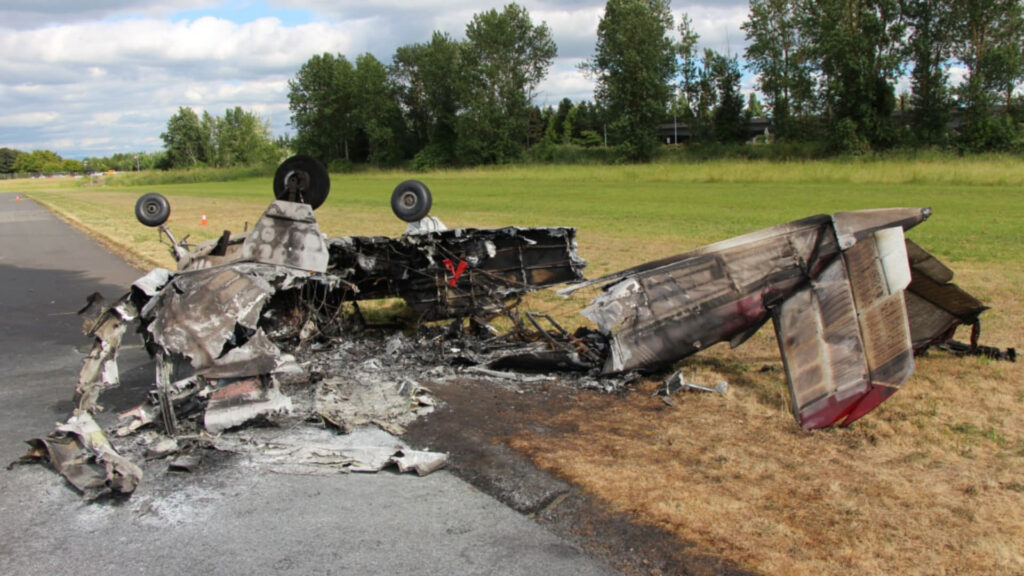
Wreckage (NTSB Image)
The Decision Gates
There are pilots reading this who have flown that exact pattern at that exact airport. There are pilots reading this who have made an early base turn at their home field and salvaged it. The reason this one ended on the runway threshold isn’t that the pilot did something nobody else does. It’s that he did three normal things in a row, in conditions where the third one didn’t tolerate the first two.
Gate 1: The decision to fly the pattern in visibility that wouldn’t reliably build the sight picture he was used to.
The METAR was 1 3/4 statute miles in haze, varying between a quarter mile and 5 miles. The pilot was returning to a familiar airport, but familiar doesn’t mean visible. In haze, the runway, the displaced threshold, the white building, and the abeam-the-numbers reference all wash into the same gray. The pattern entry that works on a clear day is the same physical maneuver, but the inputs your eyes are giving you are degraded. Familiarity covered the gap until the moment it didn’t.
The check: When the picture out the window isn’t building the way it normally does, the pattern is the wrong place to figure that out. Climb away, breathe, get a hold of approach control, and try again with a real plan.
Gate 2: The decision to fix a misaligned approach inside the turn instead of going around.
The base leg started early. From that geometry, the only way to reach the runway centerline was to extend the base or tighten the turn to final. He chose to tighten. Each correction added bank angle, and each bank-angle increase raised the airspeed the wing needed to stay flying. He was flying to a runway he could see, fixing a setup that was already broken. There was a working airplane underneath him and 360 degrees of sky to use.
The check: A pattern entry that’s already wrong does not get fixed in the turn. It gets fixed by another lap. The go-around isn’t a failure. Continuing a salvageable approach into an unsalvageable one is the failure.
Gate 3: The decision to bank past what the airspeed could carry.
The published stall chart for this airplane, at his weight, said the wing would stall above 80 knots in a maximum bank turn. ADS-B put him at about 73 knots when he rolled into the final turn. The math was already against him before he reached for the runway. There is no version of this turn where the wing keeps flying. The accelerated stall isn’t a surprise the airplane springs on you. It’s an arithmetic result.
The check: The wing has one number you cannot negotiate with: the critical angle of attack. Bank angle multiplies the airspeed required to stay below it. If the airspeed isn’t there, the wing isn’t either, and 200 feet above the ground is not where you find that out.
Before your next flight
Here are a few things I want you to think about.
- If the visibility at your home field is at the edge of what you’d accept anywhere else, treat the return pattern as new airspace, not familiar airspace.
- When the base leg is in the wrong place, the answer is another lap. Salvaging a misaligned approach inside the final turn is the most expensive geometry trick in aviation.
- The wing has one number you can’t negotiate with: the critical angle of attack. Bank angle multiplies the airspeed you need to stay below it. There is no familiarity discount.
More patterns like this one
If you want to dig into more stall-spin cases from the archive: