


On the morning of July 21, 2025, a Piper PA-28-181 Cherokee, registration N4187U, lined up on Runway 9 at Fernando Luis Ribas Dominicci Airport in San Juan, Puerto Rico. It was a clear day with visual meteorological conditions, light winds out of the east at about 12 knots, and no obvious environmental factors that would complicate a routine departure. This was a local instructional flight under Part 91, and for the pilot in the left seat, it was a milestone moment: her second solo flight.
The pilot was a 20-year-old student pilot holding a student certificate with no additional ratings. At the time of the accident, she had accumulated 43 total flight hours, all of them in the Piper PA-28. Of those hours, only 0.6 were solo time, all from her first solo flight. Her recent experience included 21.4 hours in the previous 90 days and 4.3 hours in the last 30 days. She held a valid FAA medical certificate and was flying an aircraft maintained under a 100-hour inspection program at a Part 141 pilot school.
Her instructor had told her she could practice soft-field and short-field takeoffs if she felt comfortable. That guidance, combined with very limited solo experience, set the stage for what unfolded next.
The Takeoff Attempt
After taxiing out and positioning on Runway 9, the student pilot began her takeoff roll. She was attempting a soft-field takeoff technique, which typically involves holding back pressure to keep weight off the nosewheel, allowing the aircraft to lift off at the lowest possible airspeed, and then remaining in ground effect until reaching a safe climb speed.
According to the NTSB report, shortly after liftoff, the airplane drifted left. This is not unusual during takeoff, especially in single-engine propeller airplanes where left-turning tendencies are present. The pilot attempted to correct the drift using right rudder.
However, video from an airport surveillance camera later revealed that the airplane had rotated into an extreme nose-high attitude almost immediately after leaving the runway. Instead of remaining in ground effect and accelerating, the aircraft continued pitching up. As the nose rose, the margin above stall speed rapidly decreased.
Within seconds, the aircraft yawed left, stalled, and descended out of control.
Loss of Control After Liftoff
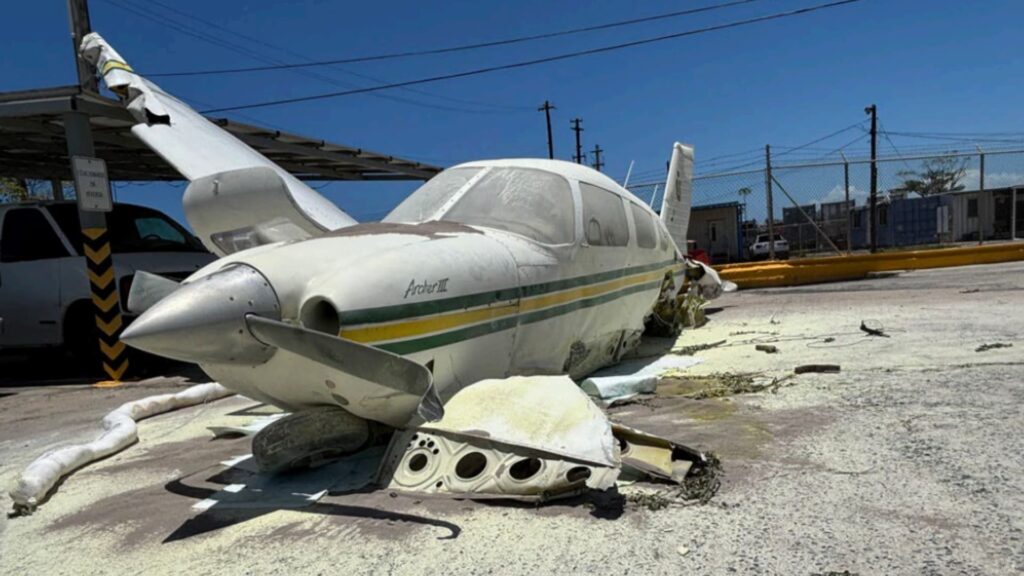
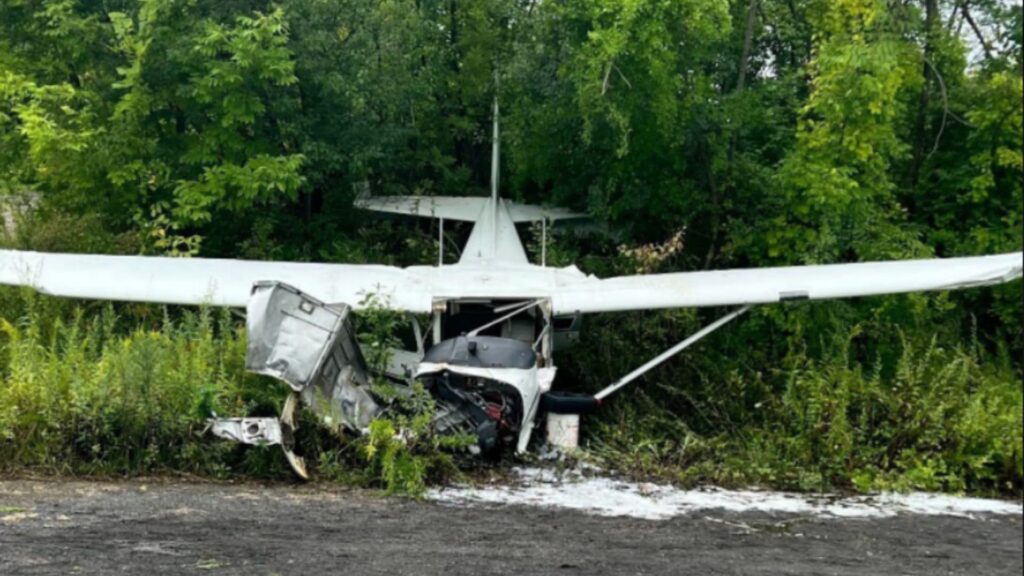
The stall occurred at very low altitude, leaving no room for recovery. The airplane impacted a parking lot near the airport, sustaining substantial damage to both wings and the fuselage. Despite the severity of the impact, the pilot was not injured.
Investigators found no evidence of any preimpact mechanical malfunctions or failures. The Lycoming O-360 engine was producing power, the flight controls were continuous, and there were no anomalies that would explain the loss of control. The weather was benign, and the runway was dry.
The defining event was a loss of control in flight during the takeoff phase, followed by an aerodynamic stall.
Aircraft and Environment
The aircraft involved was a 1998 Piper PA-28-181 Cherokee, powered by a 180-horsepower Lycoming engine. It was owned and operated by Inter American University of Puerto Rico as part of its pilot training program and held a normal airworthiness certificate. The airplane had accumulated over 10,600 hours total time on the airframe.
Fernando Luis Ribas Dominicci Airport sits just nine feet above sea level, and on the morning of the accident, density altitude was not a significant factor. Visibility was 10 miles, with scattered clouds at 2,500 feet AGL. There was no reported turbulence, precipitation, or obstructions that would have influenced the takeoff.
In other words, the environment was about as forgiving as it gets. This accident unfolded almost entirely within the airplane and the cockpit.
Why Soft-Field Technique Matters
Soft-field takeoffs are often introduced early in flight training, but they demand precise control and discipline. The goal is not simply to lift off as soon as possible, but to manage pitch carefully, remain in ground effect, and allow the airplane to accelerate before climbing.
An excessive pitch attitude increases angle of attack rapidly. If airspeed does not increase at the same time, the wing will stall. At low altitude, especially immediately after takeoff, there is little opportunity to recognize and correct that mistake.
For a student pilot with less than one hour of solo experience, the workload can be high. There is no instructor to guard the controls, correct pitch, or call out airspeed. Small errors can compound quickly.
In this case, the excessive nose-high attitude was the critical error. Once the airplane exceeded its critical angle of attack, the outcome was largely predetermined.
Human Factors and Training Context
The NTSB findings identified aircraft control issues attributed to the student pilot, specifically noting that pitch control was not attained or maintained and that the aircraft’s angle-of-attack capability was exceeded.
This was not a reckless maneuver or an intentional push beyond limits. It was a training flight, conducted within the bounds of what the pilot believed she was authorized and prepared to do. The instructor had given permission to practice soft-field takeoffs if she felt comfortable.
That phrase matters. Comfort does not always equal proficiency, especially early in solo flight. Students may overestimate their ability to manage unfamiliar techniques without supervision, particularly when those techniques involve subtle control inputs during high-workload phases of flight.
The Probable Cause
The NTSB determined the probable cause of the accident to be the student pilot’s excessive pitch attitude during takeoff, which resulted in a loss of aircraft control and an aerodynamic stall.
There were no contributing mechanical factors, no environmental hazards, and no evidence of impairment. This was a classic low-altitude stall following takeoff, driven by pitch mismanagement.
Safety Takeaways
This accident reinforces several recurring lessons in general aviation training.
First, pitch discipline after liftoff is critical. Regardless of takeoff technique, maintaining adequate airspeed is non-negotiable. Ground effect is a tool, not a substitute for acceleration.
Second, early solo flights are not the time to experiment. Even maneuvers that seem basic can introduce risk when flown without an instructor’s oversight. Building confidence should come from repetition and mastery, not from expanding the envelope too quickly.
Third, instructors and training programs should be deliberate about what students practice during solo operations. Clear boundaries and conservative expectations can help prevent well-intentioned students from putting themselves in situations they are not yet equipped to handle.
Finally, this accident shows how quickly things can go wrong close to the ground. There is little margin for error during takeoff, and stalls at low altitude remain one of the most unforgiving scenarios in aviation.
The outcome could have been much worse. The fact that the pilot walked away without injury is fortunate. The airplane, however, was substantially damaged, and the lesson is one that continues to repeat itself across decades of accident data.
6 Comments
First, if I had a student who had over 40 hours of flying time with only 0.6 solo, no way would I let them do anything but regular takeoffs and landings! I understand how training can get stretched out but in this case I think the young Lady was having problems learning to fly. Also, it seems to me that she had NO instrument discipline. I remember being drilled on how to scan my instruments and get your eyes back outside. I think that young Lady just froze up, not reacting to what she saw outside, let alone her attitude indicator and airspeed! By the time I had 40 hours logged I had significant time spent under the hood learning how to fly with instruments, not because it was required but because it was smart to get comfortable trusting the instruments, just in case!
Personally I appreciate your comments, where you mentioned about trust your instrument. However, the point you said you think the young lady is having problems learning how to fly sounds offensive. You need to be considerate with your words; I doubt you know her instructor because you’re indirectly saying her instructor doesn’t know his/her onion. Even the NTSB where mindful with words adding that it was a training flight, they also further saying that the SP conducted the maneuver within the bounds she was authorized and prepared to do and that the instructor had given permission to practice soft-field takeoffs if she felt comfortable.
Honestly your comment could be discouraging Sir.
Thanks with regards.
Poor judgement on instructor . She was basically allowed to decide on the soft field take off. This is a challenging exercise for even an experienced pilot.
I am not a pilot, but am willing to fault the instructor who should not be allowed to oversee students who apparently take more time than usual to become used to the basics of flying if the instructor cannot recognize exhibited student limitations.
One thing I remember of my first solo was without the instructor the aircraft seemed to just leap into the air. I don’t recall solo number 2 but I wonder if in this case the increased performance of the aircraft without the instructor added another layer of complexity to the soft field take off.
The only thing I felt was that for someone learning to fly, she didn’t seem to be doing it very regularly. I was quite surprised to see how few regular hours were flown.
I’m not a pilot though and this may be quite normal.