




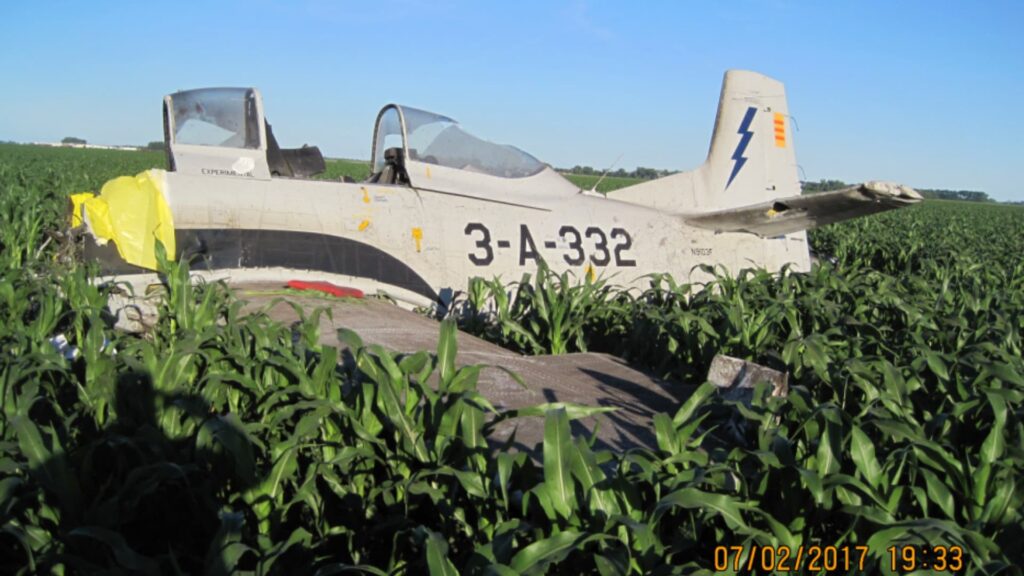
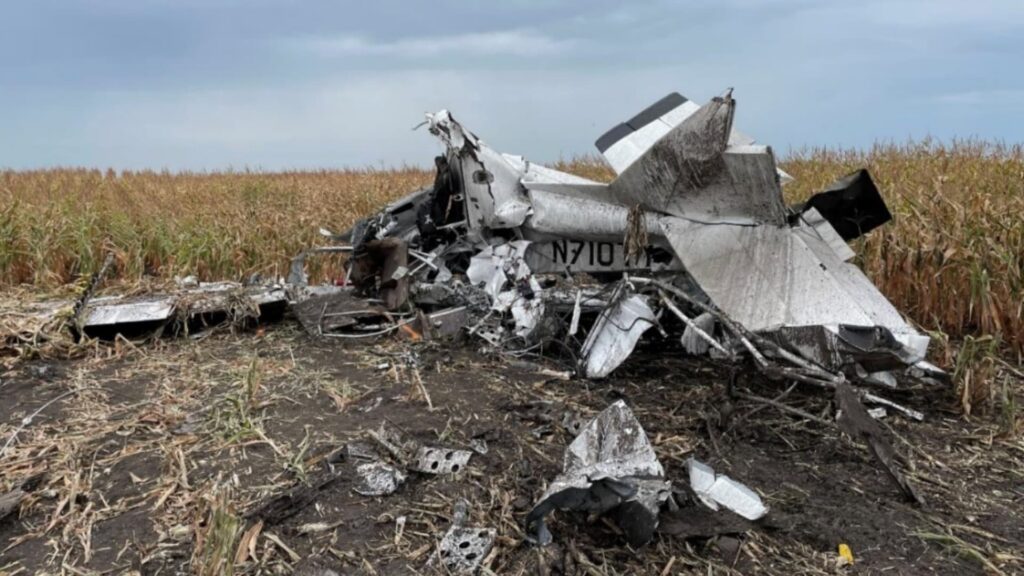
On July 2, 2017, a North American T-28A, N9103F, was lost during a short reposition/diversion and approach into Moorhead Municipal Airport (JKJ) in Moorhead, Minnesota. The flight was Part 91 personal, day VMC, and it ended in a fatal impact in a cornfield about a half-mile from the approach end of runway 12 after the airplane clipped a light pole with its right wing.
Pilot and Airplane
The pilot was 41 years old and held a private pilot certificate with an airplane single-engine land rating. He did not hold an instrument rating. His reported total time was about 792 hours (791 hours when he applied for a medical in March 2017), and the report noted that his time in the T-28A could not be determined. He held a second-class medical dated March 17, 2017.
The airplane was a 1951 North American T-28A operating in the experimental category, powered by a Wright R-1820-series engine rated at 1,475 horsepower. In other words: a big, high-energy, warbird-style airplane that doesn’t give you much time to troubleshoot when something feels off close to the ground.
The Plan, and the First Sign Something Wasn’t Right
The flight launched from Hector International (FAR) in Fargo, North Dakota, around 1750 local, originally headed for Lyons Field (47Y) in Pelican Rapids, Minnesota. Not long after takeoff, the airplane climbed to about 1,800 feet msl—roughly 900 feet agl in that area—and was moving along at about 160 knots per the FAA inspector’s statement.
That’s when the story took its first turn. The pilot contacted Fargo Departure and said he was diverting to Moorhead (JKJ), a nearby airport. He didn’t state a reason, he didn’t declare an emergency, and when the controller asked if he needed assistance, the pilot replied along the lines of “I don’t think so,” and later, “No.” The controller cleared him toward JKJ, approved a frequency change, and instructed him to squawk VFR. After that, there were no more responses from the pilot.
In a lot of accidents, that radio transcript is the whole tone. Not panic—just a short, contained decision to stop the plan and get on the ground. The fact that he diverted quickly after leveling at 1,800 msl suggests something changed early: a noise, a roughness, an indication, a control feel, maybe even a physiological issue. The report couldn’t pin down a single “smoking gun,” but the diversion itself was a clue.
The Descent Toward JKJ
Radar showed the airplane in a controlled descent on a southerly heading toward Moorhead. From 1,800 feet msl to the impact point was about 7.5 miles—an average descent gradient of roughly 120 feet per mile. That’s not a wild plunge. It read more like a managed descent where the goal was “get it on the ground soon,” not “I’ve already lost it.”
But as the airplane got low, multiple witnesses described a machine that didn’t sound healthy. One witness about two miles north of the crash site saw the airplane pass overhead at an estimated 150–200 feet agl with the landing gear extended. He said it was “obviously in distress” and making a “terrible racket,” like a gearbox or engine failing or maybe running out of oil. Two other witnesses in a public park reported the airplane was very low—around 100 feet agl—and that the engine was “missing and popping,” and that it sounded like it was in trouble.
Clay County deputies interviewed additional witnesses who largely backed up the same picture. One detail stood out: one witness noted the airplane appeared slow and the wings were “rocking” before the right wing clipped a light pole.
When you put those pieces together, you can build a plausible timeline: the pilot configured early—gear down—likely trying to set up a straightforward arrival. But the airplane was low, possibly slow, and something about the engine/prop system sounded abnormal to people on the ground.
The Impact and Immediate Aftermath
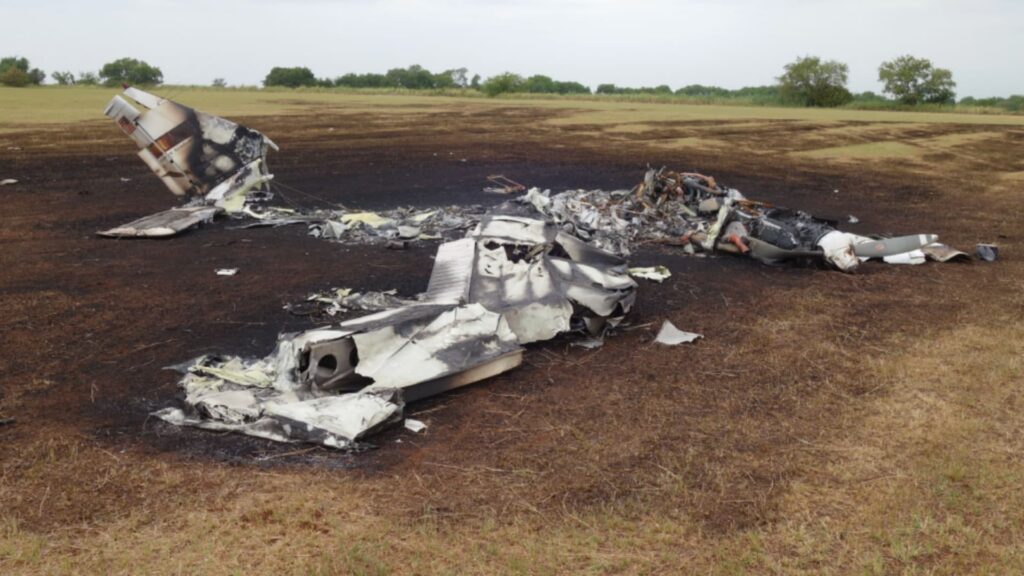
After the right wing struck the light pole, the airplane continued into a cornfield near I-94, about two miles east of Moorhead and about a half-mile from the approach end of runway 12. The right main gear hit first, then the nose. The impact was severe enough that the propeller and gear case separated from the engine; the engine itself separated from the fuselage and was found farther south of the main wreckage. The landing gear was extended, and investigators noted paint transfer marks from the light on the right wing.
Several bystanders and witnesses went to the site to help. According to the report, the pilot was initially conscious, coherent, and talking. He had a large laceration on his forehead, and people applied pressure with a shirt. Shortly after, he succumbed to his injuries and had to be extricated by emergency personnel.
There was also a survivability detail that matters for the broader safety conversation: the pilot was wearing a lap belt and shoulder harness, but the shoulder harness had failed.
Weather and Why It Probably Wasn’t the Driver
This was not a marginal-weather day. The observation at JKJ around 1814 local showed wind from 030 at 6 knots, 10 miles visibility, and clear skies (with no ceiling reported). In other words, the pilot was working in VMC with decent visibility and light winds.
That matters because it narrows the problem set. There wasn’t a hidden IMC trap here. If something went wrong, it likely wasn’t because the environment forced the airplane into a corner.
The Engine Question: Lots of Noise, Not Much Evidence
Given the witness statements, you’d expect to find something obvious in the engine. The airplane sounded like it was “missing,” “popping,” and making a “terrible racket.” But when the engine was disassembled and examined under FAA auspices a few days later, investigators found damage consistent with the engine developing power at impact. The engine showed no visible signs of a failure that would have precluded normal operation. The oil filter was free of contamination, and oil analysis came back within normal ranges.
So how do you reconcile those two things—witnesses describing a sick engine, and a teardown that doesn’t reveal a clear mechanical culprit?
The report essentially left that question open. The NTSB noted that the reason for the abnormal engine sounds could not be determined, and the probable cause pointed to a controlled descent into terrain associated with engine issues of undetermined origin.
One more subtle data point: investigators consulted other T-28 pilots and noted that, to remain airborne in the landing configuration, the airplane would have needed power. The inspector calculated the airplane flew about 1.6 miles in landing configuration before impact. That supports the idea that, even if the engine sounded rough, it was still making enough power—at least part of the time—to keep the airplane flying with gear down.
Human Factors and Medical Notes
Toxicology found diphenhydramine in urine and cavity blood. Diphenhydramine is a sedating antihistamine commonly found in over-the-counter allergy and motion-sickness medications, and it can impair alertness and reaction time. The report did not explicitly connect it to the accident sequence, but it was part of the factual record.
In a scenario where a pilot is suddenly dealing with an abnormal noise, possible rough running, and a diversion with a rapid setup to land, anything that degrades crisp decision-making can matter. Even in VMC. Even with a runway in sight.
Safety Takeaways
First: if you divert because something feels wrong, treat that decision like it matters. The pilot here did the right initial move—head for a nearby airport—but he didn’t declare an emergency and repeatedly declined assistance. Controllers can’t troubleshoot your engine, but they can clear airspace, coordinate emergency response, and reduce your workload. Saying “unable” or “declaring” isn’t a character flaw; it’s an operational tool.
Second: altitude is options. The airplane was observed extremely low—100 to 200 feet agl—with the gear down well before the crash. If the airplane truly was struggling to make power, configuring early may have traded away energy and climb performance at the worst possible time. None of us can know exactly what indications the pilot had in the cockpit, but the outside picture—low, configured, rocking wings—looked like an airplane that was running out of margin.
Third: in an abnormal, fly the airplane first and keep the landing site wide. The accident site had open fields in the area, and the report noted the pilot made no attempt to land in those fields. That doesn’t mean a field landing was easy or obvious from the cockpit, but it’s a reminder that “make the runway” can quietly become “press the glide” when the airplane is already low and something changes.
Finally: restraint systems matter, especially in high-energy aircraft. The shoulder harness failure was documented in the wreckage findings. For warbird and experimental owners, that’s a prompt to look hard at restraint condition, installation, and maintenance—because crashes are survivability problems as much as they’re accident-causation problems.
At the end of the day, this was one of those reports that left you with an unsettling reality: multiple people heard an engine that didn’t sound right, the pilot clearly changed the plan and tried to get the airplane on the ground, and yet the post-accident teardown didn’t deliver a neat mechanical explanation. Sometimes the data doesn’t hand you a clean answer. What it does hand you are the margins—communication, configuration, altitude, and decision points—that pilots can control when the cockpit suddenly gets busy.

One Comment
I believe this might have been a survivable accident. Not sure if the pilot was wearing a helmet, but that would have helped, along with a properly maintained functioning restraint system—excellent report and a lot to think about if I were in the situation.