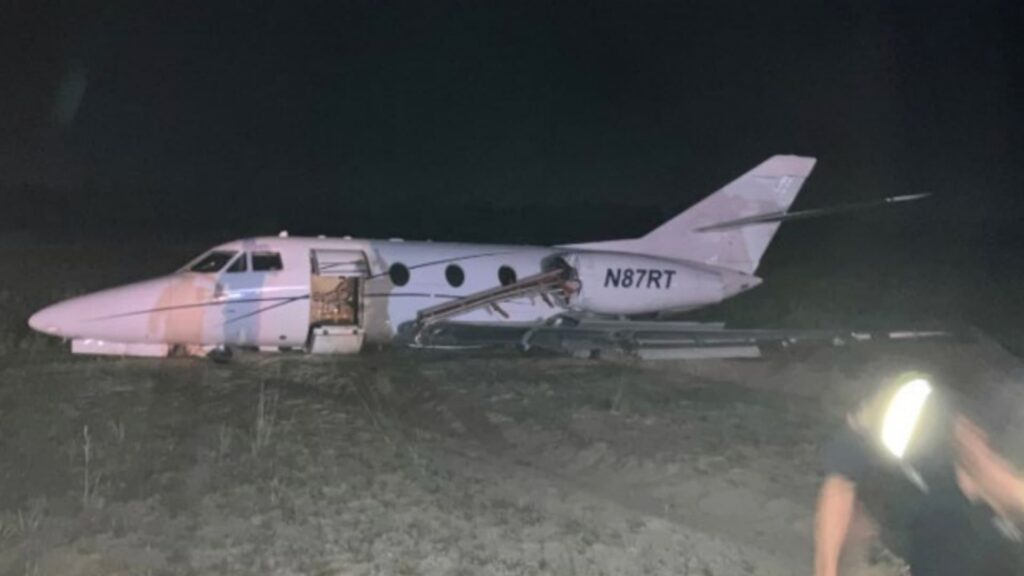



On the evening of June 6, 2023, a Dassault-Breguet Falcon 10, registration N87RT, departed Atlanta for what should have been a routine Part 91 flight into Northwest Florida Beaches International Airport in Panama City, Florida. Weather was not a factor. The approach was straightforward. The runway was long, dry, and well-lit. And yet, by the end of the landing roll, the airplane would be off the end of the runway, damaged, and sitting in the sand. Everyone would walk away, but the lessons from this mishap are worth slowing down and unpacking.
The Crew and the Airplane
The captain in the left seat was a very experienced aviator. He held an airline transport pilot certificate along with commercial, flight engineer, and flight instructor certificates. At the time of the accident, he had accumulated about 29,000 total flight hours, with roughly 86 hours in the Falcon 10. He had flown recently and held a current first-class medical with waivers.
The copilot, seated on the right, held commercial and private pilot certificates with instrument privileges. He had about 441 total flight hours and 33 hours in the Falcon 10. While significantly less experienced than the captain, he was current and medically qualified.
The airplane itself was a 1977 Falcon 10 equipped with Garrett TFE731-2C engines. Importantly, this aircraft had thrust reversers installed under a supplemental type certificate. That detail would become central to what followed.
The Setup into Panama City
The flight departed Cobb County International Airport near Atlanta in the early evening and proceeded under IFR to Panama City. The crew briefed and flew a straight-in ILS approach to Runway 16. Night VMC prevailed, winds were light, and visibility was excellent. There were no abnormal indications during the approach. Landing gear, flaps, and hydraulics all behaved as expected.
From an outside perspective, this was about as benign a setup as you could ask for. A 10,000-foot runway at sea level, light winds, clear skies, and a stabilized instrument approach at night.
Touchdown and the Start of Trouble
The Falcon touched down about 2,500 feet beyond the runway threshold. On a 10,000-foot runway, that still left plenty of pavement, but it reduced the available stopping margin.
After touchdown, the captain deployed the speed brakes and brought the thrust levers into reverse. Almost immediately, things did not feel right. The airplane was not decelerating as expected, and a warning horn sounded. The thrust reversers did not deploy.
The captain applied normal braking. There was no meaningful deceleration. He called out “no brakes,” and the copilot applied his brakes with the same result. The captain then pulled the emergency brake handle to the first notch, then to full emergency braking. Still nothing that felt effective.
At this point, the airplane was still moving fast, with runway rapidly disappearing ahead.
Why the Airplane Wouldn’t Slow Down
As the crew tried to make sense of what was happening, the captain attempted to recycle both the brakes and the thrust reversers. With the end of the runway approaching, aborting the landing was no longer a realistic option. He attempted to shut down the engines using the throttles but couldn’t, because the thrust reverser handles were still raised. Pulling the fire handles crossed his mind, but his attention was consumed by the obstacles ahead as the airplane exited the prepared surface.
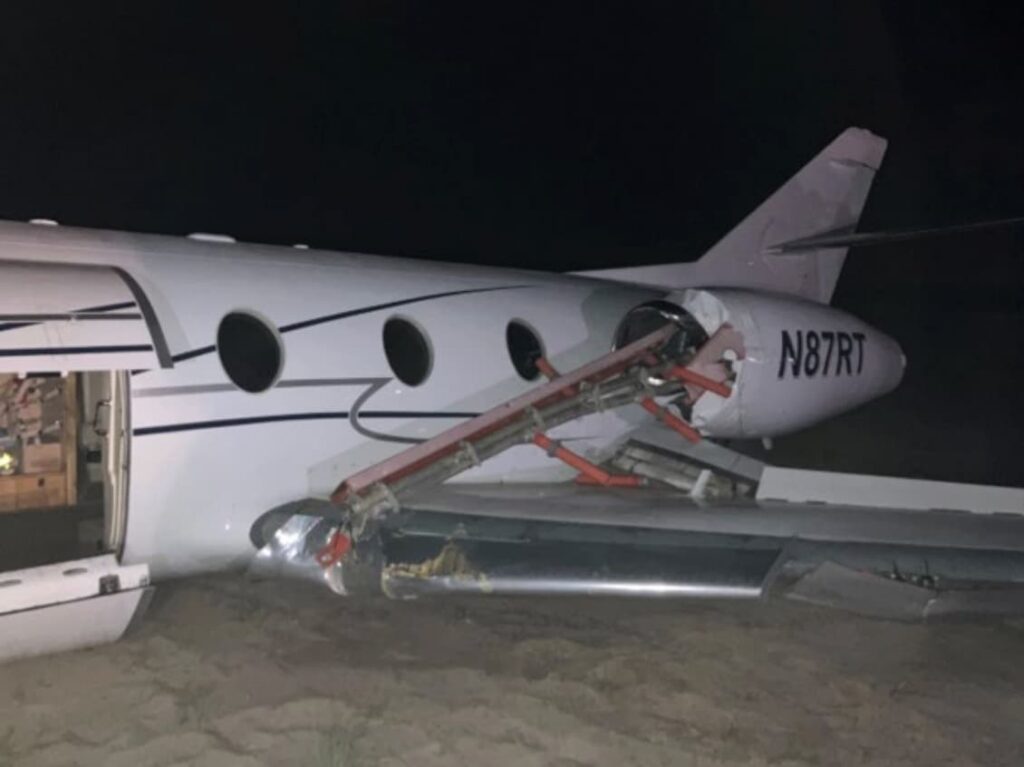
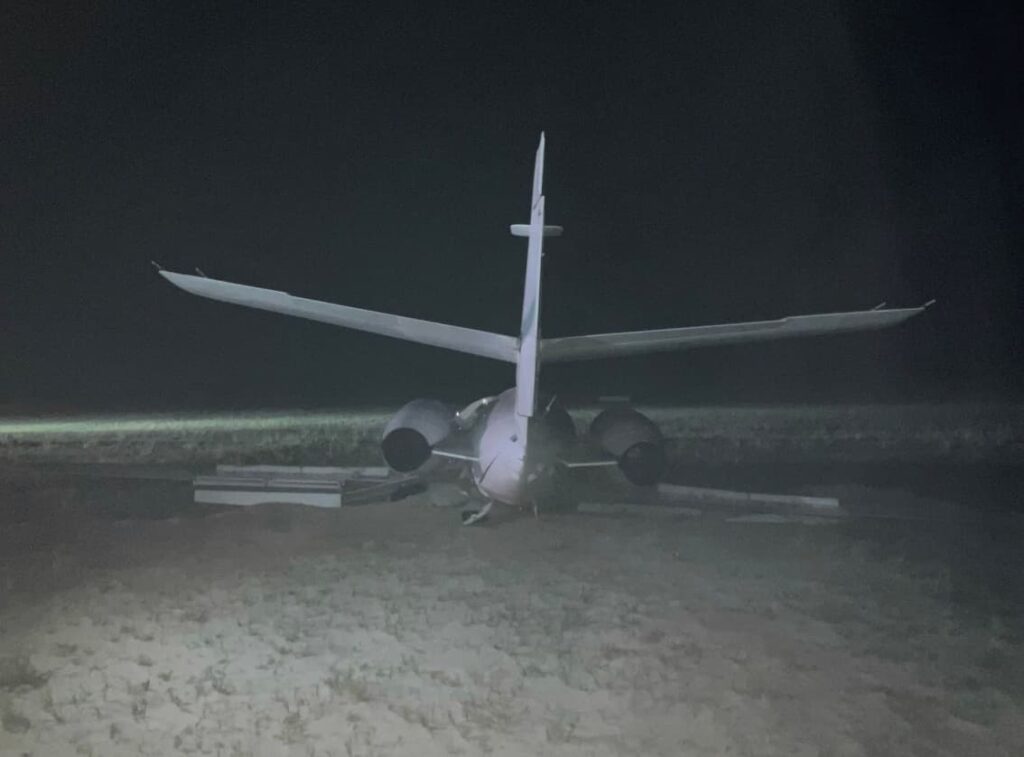
The Falcon ran off the end of the runway and struck several approach lighting stanchions. The wings were damaged near the inboard sections, the airplane bounced over a mound, and then rolled into deep, soft sand. The landing gear collapsed, and the airplane came to rest. The crew secured the engines, evacuated the aircraft, and the captain extinguished a small fire on the left wing with a cockpit fire extinguisher. Airport rescue crews arrived shortly thereafter. Remarkably, no one was injured.
The Key Detail Found After the Accident
While photographing the cockpit after the evacuation, the captain noticed something that immediately stood out. The thrust reverser emergency stow switches were in the unguarded, up, or stow position. That was not where they should have been for normal operation.
Earlier, during preflight, the captain had performed thrust reverser checks. At some point afterward, he failed to return the emergency stow switches to their normal position. With the switches left in STOW, the thrust reversers could not deploy normally.
The warning horn heard during landing was the system disagree alert, indicating that the thrust reversers were commanded but unavailable.
How Forward Thrust Overwhelmed the Brakes
Here’s where the situation became counterintuitive. With the emergency stow switches in the stow position, the normal interlock that prevents additional thrust until the reverser buckets are deployed was no longer protecting the crew. The captain was able to pull the reverse levers higher, increasing engine RPM.
Instead of producing reverse thrust, the engines were producing increased forward thrust.
In his own words, the captain later explained that with airspeed around 100 knots and higher-than-expected forward thrust, the braking system was immediately overwhelmed. Both the normal and emergency brakes were technically functioning, but they were being asked to absorb far more energy than they were designed to handle in that configuration.
This explains why it felt like a total brake failure, even though no mechanical faults were found.
Checklists and Configuration Errors
Postaccident examination found no preimpact mechanical malfunctions. The flaps, spoilers, and slats were deployed as expected. The engines showed damage consistent with debris ingestion after the runway excursion. Everything pointed back to configuration and procedural issues.
One particularly telling detail was the checklist found in the cockpit. It was marked “For Training Purposes Only” and was for a Falcon variant that was not equipped with thrust reversers. The proper checklist associated with the supplemental type certificate included explicit steps to confirm the thrust reverser throttles were in the stow position and that the emergency stow switch guards were down.
The NTSB concluded that the flight crew failed to appropriately configure the airplane for landing and failed to use the correct checklist for a thrust-reverser-equipped aircraft. That combination led directly to the failed deployment of the reversers and the inability to stop the airplane.
Human Factors at Play
What makes this accident particularly instructive is how subtle the initial error was. Forgetting to reset a switch after a preflight check is easy to imagine, especially for a pilot with thousands of hours and deep system familiarity. The presence of an incorrect checklist further normalized the configuration error.
Once the landing roll began, the crew was suddenly faced with multiple cues at once: a warning horn, unexpected acceleration, and ineffective braking. Under time pressure, diagnosing that increased forward thrust was the root cause was extremely difficult. By the time the picture became clearer, there was simply no runway left.
Takeaways for Pilots
This accident reinforces several timeless lessons. Configuration discipline matters, especially with modified aircraft operating under STCs. Checklists are only effective if they are the correct ones, and “training only” documents have no place in operational cockpits.
It also highlights how systems can interact in unexpected ways. A perceived brake failure was actually a thrust management problem, and the cues available in the moment were easy to misinterpret.
Finally, this event is a reminder that long runways and good weather don’t eliminate risk. Small setup errors can cascade quickly, even for experienced crews, and the landing roll is still a critical phase of flight that deserves full attention and verification.
Everyone walked away from this one, but the airplane did not. The value here is in understanding how a simple switch position and the wrong checklist turned a routine night arrival into a runway excursion.