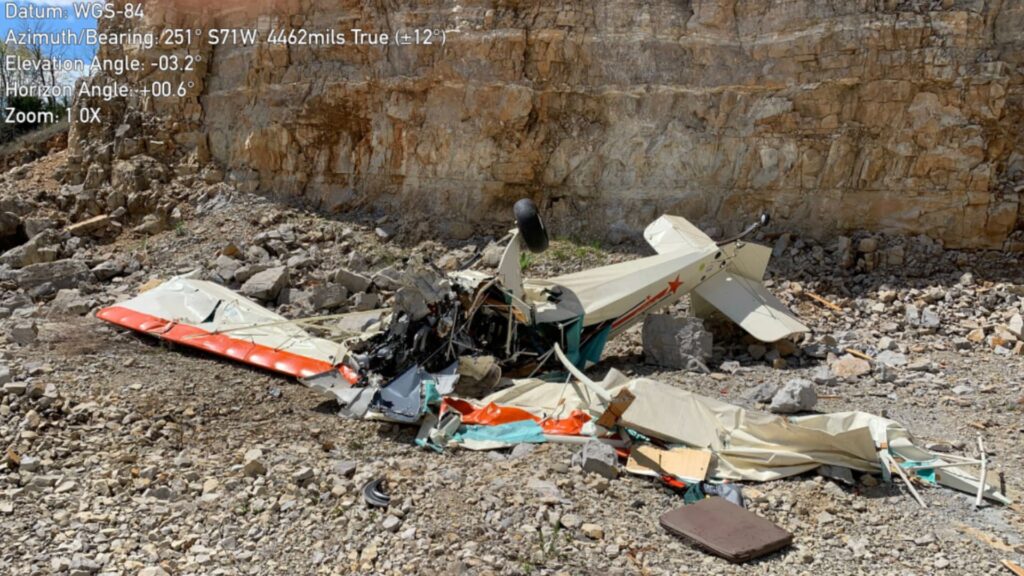



On the afternoon of April 13, 2023, a single-seat Junior Ace, registration N5545, departed from a private airstrip in Ash Flat, Arkansas, for what appeared to be a short local flight. About thirty minutes later, the airplane impacted a vertical rock wall inside a quarry near Mammoth Springs, Arkansas. The pilot, the sole occupant, was fatally injured.
The flight was conducted under Part 91 as a personal flight, in day VMC, with no flight plan filed. Weather conditions were not a factor. Visibility was good, winds were light, and there were no reported mechanical issues with the aircraft. What unfolded over the next few minutes was not an accident driven by systems, weather, or skill, but by a deeply human factor that ultimately defined the outcome.
The Pilot
The pilot was a 67-year-old private pilot with an estimated 1,000 hours of total flight time. Approximately 200 of those hours were in the Junior Ace make and model. He did not hold an instrument rating or any instructor or commercial certificates. His most recent FAA medical examination was completed in May 2021, and he was operating under BasicMed at the time of the flight.
From a qualification standpoint, there was nothing to suggest the pilot was inexperienced in the airplane or unfamiliar with local flying. He owned the aircraft and flew it regularly. This was not a case of a pilot being overwhelmed by the machine or the environment.
The Aircraft
The aircraft involved was a 2015 Junior Ace, an amateur-built experimental light-sport airplane. It was powered by a Lycoming O-235-C1 engine producing 185 horsepower and configured as a single-seat, tricycle-gear airplane. The aircraft was maintained under continuous airworthiness inspection and showed no evidence of unresolved maintenance issues.
Post-accident examination of both the airframe and engine revealed no mechanical anomalies that would have prevented normal operation. Control continuity was established, and damage patterns were consistent with a high-energy impact rather than an in-flight failure.
In short, the airplane was capable of flight until the moment it struck terrain.
Departure and Initial Flight
The flight departed the pilot’s private airstrip around 1:00 p.m. local time. The strip was located roughly 16 miles from the eventual accident site. Witnesses did not report anything unusual during departure or en route flight.
Rather than returning to the airstrip or continuing on a cross-country route, the pilot flew toward a rock quarry near Mammoth Springs. This quarry would soon become the focal point of the flight’s final moments.
Low-Altitude Maneuvering Over the Quarry
Multiple witnesses near the quarry observed the airplane arrive and begin circling the area. The aircraft made several passes, remaining low and maneuvering in a confined space surrounded by rock walls.
At low altitude, especially over uneven terrain like a quarry, there is very little margin for error. But in this case, the evidence showed that the airplane was not struggling. It was not descending unintentionally, nor was it avoiding terrain. The pilot appeared to be deliberately maneuvering the airplane within the quarry environment.
On the final pass, witnesses reported seeing the airplane dive directly into the quarry and collide with a vertical rock wall.
The Impact
The airplane struck a rock wall approximately 75 feet tall, with impact marks located about 20 feet below the top. The wreckage came to rest directly below the point of impact. Damage signatures indicated a near-vertical, high-energy collision.
There was no post-impact fire, no explosion, and no evidence of an attempt to arrest the descent or recover prior to impact. The physical evidence aligned with witness statements: this was a deliberate, controlled flight path into terrain.
Post-Accident Findings
An autopsy was conducted by the Arkansas State Crime Laboratory. The cause of death was listed as multiple injuries, and the manner of death was classified as suicide.
Toxicology testing detected ethanol at a level of 0.048 g/dl in cavity blood, along with n-propanol. However, neither substance was detected in vitreous fluid. The presence of n-propanol suggested postmortem microbial activity, and investigators concluded that the ethanol was most likely produced after death rather than consumed prior to the flight.
From an investigative standpoint, there was no evidence that impairment, medical incapacitation, or substance use contributed to the event.
Probable Cause
After reviewing witness statements, physical evidence, toxicology results, and the findings of local law enforcement and the coroner, the National Transportation Safety Board determined the probable cause of the accident to be the pilot’s intentional flight into terrain as an act of suicide.
This conclusion was not based on speculation, but on corroborated observations and forensic findings.
Human Factors and Hard Realities
Accidents like this are among the most difficult to discuss in aviation. They don’t fit neatly into categories of weather decision-making, aeronautical skill, or mechanical reliability. Instead, they force the aviation community to confront the reality that pilots are human first and aviators second.
Aviation places heavy emphasis on checklists, procedures, and proficiency, but mental health does not always show itself in logbooks or preflight inspections. Pilots are often conditioned to self-rely, push through stress, and minimize vulnerability. That culture can make it harder to recognize when someone is struggling.
In this case, the airplane flew exactly where it was pointed. The systems worked. The environment cooperated. The outcome was shaped entirely by human intent.
Safety Takeaways
There is no procedural fix or equipment upgrade that would have prevented this accident. However, there are still lessons worth acknowledging.
First, mental health matters in aviation, even when it is uncomfortable to talk about. The FAA, pilot organizations, and peer networks have made progress in reducing stigma, but barriers still exist.
Second, the presence of an aircraft does not automatically make every fatal event an “accident” in the traditional sense. Investigators must follow the evidence wherever it leads, even when the conclusion is difficult.
Finally, for pilots reading reports like this, it serves as a reminder to look out for one another. Subtle changes in behavior, isolation, or uncharacteristic decisions can matter. Aviation is often safer when it is shared.
Closing Thoughts
This flight did not end because of weather, mechanical failure, or lack of skill. It ended because of a personal struggle that never appeared in a maintenance log or weather briefing. While the facts are clear, the underlying reasons remain known only to the pilot himself.
As with all NTSB reports, the purpose of documenting this event is not to assign blame, but to understand what happened and, where possible, prevent future loss. In some cases, prevention begins not in the cockpit, but in the conversations we are willing to have on the ground.