
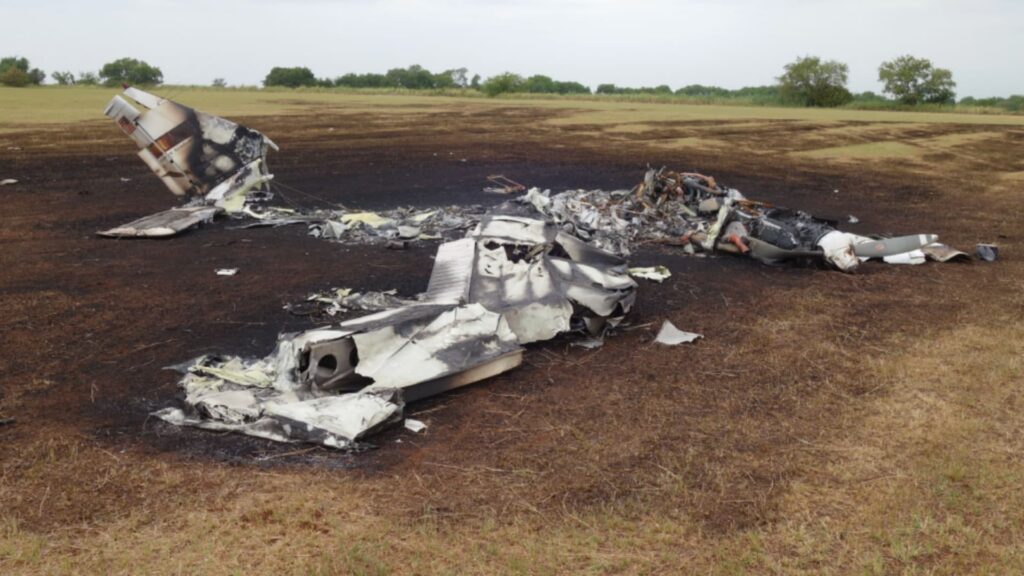



This mishap didn’t start with a dramatic weather system or an unexpected diversion. It began with a routine multi-engine training flight. A Piper PA-34-200 Seneca, N456AG, departed Denton Enterprise Airport for what was supposed to be a standard instructional sortie: pattern work, approaches, and multi-engine procedures. The two pilots onboard were both young but working their way through the industry pipeline. The pilot receiving instruction was 22 years old, holding a private pilot certificate with an instrument rating and 214 total hours. He had only 16 hours in the Seneca. The instructor, just 25, held a flight instructor certificate with single-engine, multi-engine, and instrument privileges. She had accumulated 536 total flight hours, including 71 hours in the PA-34.
Both were relatively early in their careers, and this training flight was part of the student’s path toward a commercial certificate. But behind the scenes, several issues were already in play: recent engine replacements, recurring power-loss events, and a student pilot who had a documented history of difficulty during simulated engine-out scenarios. The ecosystem surrounding this flight was showing strain long before the airplane left the ramp.
A Seneca With Troubles Under the Cowling
The Seneca had recently received two overhauled engines after a prop strike. Each had logged only about 22 hours since installation. But those 22 hours were problematic. In the days leading up to the accident, multiple instructors had reported intermittent power losses on both engines during taxi, landing, and idle operations. Maintenance technicians made adjustments, including increasing idle speeds and inspecting the engines, but some of the corrective actions were not properly logged.
Just before the accident flight, a witness observed the left engine lose power and shut down. The crew restarted it, conducted run-up checks, and departed anyway.
None of this guaranteed an accident outcome, but it set expectations: the airplane had a recent history of inconsistent engine behavior, and the training environment often emphasized pushing flights through to stay on schedule.
An Afternoon of Training That Looked Normal Until It Didn’t
According to ADS-B data in the report, N456AG departed Denton at 1440 local and flew a series of visual approaches at DTO. The flight then climbed northwest to maneuver between 4,000 and 5,000 feet before heading toward Gainesville Municipal Airport (GLE). Once there, the crew entered the pattern and completed several takeoffs and landings. Everything appeared normal from the outside.
At 1609, the airplane was on a half-mile final for Runway 18 at about 250 feet above ground level. Groundspeed was 75 knots. That’s below the company’s recommended 105 mph (~91 knots) minimum for engine-out approaches and below the airplane’s published Vmc, the minimum control speed with the critical engine inoperative, which for this model is 80 mph.
Whether the crew was simulating a single-engine approach or coping with an actual loss of left engine power couldn’t be determined definitively. But the evidence is clear on what happened next: asymmetric thrust developed, control degraded, and the Seneca rolled left before impacting a field about 1,500 feet left of the runway.
The airplane was destroyed in the post-impact fire.
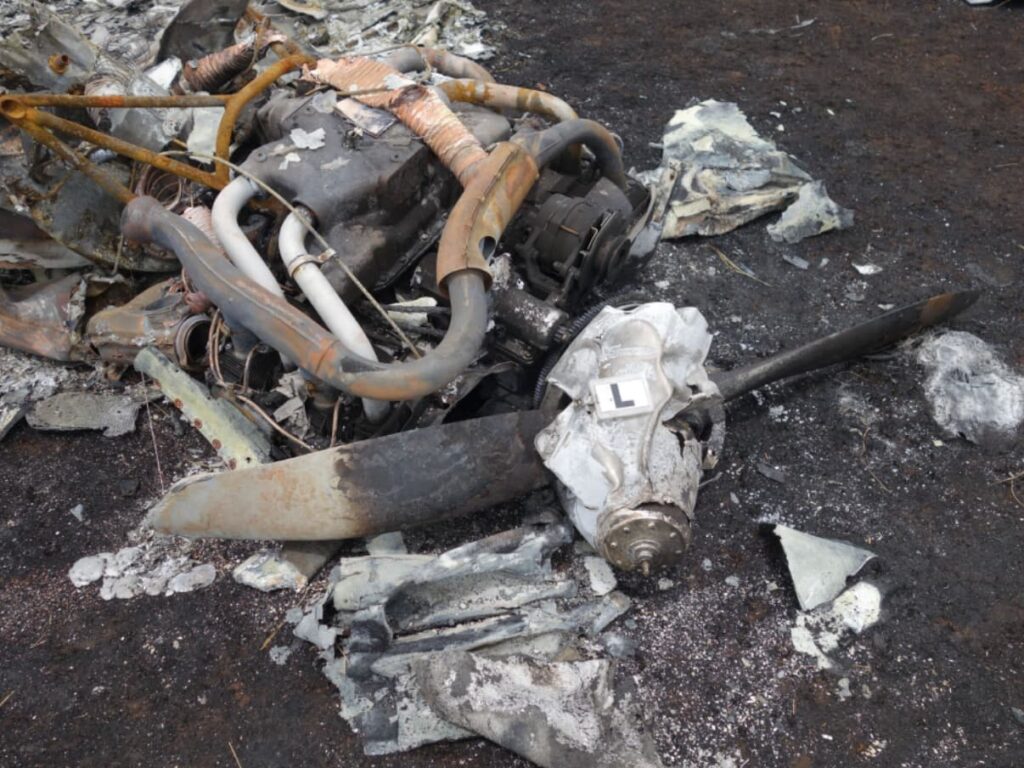
What the Wreckage Revealed
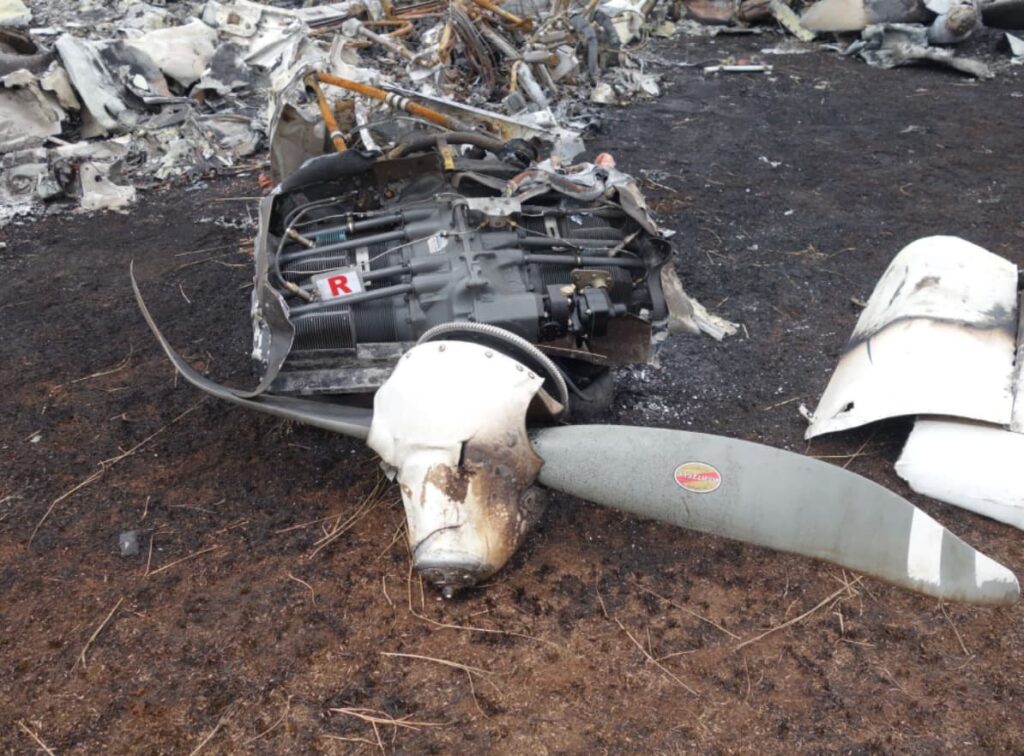
The NTSB found that the left propeller showed signs of low or no power at impact. The blades were in a low-pitch setting with no scoring. The right propeller, on the other hand, showed clear evidence of producing higher power, with leading-edge polishing and chordwise scraping.
Investigators also discovered the left engine’s No. 2 cylinder fuel injector nozzle was plugged with an unidentified substance. Fire damage prevented a deeper mechanical determination, but this blockage was consistent with the low-power state of the left engine at impact.
Control continuity was intact through the airframe, and no pre-impact structural failures were noted. This wasn’t a case of mechanical flight control failure or a sudden catastrophic event. It was a matter of asymmetric thrust at low altitude, with insufficient airspeed to maintain directional control.
A Student Pilot Struggling With the Fundamentals
Training records revealed significant challenges for the pilot receiving instruction. He had failed his Stage 1 check ride twice, struggling with basic aircraft control and situational awareness. During simulated engine failures, he had repeatedly failed to maintain control of the Seneca in the pattern. In one earlier flight, another instructor had to physically intervene to take control because the pilot didn’t respond to verbal commands to release the controls.
Language proficiency also emerged as a concern. English was not his first language, and instructors reported communication breakdowns during critical phases of flight.
He had not flown for about five weeks due to administrative delays in requesting additional training hours. During that downtime he practiced extensively in a simulator but logged minimal recent time in the Seneca itself.
The Instructor’s Role and Environment
The instructor was experienced for her age but still building her multi-engine instructional time. She had flown 36 hours in the last 30 days but none in the previous 24 hours. Company instructors described internal pressures to complete training within allocated hours, and although no one claimed the company explicitly pushed instructors to take unsafe flights, there was a widespread sense of being short on multi-engine instructors and aircraft.
In other words, the organizational environment leaned toward “keep things moving,” even if airplanes had recurring issues or students needed more coaching than the schedule allowed.
A Final Approach Below Minimum Control Speed
The NTSB’s probable cause centered on one factor: the flight crew’s failure to maintain adequate airspeed while on final approach with asymmetric engine power. With one engine producing significantly less thrust than the other, staying above Vmc is non-negotiable. Below that speed, the rudder cannot counteract the yaw, and once the airplane departs controlled flight, recovery becomes unlikely—especially at low altitude.
ADS-B showed the Seneca at 75 knots groundspeed on short final, already below published Vmc. With asymmetric thrust—whether simulated or real—the airplane would have been on the edge of controllability.
The left-wing-low, off-runway impact signature was entirely consistent with a Vmc roll.
The Human Story Behind the Technical Failure
It’s easy to view this as a simple “lost control below Vmc” accident, but the human factors here matter. A student pilot with known difficulties was flying a complex multi-engine aircraft that had shown repeated engine anomalies. An instructor was working in a busy, resource-constrained training environment. A company was trying to balance throughput with aircraft maintenance challenges and student proficiency concerns.
In that mix, even routine pattern work becomes a high-risk scenario.
The final approach wasn’t just a momentary mistake—it was the end result of training deficiencies, maintenance inconsistencies, and a system trying to push forward despite red flags.
Lessons for Every Multi-Engine Pilot
There are several takeaways worth revisiting:
- Airspeed is life, especially in multi-engine aircraft. Operating below Vmc with asymmetric thrust is a trap that closes fast.
- Simulated engine-out training must always include strict adherence to minimum safe speeds.
- Recurrent engine issues should be treated conservatively—especially when maintenance records reveal incomplete documentation.
- Instructor workloads and training pressures matter. Pushing flights under time, equipment, or proficiency strain increases accident risk.
- Language proficiency and communication clarity are safety issues, not administrative ones.
None of these elements alone caused the accident, but together they created an environment where a Vmc roll on short final became a tragically predictable outcome.
3 Comments
Excellent as always. Maybe it would be helpful to include a recommended procedure(s) for handling engine out below VMC minimums?
God these young eagles are killings themselves in these training accidents lately…
Having flown twin recips for decades under part 135 I am a bit surprised that there is not more respect shown towards these birds. Underpowered and ungainly when slow! High workload under normal circumstances much less when the panel is illuminated with red lights.
I had an interview to serve as PIC in a Seneca II long ago. I told the owner with a butt in each seat and full fuel, one engine would take you to the crash scene. I got the job. Single pilot, multi-engine recip=highest workload known to man.
Exercise care if you want to be old someday…
p.s. if you want to pilot small airplanes (or even hig ones) you have to be comfortable occasionally telling the boss no. They will respect you, if not walk away…
What I found missing was the company said “safe for flight”, but the engines had repeated complaints about performance. At the cost of two engine replacements (2 x ~$50.000 plus labor) and still complaints, why, oh why, was the plane flown as if nothing is/was wrong. I reviewed the Mag check requirements, 150 RPM drop, with a 50 RPM differential. Hopefully, they performed a Mag Check, we will never know what the results were, the requirements a max of150 RPM drop and differential or 50 RPM. It seem the 150 RPM drop gives a lot of room for a poor engine performance to hide?? Also, apparently there was no record of what was actually done when the engines were replaced. The point being were the fuel nozzles/fuel injector pump replaced or the fuel system (tanks) checked for debris. Was the main fuel filter changed as part of the engine changes or even a fuel sample performed on preflight?? This tragedy remines me of the recent crash (reported in Pilot Debrief) of the MIG-23 (cost 1.2M), a fuel control was changed, not noted whether the main or afterburner fuel control and apparent no record of an engine test prior to flight. If interested, you could Wikipedia (one source) the MIG-23 to see the problems they had. To close, this tragedy it is not about how underpowered the PA-34-200 may be, or how it handles, it is about (once again) improper or lacking proper maintenance and subsequent record keeping.