
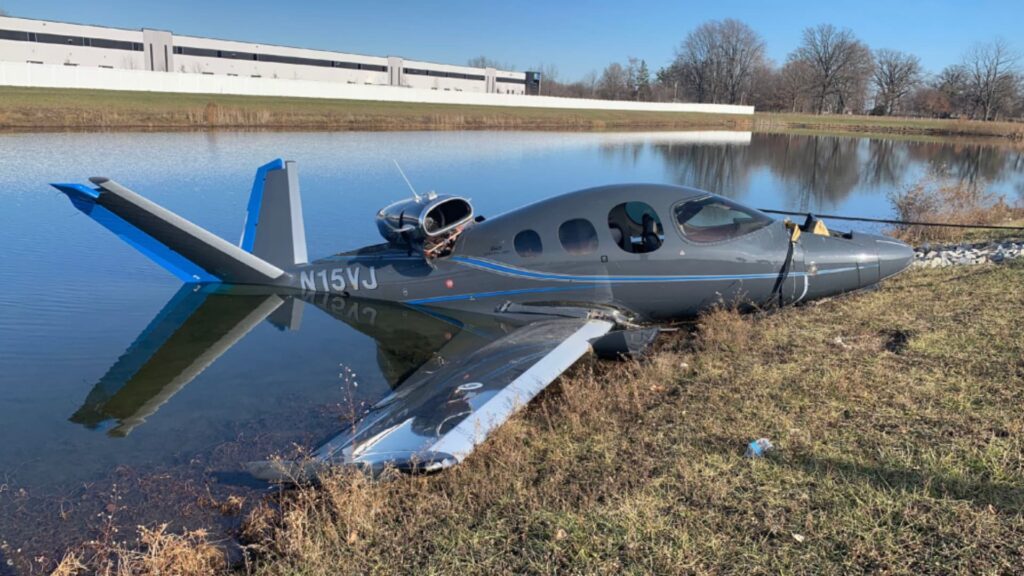



On the morning of November 25, 2022, a Cirrus SF50 Vision Jet, registration N15VJ, departed Indianapolis Regional Airport (MQJ) in Greenfield, Indiana, on an IFR flight bound for Greensboro, Georgia. The flight was conducted as a Part 91 positioning flight and was expected to be routine. Weather conditions were not unusual for a late fall morning, and nothing during preflight or taxi suggested that the departure would turn into anything more than another normal leg. Within minutes of liftoff, however, the flight began to diverge sharply from expectations, culminating in a parachute deployment less than 700 feet above the ground.
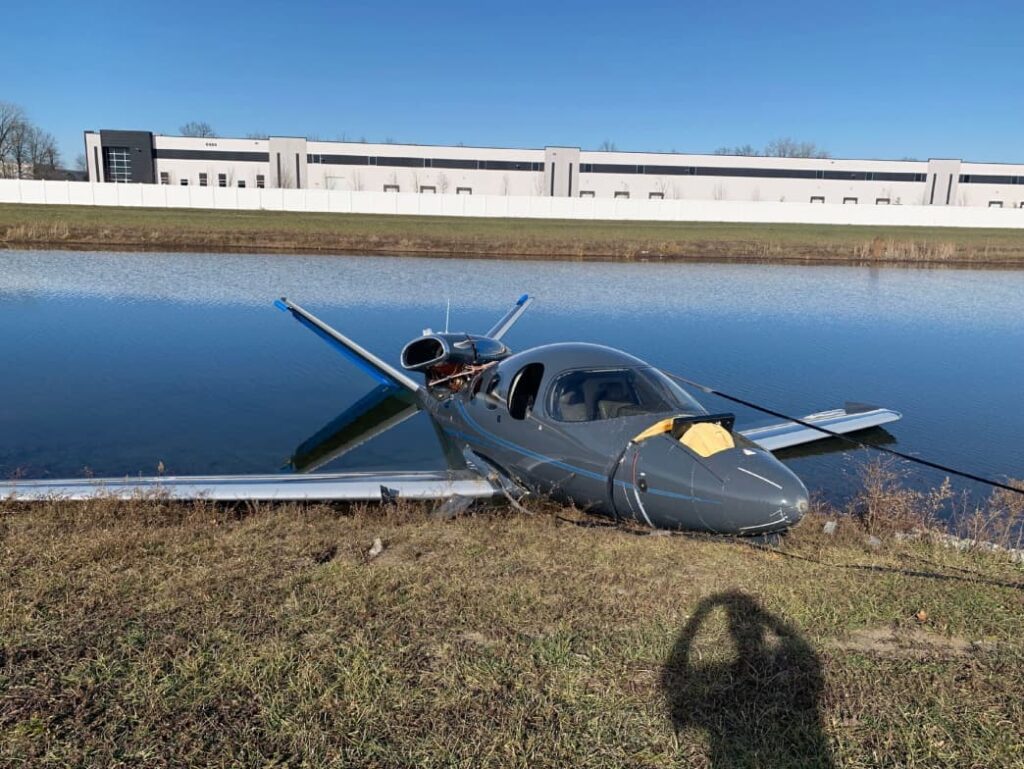
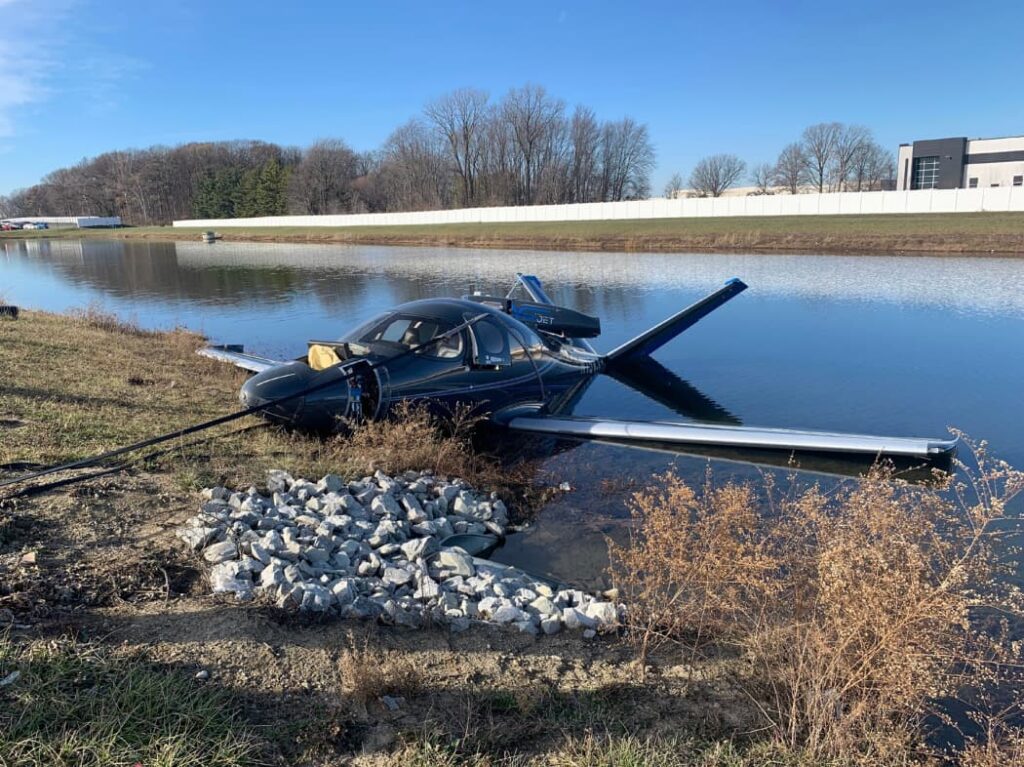
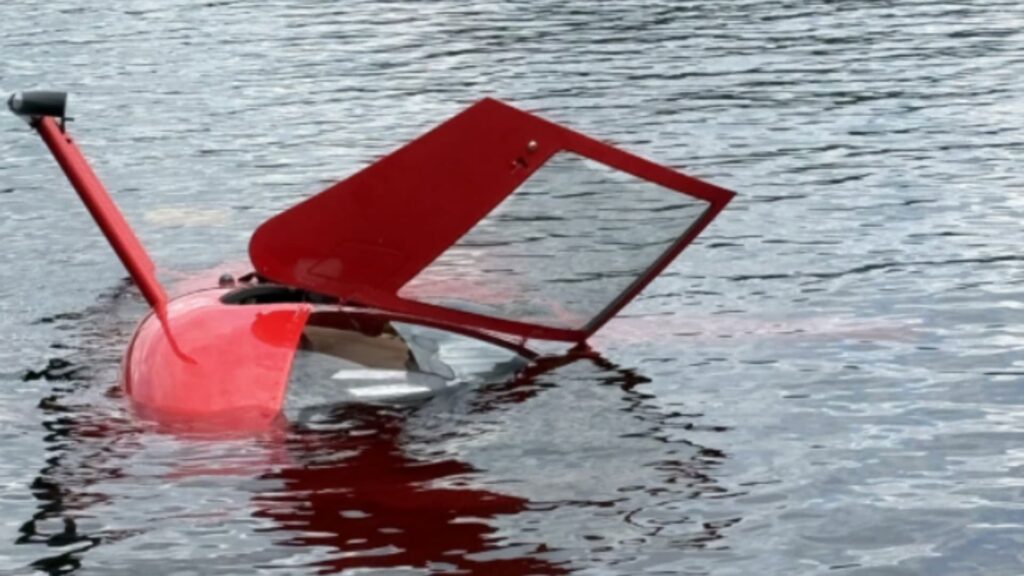
The pilot was the sole occupant and was not injured, but the airplane sustained substantial damage after descending under canopy and coming to rest in a retention pond near the airport.
The Pilot
The pilot was a 54-year-old airline transport pilot with approximately 12,000 hours of total flight time. He held single- and multi-engine land ratings, an instrument rating, and multiple flight instructor certificates. He was employed as a professional pilot and had accumulated about 200 hours in the Cirrus SF50. His most recent first-class FAA medical certificate had been issued in October 2022, just weeks before the accident.
From an experience and qualification standpoint, there were no red flags. This was not a low-time pilot, nor was he new to turbine aircraft or advanced avionics. He was flying an airplane he knew, operating in an environment he was accustomed to, and conducting a flight that did not present unusual complexity.
The Aircraft
The airplane involved was a 2020 Cirrus SF50 Vision Jet, powered by a Williams FJ33-5A turbofan engine. The aircraft was equipped with Cirrus’s integrated avionics suite, including autopilot, autothrottle, and the Cirrus Airframe Parachute System, or CAPS. The airplane was certificated in the normal category and had been maintained in accordance with its approved inspection program.
There were no known mechanical discrepancies prior to the flight, and post-accident examination would later confirm that the primary flight controls were intact and functioning normally. What ultimately drove this event was not a traditional flight control failure, but an unexpected interaction between electrical components and automation logic.
Departure from Mount Comfort
The pilot departed runway 25 at Indianapolis Regional Airport under IFR clearance. He reported that the preflight inspection and pre-takeoff checks were normal. After liftoff, he retracted the landing gear and flaps, continuing the climb as expected.
At approximately 800 feet above ground level, the pilot engaged the autopilot and autothrottle. Up to this point, the departure profile appeared completely normal. Shortly afterward, however, the airplane began behaving in a way the pilot did not command and did not immediately understand.
Automation Begins to Take Control
Not long after engaging the automation, the pilot began receiving audible and visual landing gear warnings. At nearly the same time, the airplane pitched up aggressively and engine thrust reduced without any pilot input. The pilot attempted to correct the situation by disconnecting the autopilot using the yoke-mounted disconnect button, first pressing and releasing it, then pressing and holding it.
He also attempted to disconnect the autothrottle using the center console button and tried to manually override both pitch and power. Instead of responding normally, the control yoke resisted his inputs, and when he advanced the throttle, it returned to idle as soon as he released it. From the pilot’s perspective, the airplane appeared to be actively fighting him.
What the Airplane Was Actually Doing
Data recovered from the airplane’s Recoverable Data Module later clarified what was happening behind the scenes. Just after takeoff, at about 226 feet above ground level, the airplane’s yaw damper engaged and the flight director modes switched to CAPS/CAPS. This indicated that CAPS autopilot mode had activated.
CAPS autopilot mode is designed to prepare the airplane for parachute deployment by slowing it down. It does this by commanding idle thrust through the autothrottle, leveling the wings, and pitching the airplane to a nose-high attitude of approximately 30 degrees. In this mode, manual throttle inputs do not disengage the autothrottle, and the autopilot disconnect button is required to fully decouple the system.
Although the pilot believed he was attempting to disconnect the automation early, the recorded data showed that the autopilot disconnect button was not actually pressed until about 26 to 27 seconds after CAPS mode engaged. By that point, the airplane’s pitch trim was fully nose-up, and the automation had already significantly altered the airplane’s energy state.
A Rapidly Closing Window
As the airplane slowed, multiple landing gear warnings were triggered due to the combination of low thrust and retracted gear. A brief stall warning also occurred as airspeed decayed. The pilot observed what he believed was an impending aerodynamic stall, including a left wing drop, at an altitude where there was very little margin to troubleshoot further.
At approximately 570 feet above ground level, the pilot made the decision to pull the CAPS handle. The parachute deployed as designed, and the airplane descended under canopy, drifting into an industrial area retention pond just beyond the airport environment.
The pilot exited the airplane without injury.
Post-Accident Examination
Investigators found the airplane largely intact after recovery. The fuselage structure remained sound, all major flight control surfaces were attached, and the parachute system had functioned properly. Flight control continuity was confirmed, and no anomalies were found in the primary control systems.
Attention then turned to the CAPS activation system. Examination and testing of electronic components revealed corrosion within parts of the CAPS electrical system. Investigators determined that a momentary interruption of electrical power or grounding could generate a false “CAPS Activated” signal. Once generated, that signal would latch, triggering CAPS autopilot mode even if power was restored.
This explained the uncommanded activation shortly after takeoff.
Why the Situation Escalated
The NTSB concluded that the pilot likely did not recognize that the airplane had entered CAPS autopilot mode. Although the autopilot status bar on the primary flight display would have annunciated “CAPS,” the pilot interpreted the aggressive pitch-up, thrust reduction, and control resistance as a malfunction or unrecoverable flight condition.
Complicating matters further, CAPS autopilot mode is designed to re-engage if disconnected unless the autopilot disconnect button is held continuously for five seconds. That step was not performed until late in the sequence, leaving the pilot with a slow, nose-high airplane at low altitude and limited time to diagnose the problem.
Probable Cause
The National Transportation Safety Board determined that the probable cause of the accident was the uncommanded activation of the CAPS autopilot mode due to corrosion of the system’s electrical components. Contributing to the accident was the pilot’s failure to identify the CAPS autopilot mode and promptly follow the procedures outlined in the airplane flight manual.
Safety Takeaways
This accident underscores how advanced automation can create confusion when it behaves unexpectedly, especially close to the ground. Even experienced pilots can struggle when multiple systems interact in ways that are not immediately intuitive.
It also reinforces the importance of deep system knowledge, particularly in aircraft where emergency logic can radically change control behavior. CAPS worked exactly as designed, and the pilot survived, but the event highlights how critical it is to quickly recognize when an airplane has shifted into an abnormal mode.
Ultimately, this was not a story of poor judgment or lack of skill. It was a reminder that in modern cockpits, understanding what the airplane thinks is happening can be just as important as what the pilot sees happening out the window.
One Comment
CAPS did NOT work as designed; a ‘fault’ (short/ground) in the system activated it and, without seeing the annunciation panel during climb-out, he had no idea what was happening, especially with no apparent A/P disconnect response and no throttle response. I wouldn’t be doing anything (in VMC) at this point other than looking outside for traffic, etc. Plus, a well designed system would ALWAYS allow the pilot to over-ride auto-throttles, and pitch control. Poor design is clearly the culprit here- one (possible) electric ‘short’ caused all this??? Sounds like an over zealous design engineer, was laid off from Tesla and needed a job.Tesla’s latest self-driving software has several driving modes, and except for the slowest mode (which has a minimum speed as the speed limit(!!), all the others are designed to exceed the speed limit!! And we are supposed to embrace AI???? Sorry for the rant!!
I will say, that, perhaps the immediate habit/desire to engage A/T and A/P right after takeoff, should be tempered with the thought of: ” What happens if when I engage [A/P and/or AT) everything goes South”.?? Avigate, Navigate, AUTOGATE, Communicate.