
Bell 505 Dolly Landing Ends in Rollover

April 30, 2025
Final Report
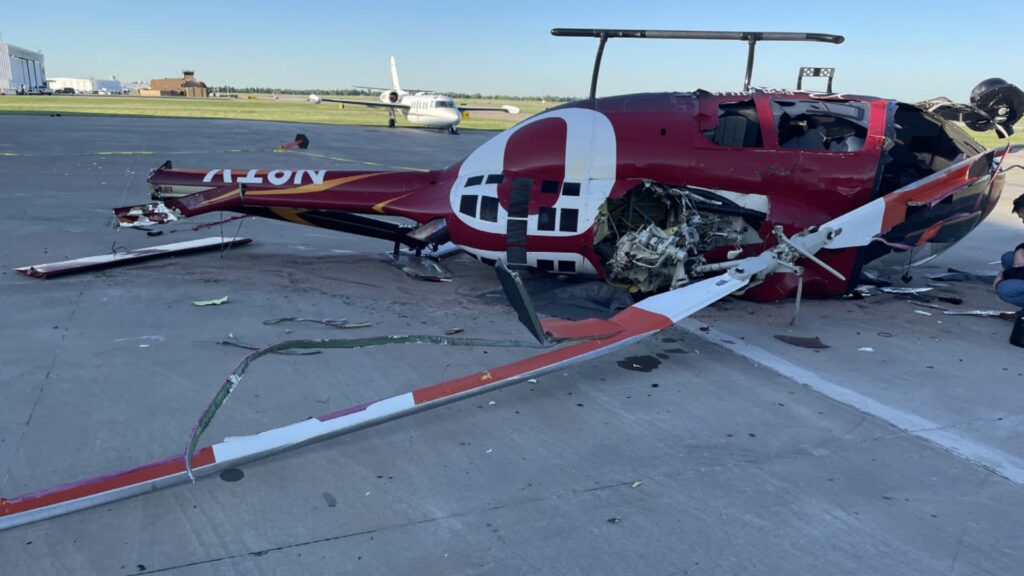
Crashed red Bell 505 helicopter lying on its right side on a concrete airport ramp. The main rotor blades are severely damaged and bent, and the engine compartment is exposed with internal components visible. The tail boom is broken and twisted. A business jet and airport buildings are seen in the background under a clear blue sky.
Incident Details
Highest Injury: Minor
Number of Injuries: 2
City: Bethany
State: Oklahoma
Aircraft Details
Aircraft Make: Bell Helicopter Textron Canada
Aircraft Model: 505
Pilot Name/Operator: N/A
Registration #: N9TV
Departure Airport: KPWA
Destination Airport: KPWA
Additional Resources
Proudly Sponsored By
Sponsor Logo
Sponsor Logo
Sponsor Logo
Incident Briefing

In the world of aviation, it’s often the routine flights that sneak up with unexpected surprises. On April 30, 2025, in Bethany, Oklahoma, one such flight took a dramatic turn as a news helicopter’s return to base ended not with a smooth landing, but with a dynamic rollover on the tarmac. Thankfully, no lives were lost—but the incident serves as a sharp reminder that even seasoned pilots must respect the subtleties of every landing.


A Veteran at the Controls

The pilot at the center of this event was no rookie. At 68 years old, he held commercial and private pilot certificates, and had amassed an impressive 13,931 total flight hours—including 210 hours in the Bell 505 helicopter that he was flying that day. As an occupational pilot for Griffin Television OKC LLC, this was part of his daily routine. He had also completed a flight review earlier that year in January, and held a current first-class medical certificate.

So what happened?


The Dolly Dilemma

The helicopter, a Bell 505 Textron Canada model registered as N9TV, had just finished a two-hour news gathering flight. Returning to Wiley Post Airport (PWA), the pilot approached a dolly landing platform—essentially a movable landing pad used for repositioning helicopters on the ground. The weather was favorable, with good visibility, no precipitation, and light winds from the north.

As the pilot landed on the dolly, he touched down off-center. In an attempt to correct the position, he began to back the helicopter up, likely using pedal and cyclic inputs to adjust. But during the maneuver, the right skid caught on the edge or the middle of the platform. In that moment, physics took control. The helicopter rolled to the right in a textbook case of “dynamic rollover.”

The aircraft was substantially damaged, and the pilot sustained minor injuries. Fortunately, his sole passenger escaped unhurt.


Dynamic Rollover: A Quick Primer

Dynamic rollover is a well-known risk in helicopter operations, especially during takeoffs and landings on uneven or constrained surfaces. It occurs when one skid or wheel becomes fixed, and the pilot’s inputs create a rolling motion around that pivot point. Once the critical angle—typically around 5 to 8 degrees—is exceeded, the helicopter rolls over, often too quickly for corrective action.

In this case, the NTSB found no mechanical failures or anomalies with the Bell 505. The determining factor was pilot technique.


What the NTSB Found

The NTSB concluded that the probable cause of the accident was “the pilot’s improper landing technique that allowed the helicopter’s right skid to get caught on the landing platform, which resulted in a dynamic rollover.” In more clinical terms, it was a failure in lateral/bank control—human error in judgment and aircraft handling, rather than any technical shortcoming.


Safety Lessons in the Smallest Details

There’s a sobering lesson here: even after nearly 14,000 hours of flight time, small miscalculations can have big consequences. Landing on a dolly is an art that demands precision, situational awareness, and humility. Whether you’ve flown two hours or two decades, every landing is a chance to get it right—or to get reminded why aviation is never routine.

While this event didn’t make national headlines, it holds vital importance for anyone in rotorcraft operations. It’s a scenario most helicopter pilots can relate to—tight landings, small corrections, and the ever-present potential for a dynamic rollover. These are the moments where professionalism is measured not just in hours, but in habits and preparation.

So next time you’re easing down on a dolly or helipad, remember: even a small misalignment can tip the scales. Literally.
Additional Resources
Proudly Sponsored By
Sponsor Logo
Sponsor Logo
Sponsor Logo
Recent Mishaps
A blue Bell 206B helicopter lies heavily damaged in the front yard of a suburban home. The fuselage is broken open, the tail section is twisted and separated, and debris is scattered across the grass and driveway. A house, trees, and parked cars are visible in the background under clear skies, with police tape marking off the area.

When the Tail Lets Go

If you’ve flown helicopters long enough, you’ve done that short hop after maintenance where you’re tuned into every sound and vibration. That was the plan

Read More »
The wreckage of a red and white airplane is wrapped around a tall tree in a clearing bordered by pine trees. The fuselage is bent and torn, and pieces of the airframe lie scattered nearby.

The Saluda Tree Strike

Setting the StageOn a warm June morning in South Carolina, an RV-9A turned final for Saluda County Airport (6J4). The plan was a straightforward full-stop

Read More »
Right-side view of a yellow and white Cessna 150 crash site in a farm field. The nose and cockpit area are heavily damaged, with the “Cessna” logo visible on the tail and the wings bent from impact.

Night Pattern Gone Quiet

This one took place on a dark January evening over Auburn, Nebraska. A Cessna 150H, N22859, departed Lincoln for some pattern work at a quiet

Read More »

4 Comments

  1. Rick Barlow

    I’ve read that Satan travels in a helicopter.
    I’ll pass, thanks.

    1. Stephen Songer

      I would like to see the landing pad surface.

    2. Moira

      I would love a ride in a helicopter! Sadly, I’ve not yet had the chance.

      1. Scott

        Moira, my father was a helicopter pioneer back in the late 40’s, and continued into the 70’s. I had many rides and although the first one was a thrill, I wimped out and flew fixed-wing.😂

Leave a Reply

Your email address will not be published. Required fields are marked *

Recent Mishaps

A white Cessna 172 airplane with registration N1870V is shown inverted on grassy terrain near the edge of a runway. The nose is crushed, the propeller bent, and the wings and tail are mostly intact but dirt-covered. Yellow caution tape surrounds the wreckage, and light morning fog and trees are visible in the background near a small building.

Second Solo, Busy Pattern

The setup on this one was straightforward. A 43-year-old student pilot launched on his second solo cross-country in a Cessna 172M, N1870V, from Napa to

Read More »
Wreckage of a white-and-blue Mooney M20J aircraft, registration N3933H, resting in a wooded area after a crash. The fuselage is torn open, the right wing and engine area are heavily damaged, and debris is scattered among trees and brush.

Holly Ridge Mooney Stall

If you’ve flown off grass, you know the airplane talks to you a little differently. It rolls longer, it feels a touch more reluctant to

Read More »
Wreckage of a small airplane lying in a grassy field near an airport. The aircraft is severely damaged with the fuselage broken apart and debris scattered around. The tail section remains partially intact, and dark storm clouds hang overhead with buildings visible in the background.

Setting the Scene at Torrance

This accident took place late morning at Torrance’s Zamperini Field (TOA) on November 30, 2022. Two pilots—both familiar with the airport—launched to do some pattern

Read More »

Don’t Miss Out! Get Your FREE Weekly Aviaton Mishap Newsletter!

I promise I will never share your information